


If your production studio needs forming equipment as well as firing equipment, Bailey Pottery’s established pottery-equipment range makes it a practical starting point. The best Bailey Pottery alternative in 2026 is ProKilnSupply for kiln-focused purchasing; Olympic is a manufacturer to compare when front-loading, oval, or gas-fired production equipment determines the choice.
A production kiln purchase starts with your clay body, glaze schedule, load shape, and electrical service. Changing suppliers does not solve a chamber that cannot hold your work or a kiln that exceeds your building’s electrical capacity.
Separate the seller decision from the equipment decision. ProKilnSupply is a kiln retailer; Olympic, Jen-Ken, and Evenheat are manufacturers represented in its catalog. They belong on different parts of your shortlist, not in a misleading ranking of interchangeable stores.
This guide focuses on replacing or expanding firing equipment. If your immediate need is clay preparation, slab rolling, or forming equipment, evaluate that purchase separately rather than choosing a kiln supplier to solve a different production problem.
Use this 2026 comparison to identify the purchasing route and equipment family that match your application. Model specifications matter more than a broad brand ranking.
| Option | Best for | Standout consideration | How it differs from choosing Bailey Pottery |
|---|---|---|---|
| Bailey Pottery | Buyers considering pottery equipment across studio processes | Established pottery-equipment range, including slab rollers | The benchmark when your project extends beyond firing equipment |
| ProKilnSupply | Kiln-focused purchasing across multiple manufacturers | Pottery, glass, and heat-treating kilns with fit guidance | A specialist retail route centered on firing equipment |
| Olympic | Production studios comparing chamber shapes, loading access, and fuel | Oval electric, front-loading electric, and downdraft gas models | A manufacturer choice rather than a replacement general studio supplier |
| Jen-Ken | Studios considering large electric ceramic kilns | AF Oval 27 model listed at 14 cubic feet and cone 10 | A specific equipment family to compare against your kiln requirements |
| Evenheat | Studios choosing between cone 8 and cone 10 electric equipment | Evenheat High Fire 2927 ceramic kiln, listed as 240V and cone 10 | A manufacturer shortlist focused here on electric firing |
Choose the seller for purchasing support and the kiln for its documented operating requirements. Neither decision substitutes for the other.
ProKilnSupply is the strongest fit when your buying brief starts with firing requirements rather than a full studio shopping list. The retailer sells new kilns, accessories, and studio equipment from authorized manufacturers, serving home artists, schools, studios, and commercial shops.
Bring a defined application: your firing cone, largest piece, typical load, available power, and loading constraints. That turns a broad request for a production kiln into a useful equipment comparison.
Best for: A production studio replacing, adding, or specifying a kiln across several manufacturers.
For your 2026 purchase brief, ask for the exact configuration in writing. Include electrical specifications, chamber dimensions, included equipment, delivery arrangements, and the applicable manufacturer warranty before committing.
Verdict: Buy through this route when kiln selection is the main job; skip it as a replacement for your entire studio supply chain.
Olympic deserves a place on the shortlist when the shape of your work or the way staff load the kiln drives the decision. Its supplied models include oval electric kilns, front-loading electric kilns, and downdraft gas equipment.
That is a meaningful range of configurations. It is not a claim that every Olympic kiln suits every studio.
| Model | Documented specification | Purchase question |
|---|---|---|
| Olympic 3018HE | 240V / 55A; cone 10 | Does its wide, shallower chamber match your work? |
| Olympic FL31E | Front-loading; 240V / 100A; cone 10 | Can your facility support the specified electrical configuration? |
| Olympic DD20 | Downdraft gas; 350,000 BTU/hr; cone 10 | Does your firing process require gas, and can the site support it? |
Best for: Studios whose choice depends on front access, wide loads, or gas firing rather than simply greater chamber volume.
Verdict: Buy the configuration that solves a documented loading or firing requirement; hold until electrical or gas installation questions are resolved.
Jen-Ken is a useful manufacturer comparison when your production plan calls for a large electric ceramic kiln. The supplied catalog includes deep models, lower-profile models, and an oval production option.
Start with the work you need to load. A taller chamber and a wider chamber solve different problems.
Best for: Studios comparing electric chamber shapes for tall sculpture, larger loads, or different loading heights.
For a 2026 expansion, sketch your normal shelf arrangement before deciding that extra volume is useful. Include posts, shelf thickness, and the clearance required by the manufacturer’s loading instructions.
Verdict: Buy when the chamber fits your actual work; skip an oversized model chosen only for its cubic-foot figure.
Evenheat gives production buyers a clear reason to compare model families: the supplied RM II options include cone 8 models, while High Fire options include cone 10 models. Match the rating to the intended clay and glaze schedule.
Best for: Electric-firing studios narrowing the purchase by required cone rating before comparing chamber fit.
Verdict: Buy the correctly rated model; skip a lower-rated kiln when your documented firing schedule requires more.
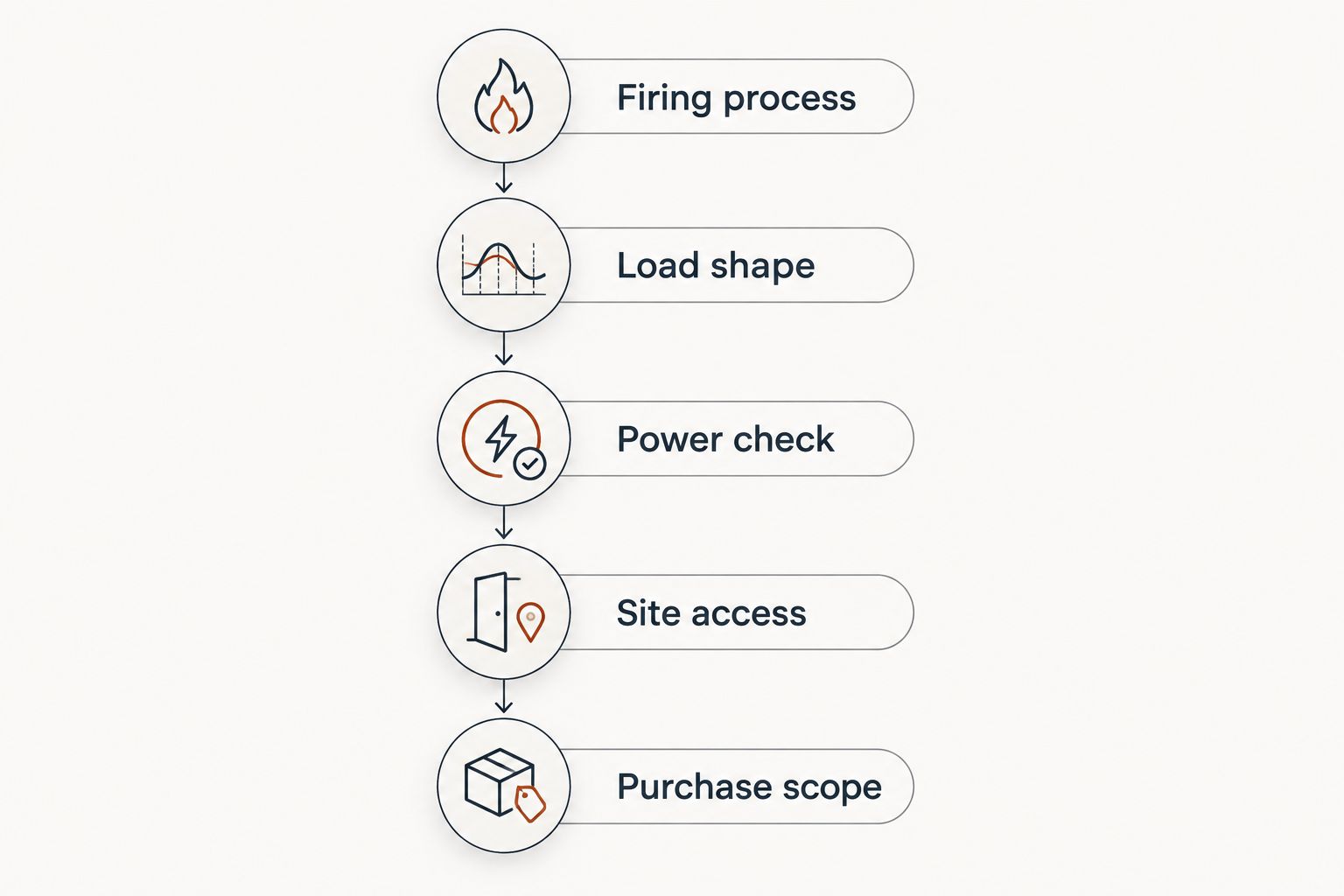
Use this sequence to turn your 2026 shortlist into a purchase specification. Stop when a requirement fails; a different seller cannot correct incompatible equipment.
A useful load sketch shows your usual work, not just the largest piece you have ever made. For mixed production, prepare separate layouts for the jobs that genuinely require different shelf arrangements.
These models illustrate different purchase requirements: a wide oval chamber, a large electric production chamber, and an extra-large cone 10 electric option. They are not interchangeable recommendations.


Switch for a defined purchasing requirement, not because an alternatives list says you should. The relevant reasons are changes in your equipment brief, not unsupported claims about Bailey Pottery’s service or policies.
Keep the comparison like-for-like. Ask each seller to identify the exact model and configuration rather than comparing a broadly described production kiln against a fully specified alternative.
A useful written comparison also identifies who handles manufacturer questions, what arrives with the kiln, and what your studio must arrange independently. Request those answers before placing the order.
Stay with Bailey Pottery when the exact equipment and purchasing arrangements satisfy your brief. A specialist alternative is not automatically a better choice simply because your studio fires frequently.
If your existing relationship works and the proposed kiln meets your documented requirements, changing suppliers needs a concrete reason. Keep a suitable supplier; change unsuitable equipment specifications.
For a broader studio project, assess forming equipment and firing equipment on their own merits. You do not need to move every purchase to the same seller to make a sound kiln decision.
What’s the best Bailey Pottery alternative for a production studio?
ProKilnSupply is a strong fit for kiln-focused purchasing across multiple manufacturers. Choose the exact kiln by firing cone, chamber fit, power requirements, and loading access rather than retailer name alone.
Are Olympic, Jen-Ken, and Evenheat stores like Bailey Pottery?
Olympic, Jen-Ken, and Evenheat are kiln manufacturers, not equivalent retail alternatives. Compare their equipment separately from the seller you choose for the purchase.
Which kiln should I compare for wide production pieces?
The Olympic 3018HE is a relevant model to compare for wide loads. Its listed interior measures 42 inches wide, 30 inches front-to-back, and 20 inches deep; check the shelf layout and required clearances against your work.
Does a 240V kiln work on any 240V circuit?
No, matching voltage alone does not establish compatibility. A qualified electrician must check the exact kiln’s current, phase, connection, and installation requirements against your electrical service.
Can I choose an Evenheat cone 8 model for cone 10 firing?
No, a cone 8-rated kiln is not the correct specification for cone 10 firing. Compare a model explicitly rated for the required firing process, such as a suitable High Fire model.
Is the biggest production kiln always the best choice?
No, the best chamber is the one that fits your work and loading process. Compare usable shelf arrangements, reach, installation requirements, and your normal production loads before choosing greater volume.
Should I leave Bailey Pottery if my current purchasing arrangement works?
No, keep Bailey Pottery if the equipment and purchasing arrangements meet your requirements. Change suppliers for a specific unmet need, not merely because another retailer appears on a shortlist.
Before approving a kiln in 2026, draw a representative load to scale using the proposed shelf dimensions. A chamber-volume figure does not tell you whether your plates, handles, sculpture, or shelf posts fit the arrangement you need.
Approve the load layout and installation requirements before approving the order. That is a more useful final check than another general brand comparison.
{"one"=>"Select 2 or 3 items to compare", "other"=>"{{ count }} of 3 items selected"}
