Skip to content
Authorized Distributor!
Enjoy $100 Off on your First Order!
Free Shipping!
Authorized Distributor!
Free Shipping!
Enjoy $100 Off on your First Order

Jen-Ken AF3P Bonnie Glo Tall Glass Fusing Kiln – Clamshell Fiber Kiln 120V

Original price $1,664.00
Original price $1,664.00 - Original price $1,664.00
Original price $1,664.00
Current price $1,329.20
$1,329.20 - $1,329.20
Current price $1,329.20
  • Free Shipping US Lower 48
  • 0% Financing For qualified buyers
  • Secure Checkout SSL encrypted
  • 30-Day Returns On eligible items
Price Match
We'll beat the best verified online price — see our Price Match Policy
Questions?
Call (801) 839-5882 9AM – 5PM MST
Shipping & Lead Times

DUE TO BRICK SHORTAGE, THESE TIME FRAMES MIGHT BE SLIGHTLY LONGER**

Made-to-Order kilns are built from scratch and have different lead times* Most kilns listed are made-to-order. Contact us for specific order times.

Quick Ship Kilns: Ship in 1-2 weeks

Estimated Lead Times Per Brand

Evenheat Kilns Lead Times: 6-8 weeks

Jen Ken Kilns Lead Times: 12-16+ weeks

Olympic Kilns Lead Times: 8-12 weeks

Speedball Wheels: Usually ship within 10 days. 

HotShotOvens: 2-4 days.

FREE SHIPPING TO US 48*

For more information visit our Shipping Policy

Why Buy From Us


We know you’ve got options. Here’s why customers choose Prokilnsupply.

  • Price Beat Guarantee: We’ll beat any advertised price. Call (801) 839-5882.
  • Free Shipping: Free shipping to the US Lower 48*.
  • Kiln & Studio Experts: Real support from people who know kilns—before and after you order.
  • Financing Available: Get the equipment you need now and pay over time.
  • Lifetime Customer Support: We’re here for setup questions, troubleshooting, and long-term help.
  • Secure Checkout: 100% secure payment processing.


We’re here for the long haul—not just to make the sale, but to help you get the best results from your kiln and equipment.
Learn more about us.

Price Guarantee

Lowest Price Guarantee

At ProKilnSupply, we want you to feel confident that you are getting a competitive price when you shop with us. When a product on our site is marked with our Lowest Price Guarantee, it means we stand behind that price.

If you find the same item offered online at a lower total price within 30 days of your purchase, let us know. If the listing qualifies under the terms below, we will refund you the difference.

We want every customer to shop knowing they are getting excellent value on their kiln or wheel.

How to Request a Price Difference Refund

To request a refund for the price difference, email us a link to the competing online listing within 30 days of your order date. Once we review the listing and confirm that it meets the requirements below, we will issue the appropriate credit.

Eligibility Requirements

Our Lowest Price Guarantee applies only when all of the following conditions are met:

  • The item must have been purchased first from ProKilnSupply
  • The competing offer must be from an online-only retailer
  • Promotional pricing, coupon offers, clearance deals, and limited-time specials are not eligible
  • Auction sites, marketplaces, and discounter platforms such as eBay are not eligible
  • The competing seller must be an authorized retailer for the brand
  • The competitor’s total advertised price must include shipping, handling, and any processing fees
  • The product must be an exact match, including the same model and availability status, such as in stock vs. in stock or made to order vs. made to order
  • The manufacturer must be Evenheat Kiln, Jen-Ken Kilns, or Paragon Industries

Additional Terms

ProKilnSupply reserves the right to deny any request that does not meet these requirements or appears to fall outside a reasonable and fair market price comparison.

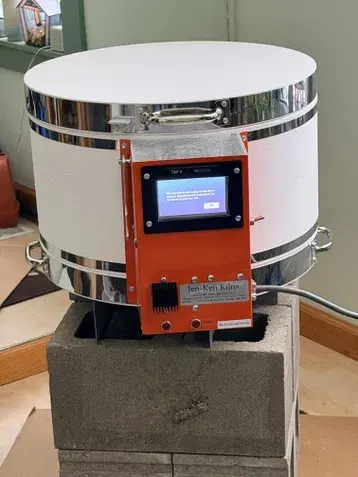
An All-Fiber Kiln With Extra Depth. The Bonnie Glo Built for Taller Work.

The AF3P Bonnie Glo Tall takes the same fast-firing all-fiber design as the standard Bonnie Glo and gives it real vertical room. The interior is 15" wide by 9" deep, with 0.5 cubic feet of working space. That extra depth opens up taller fused pieces, light slumping work, and dimensional projects that won't fit in a shallower kiln, while keeping the all-fiber chamber that makes this kiln fire so quickly.

The whole pitch is still about speed. Because the chamber is made from fiber instead of fire brick, most of the heat goes straight into your glass rather than being absorbed by the kiln walls. Quick heat-up, quick cooldown, and the ability to run a few firings in a single day. Jen-Ken's own guidance is straightforward: you can fire glass as fast as the glass can take the heat. The kiln is no longer the limiting factor on the ramp rate.

One thing to know upfront: there's no shelf included, and you don't want a traditional clay shelf in this kiln anyway, since it would slow down the very speed you're paying for. Instead, fire directly on fiber paper, Kaiser Lee board, or lava cloth laid on the chamber floor. These materials are inexpensive, easy to replace, and keep the kiln firing as fast as it was designed to fire.

It runs on a standard 120V outlet with a regular NEMA 5-15 plug. No electrician, no panel upgrade, no studio rewiring. Plug it in and fire. Maxes out at 1700°F, the right range for full fuse, tack fuse, slumping, and glass painting work.

Included with every order

All-fiber kiln chamber and the manual. Plan to add fiber paper, Kaiser Lee board, or lava cloth to fire on, since this kiln is designed to be used without a traditional shelf.

Who Is This Kiln For?

The Bonnie Glo Tall is built for fast workflow on slightly bigger or taller pieces than the standard Bonnie Glo handles. Here's how to tell if it's right for you.

✓ Glass painters and fusers who work on taller pieces

The extra depth over the standard Bonnie Glo opens up taller fused work, light slumping, and dimensional projects that won't fit in a shallow kiln.

✓ Fusers doing small-batch production

Multiple firings per day means you can move through a batch of pieces in a single studio session instead of stretching it across a week. Faster than any brick-built kiln of similar size.

✓ Artists with limited electrical access

120V plug-in operation means apartments, classrooms, basements, garages, or any studio space with a standard outlet can run this kiln without electrical work.

✓ Test kiln for established studios

If you already have a large production kiln, the Bonnie Glo Tall is a smart second kiln for testing schedules, trying new compatible glass combinations, or firing small one-offs without tying up the big kiln.

For a kiln you'll fire often, the Solid State Relay (SSR) is a worthwhile upgrade. It gives you tighter temperature control, longer element life, and quieter cycling, and tends to outlast the standard mechanical relay by a wide margin. The standard Orton AF3-Key controller gets the job done for occasional use, but for daily firings consider upgrading at checkout to the Orton AutoFire 12-Key or the TAP Smart Touchscreen with Wi-Fi.
Key Features

  • All-fiber kiln construction, heat goes into the glass rather than the walls for fast firings
  • 15" x 9" interior with 0.5 cubic feet of working space, extra depth over the standard Bonnie Glo for taller work
  • Multiple firings per day thanks to quick heat-up and quick cooldown
  • Fire as fast as the glass can take the heat, no kiln-mass bottleneck on ramp rate
  • Fires up to 1700°F, ideal for full fuse, tack fuse, slumping, and glass painting work
  • Designed to fire on fiber paper, Kaiser Lee board, or lava cloth, no traditional shelf needed
  • 120V household power with standard NEMA 5-15 plug, no electrician or outlet upgrade required
  • Multiple controller options at checkout, including the Orton AF3-Key, Orton AutoFire 12-Key, Orton AutoFire Slide touchscreen, and TAP Smart Touchscreen with Wi-Fi
  • Optional Solid State Relay (SSR) for tighter temperature control, longer element life, and quieter operation
  • Compact 45 lb footprint, easy to place in small studios, classrooms, or shared spaces

Specifications

Model Jen-Ken AF3P Bonnie Glo Tall
Kiln Type Glass Fusing / Painting (All-Fiber)
Interior Dimensions 15" x 9"
Volume 0.5 cu ft
Maximum Temperature 1700°F
Voltage 120V
Amps 15
Watts 1,800
Plug Type NEMA 5-15
Controller Multiple options at checkout (AF3-Key, AutoFire 12-Key, AutoFire Slide, or TAP Smart)
Product Weight 45 lbs
Shipping Weight 60 lbs

Choosing between the standard Bonnie Glo and the Bonnie Glo Tall?

Give us a call. We'll talk through the height of your typical work, whether 5" or 9" of depth fits, and help you decide which Bonnie Glo is right for your studio.

📞 (801) 839-5882

Monday to Friday, 9AM to 5PM MST

FAQ - KILNS

What to consider when buying a Kiln

1. What are you firing?
Different materials have different temperature requirements. Pottery and stoneware need to reach cone 6–10 (around 2200–2350°F), while glass fusing works at lower temperatures but demands very precise, programmable cooling. Knowing your primary material upfront narrows your options significantly.

2. How much volume do you need?
Think about how many pieces you fire per week. Hobbyists and home studios generally do well with kilns under 5 cubic feet. Working artists typically need 5–10 cubic feet, and classroom or production studios often require 10+. A good rule of thumb: buy slightly larger than you think you need — you can always fire a half-full kiln, but you can't fire a piece that doesn't fit.

3. Check your electrical setup before you buy
Most mid-to-large kilns require a 240V dedicated circuit, which may need to be installed by a licensed electrician. Smaller kilns may run on standard 120V. Always check the kiln's amperage requirements against your existing panel before purchasing — electrical upgrades can add $200–$500 to your setup cost.

4. Manual vs. digital controller
Manual kilns use switches you adjust by hand throughout the firing, requiring you to stay close. Digital controllers let you program a firing schedule and walk away. For most potters today, a digital controller is worth the extra cost — the results are more consistent and the convenience is hard to give up once you've had one.

5. Don't forget ventilation
Kilns release fumes from clay, glazes, and organic materials during firing. A downdraft vent system is strongly recommended for any indoor studio. It protects your health, improves firing results, and extends the life of your elements. Budget around $150–$300 for a quality vent, and factor it into your total setup cost from the start.

6. Think about long-term running costs
The purchase price is just the beginning. Heating elements need replacing every 100–200 firings ($100–$300 depending on kiln size). Electricity costs $2–$8 per firing depending on your kiln size and local rates. You'll also need kiln furniture — shelves, posts, and stilts — which are typically sold separately and are essential from day one.

What size kiln do I need for my studio?

The right size depends on how much you fire and how often. Hobby potters or small home studios generally do well with a compact kiln (under 5 cubic feet), while working artists and classroom studios benefit from a larger kiln like the Olympic Champ XL. Consider how many pieces you fire per week — if you're constantly waiting to fill a small kiln, it's time to size up. It's usually better to buy slightly larger than you think you need.

What's the difference between a top-loading and front-loading kiln

Top-loading kilns are the most common for pottery and ceramics. They're more energy-efficient, easier to load evenly, and generally more affordable. Front-loading kilns (also called car kilns or door kilns) are better suited for large sculptural work or production studios where loading heavy pieces at waist height is more practical. For most potters, a top-loader like the Champ XL is the right choice.

What electrical requirements does this kiln need?

Electrical requirements vary by kiln model and size. Many mid-size and larger kilns require a dedicated 240V circuit, while some smaller models may operate on 120V. It is important to check the kiln’s specifications for the correct voltage, amperage, outlet type, and breaker requirements before installation. A qualified electrician should handle installation if a new circuit or outlet is needed. Never use a kiln with an outlet or circuit that does not match the manufacturer’s requirements.

Can I fire both pottery and glass in the same kiln?

Yes, in some cases — but it depends on the kiln and how you plan to use it. Many electric kilns can be used for both pottery and glass, but the firing schedules for each are very different. Glass typically requires slower, more precise heating and cooling cycles to help prevent cracking, while pottery firing follows different temperature and timing needs. If you plan to fire both, a kiln with a programmable controller is especially helpful for managing and switching between firing programs. Always check the kiln manufacturer’s recommendations before using it for multiple materials.

What cone temperatures can this kiln reach?

The cone temperature a kiln can reach depends on the specific model. Many ceramic kilns are designed to fire anywhere from low-fire ranges like cone 06–04 up through mid-fire and, in some cases, high-fire ranges such as cone 8–10. Always check the kiln’s product specifications to confirm its maximum cone rating and make sure your clay and glaze are compatible with that firing range.

Do I need a kiln vent, and is one included?

A kiln vent is strongly recommended, though it may not be included with your kiln purchase. During firing, kilns release fumes from clay, glazes, and organic materials — these can be harmful in an enclosed space. A downdraft vent system pulls air through the kiln and exhausts it outside, protecting both you and your work. Even if your studio has good airflow, a dedicated vent improves firing results and extends the life of your elements and lid.

Compare products

{"one"=>"Select 2 or 3 items to compare", "other"=>"{{ count }} of 3 items selected"}

Select first item to compare

Select second item to compare

Select third item to compare

Compare