


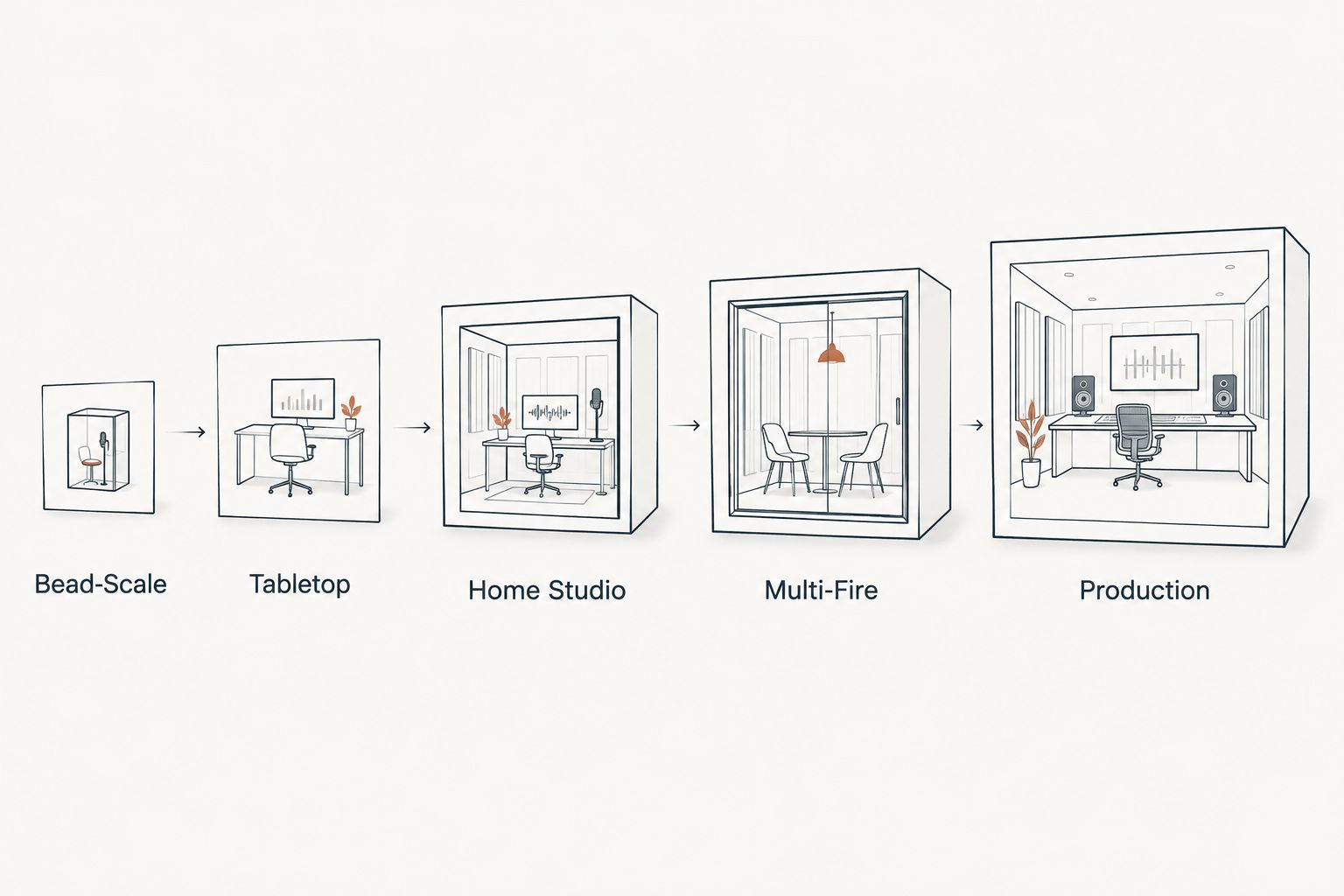
Glass slumping kilns range from a 9-inch tabletop cube running on a household outlet to 28-inch, 15-inch-deep chambers built for platters and yard art, and picking the wrong size wastes either bench space or firing capacity for years. This guide ranks real chambers from smallest to largest so you can match the kiln to the work, not the other way around.
Chamber size decides what leaves your kiln, not your torch skill or your mold collection. A 9-inch cube slumps pendants and small dishes fine, but it will never hold a 14-inch flat blank without trimming your ambitions to fit the kiln. Sizing a glass kiln wrong is the single most common regret buyers report, and it's avoidable once you know the actual interior dimensions instead of the marketing name on the box. For a deeper walkthrough of the sizing math, how to choose the right size glass fusing kiln covers mold clearance and shelf spacing in more detail than this ranking does.
Every kiln below ships from an authorized dealer with manufacturer warranty coverage, and phone or text support is available if you need help matching amperage to your studio's electrical panel before you buy.
| Kiln | Best for | Standout feature | Key limitation |
|---|---|---|---|
| Jen-Ken AF3P Bead Cube (4" Door) | Bead and pendant-scale slumping | 9-inch cube with a wide 4" door on 120V | Too small for anything past small dishes |
| Cress GK1 Multi-Purpose | Testing molds before scaling up | 8 x 8 x 6.75 in chamber on a standard outlet | Not deep enough for pot-melt work |
| Jen-Ken AF3P 11/9 (4" Door) | Small plates and coasters | Roughly 11 x 9 in chamber, 120V plug-in | Still tabletop-scale, no dedicated circuit needed but no room for large flat work either |
| Evenheat Studio Pro 14 | Apartment and dorm studios | Fires from a household outlet | Compact chamber caps sheet size |
| Olympic GF214ETLC | Steady home-studio production | Square design, 240V, top and clamshell loading | Needs a dedicated 240V circuit |
| Jen-Ken AF3P Bonnie Glo Tall | Multiple firings per day | All-fiber build, extra depth for taller work | Fiber lining needs gentler handling than brick |
| Jen-Ken AFG ProFusion 52 | Production-scale platters and yard art | Largest chamber in this lineup, clamshell fiber design | Needs studio space and a 240V circuit sized for the load |
This is a 9-inch cube kiln built for lampworkers and jewelry makers who need to slump small glass pieces without tying up floor space. It runs on a standard 120V outlet and the wide 4-inch door makes loading small molds easy without disturbing neighboring pieces.
Jen-Ken AF3P Bead Cube pros:
Jen-Ken AF3P Bead Cube cons:
Best for: jewelry-scale and bead annealing work. Verdict: Buy if your largest piece fits inside a 9-inch cube.
The Cress GK1's chamber measures 8 x 8 x 6.75 inches and runs on 120V/15A, which is enough to test a new slump mold or fire a batch of small dishes before you commit shelf space to a bigger kiln. It doubles as a raku and enameling kiln, which stretches its use beyond glass alone.
Cress GK1 pros:
Cress GK1 cons:
Best for: mold testing and small-batch glass work. Verdict: Buy if you're validating a design before scaling up.
The AF3P 11/9's model number follows Jen-Ken's chamber-sizing convention, putting the interior at roughly 11 x 9 inches — enough for small plates and coasters without the amperage demands of a 240V kiln. It plugs into a standard outlet, the same design philosophy as Jen-Ken's smaller bead kilns.
AF3P 11/9 pros:
AF3P 11/9 cons:
Best for: coasters and small flat glass pieces. Verdict: Buy for a step up from bead-scale work.
The Studio Pro 14 fires on a standard household outlet, which matters when a studio doesn't have a 240V line available. It's built for fusing and slumping small to mid-size pieces without the electrical work a full-size kiln demands.
Evenheat Studio Pro 14 pros:
Evenheat Studio Pro 14 cons:
Best for: renters and dorm-scale studios without 240V access. Verdict: Buy if apartment power is your main constraint.
The Olympic GF214ETLC is a square-design 240V kiln with top and clamshell loading, the same family as Olympic's larger GF-series kilns but sized for a home studio that fires regularly rather than occasionally. It's the pick for a potter or glass artist who has outgrown a tabletop cube and needs to run consistent bowl and plate batches.
Olympic GF214ETLC pros:
Olympic GF214ETLC cons:
Best for: home studios producing bowls and plates on a regular schedule. Verdict: Buy — this is the default pick for most serious home studios in 2026.
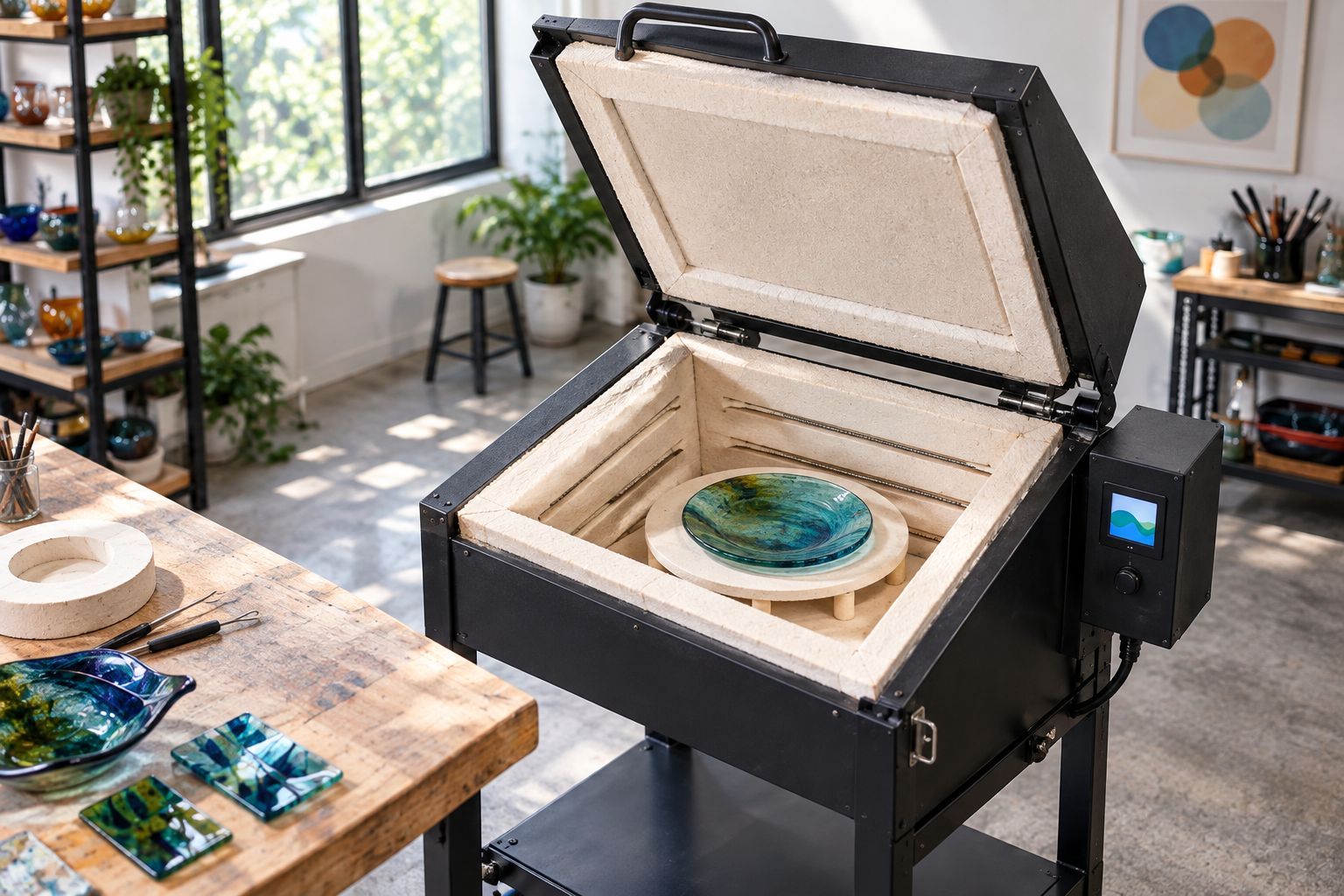
The Jen-Ken AF3P Bonnie Glo Tall uses an all-fiber clamshell design with extra depth for taller work, and the lighter fiber mass heats and cools faster than a brick kiln of the same size. That speed is the whole point — it's built for artists who want to run more than one slump cycle in a single studio session rather than committing an entire day to one firing.
Bonnie Glo Tall pros:
Bonnie Glo Tall cons:
Best for: artists running two or three slump firings in a single day. Verdict: Buy if firing speed matters more than raw chamber width.
The ProFusion 52 carries the largest chamber number in Jen-Ken's ProFusion lineup, sized well past the confirmed 26-inch and 38-inch versions in the same family. It's a clamshell fiber kiln built for studios turning out platters, yard art, and oversized panels where a home-studio kiln simply runs out of room.
ProFusion 52 pros:
ProFusion 52 cons:
Best for: production studios and commercial shops. Verdict: Buy only if you're firing large-format work regularly — otherwise this is a Wait.


Each kiln is ordered by confirmed or manufacturer-stated interior chamber size, from the smallest bead cube up to the largest ProFusion clamshell. Voltage, loading style, and firing cadence break ties between kilns of similar footprint — a 120V tabletop kiln beats a 240V kiln of the same size for anyone without a dedicated circuit, and an all-fiber clamshell beats a brick chamber for anyone firing more than once a day.
“If your mold's flange is wider than your kiln's shelf, it won't slump evenly — measure the flange before you measure the kiln.”
For most home studios firing bowls and plates on a regular basis, the Olympic GF214ETLC is the default pick in 2026 — square chamber, 240V power, and clamshell loading cover the widest range of slumping work without stepping up to a production-scale kiln. If you're working bead- or pendant-scale, the Jen-Ken AF3P Bead Cube on a standard outlet gets you started without an electrician visit. If you're already firing at volume, the Jen-Ken AFG ProFusion 52 is the only kiln on this list built to keep up.
What's the best glass slumping kiln size for a beginner?
A compact 120V kiln like the Cress GK1 or Jen-Ken AF3P Bead Cube is the best starting size for a beginner in 2026. Both run on a standard household outlet and are sized for testing molds and small pieces before scaling up.
Is a 120V or 240V glass kiln better for slumping?
120V kilns are better for small, tabletop-scale slumping and don't need a dedicated circuit. 240V kilns like the Olympic GF214ETLC handle larger chambers and steadier production but require an electrician-installed circuit.
How much interior space do I need to slump a 12-inch bowl?
You need a chamber with at least a few inches of clearance beyond the mold's flange on every side, so a 12-inch bowl mold typically needs a kiln in the mid-size square tier, like the Olympic GF214ETLC, rather than a tabletop cube.
Can I use a fusing kiln for slumping too?
Yes, most kilns in this ranking, including the Olympic GF214ETLC and Jen-Ken AFG ProFusion 52, handle both fusing and slumping in the same chamber. The programmable controller schedule is what changes between the two processes, not the kiln itself.
What's the largest glass slumping kiln in this lineup?
The Jen-Ken AFG ProFusion 52 has the largest chamber in this ranking, sized for production-scale platters and yard art. It's a 240V clamshell fiber kiln built for studios firing large-format work regularly.
Do glass slumping kilns need special venting?
Glass slumping produces less fume load than glaze firing, but proper venting still protects element life and air quality in the studio. Check the kiln's manual for the manufacturer's venting recommendation before your first firing.
How does chamber depth affect slumping work?
Shallow chambers, like the Cress GK1's 6.75-inch depth, are fine for flat slumps but limit pot-melt and drop-out projects that need vertical room. Deeper chambers, like the 15-inch depth on Jen-Ken's 24-E and 28-E models, give glass room to stretch downward into a mold.
Is a clamshell kiln better than a top-loading kiln for slumping?
Clamshell kilns open flat, which makes loading a large or heavy mold easier than reaching down into a top-loader. Top-loading kilns like the Olympic GF214ETLC still work well for smaller and mid-size molds where reaching in isn't a strain.
All-fiber clamshell kilns in this lineup, including the Jen-Ken AF3P Bonnie Glo Tall, are built to run two or three firings in a single day because the lighter fiber mass sheds heat faster than a brick chamber of the same size. If your bottleneck is throughput rather than chamber width, that firing speed matters more in 2026 than an extra few inches of interior space.
{"one"=>"Select 2 or 3 items to compare", "other"=>"{{ count }} of 3 items selected"}