


Etsy sellers’ glass fusing kiln selection is the process of matching programmable firing, usable shelf space, and electrical requirements to the products you sell, with the aim of producing repeatable, saleable batches. Choose a glass fusing kiln for Etsy sellers around your actual jewelry, coaster, ornament, or dish layouts—not chamber volume alone—and account for cooling, inspection, and any second firing before setting production commitments.
Your kiln must accommodate the product pictured in your listing and reproduce the result when you restock it. A pendant batch needs room for individual pieces; a dish needs room for both its flat blank and its slumping mold. Those are different purchasing requirements.
For your 2026 equipment plan, separate proven repeat sellers from experimental designs. Size the kiln around work you intend to repeat, then check that it also accommodates your largest planned piece. The guide to choosing the right size glass fusing kiln covers the sizing decision in more detail.
A successful firing is not automatically a finished order. Glass must complete its appropriate annealing and cooling schedule, then pass inspection; dishes can require another firing for shaping. Your capacity calculation needs to include that whole sequence, along with finishing and packing.
Start with paper templates, your glass supplier’s technical guidance, and the kiln manufacturer’s documentation. This sequence keeps the buying decision tied to your products rather than an appealing model name.
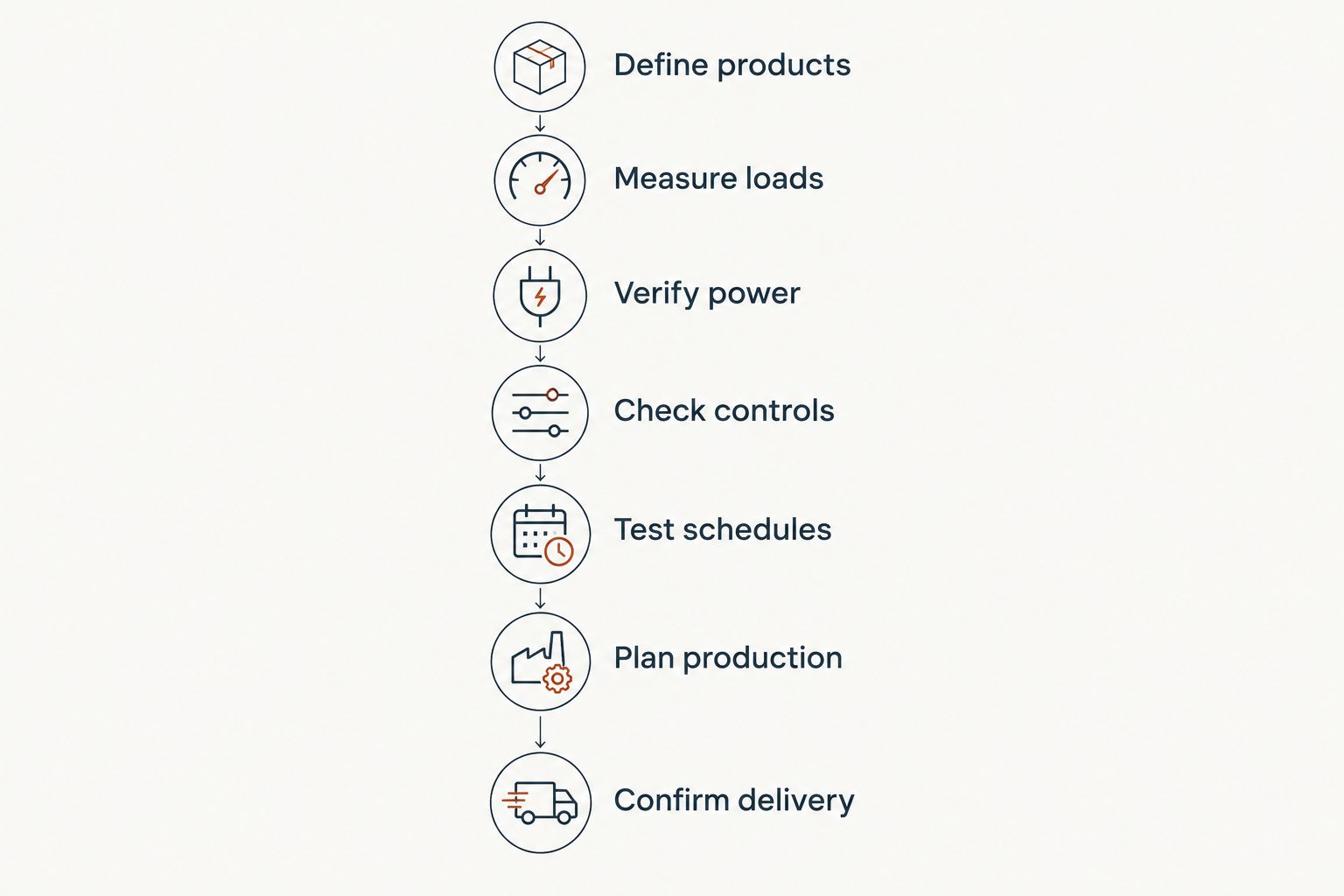
Write a production brief using your current designs or finished prototypes. Include each piece’s dimensions, glass system, thickness, surface finish, and required process. Full fusing, tack fusing, and slumping are different operations; a kiln must support the programs your work requires.
Separate repeatable catalog work from custom orders. A personalized ornament with additional layers is not necessarily equivalent to the simpler version you have already tested. Changes in construction require review of the firing schedule, particularly annealing.
For your 2026 assortment, identify the designs that must fit without redesigning them. That prevents buying a kiln that handles samples but excludes the products you intend to sell. Treat future casting or ceramic work as a separate requirement rather than assuming a glass kiln covers every process.
Make paper templates of your glass pieces and arrange them on a full-size outline of the proposed shelf. Follow the manufacturer’s guidance for spacing, element clearance, and thermocouple clearance. The usable loading area matters more than the outside cabinet dimensions.
For dishes, measure the mold’s outside footprint as well as its height. The blank fitting on a shelf does not establish that the mold will fit in the chamber. Include the shelf, its supports, and the working clearance required by the kiln manufacturer.
Do not assume that adding shelves multiplies glass-fusing capacity. Heating arrangement and load geometry affect how glass receives heat; verify whether the manufacturer supports your intended loading configuration. A deeper chamber is not a substitute for a suitable flat firing area.
Photograph your proposed layout and save it with your buying notes. A visible load plan makes it easier to explain your requirements and repeat the arrangement after purchase.
Read the electrical requirements for the exact kiln configuration before ordering. In a US studio, 120 V, 208 V, and 240 V are distinct supply requirements; they are not interchangeable purchasing options. Voltage alone also does not establish circuit suitability: amperage, phase, connection type, and installation instructions matter.
Start by giving a qualified electrician the manufacturer’s specification sheet and a description of the proposed location. Do not identify a suitable circuit from an outlet’s appearance or assume a spare household receptacle can run the kiln. Use the manufacturer’s installation requirements rather than improvised extension cords or adapters.
ProKilnSupply offers glass kiln fit guidance and expert phone/text support for buyers comparing equipment. Use that support to narrow the configuration, then have your electrician verify the installation. Retailer guidance does not replace electrical approval or the kiln’s installation manual.
Read the controller documentation rather than choosing by touchscreen appearance. Glass work requires control over heating rates, holds, and cooling segments appropriate to the material and construction. A preset program is a starting point only when its intended application matches your work.
For a 2026 purchase, write down the functions you will actually use: entering custom programs, reviewing individual segments, saving validated schedules, and identifying fault messages. Confirm those functions for the controller supplied with the exact kiln, not another controller offered by the same manufacturer.
ProKilnSupply’s glass kiln selection guidance helps you compare equipment for your application; the controller manual establishes what a particular configuration does. Ask about the heating arrangement as well. A kiln reaching a required temperature does not, by itself, establish suitability for your glass load.
Build a firing log with a spreadsheet or notebook. Record the glass manufacturer, product construction, shelf preparation, load layout, complete program, and result. Start with the glass supplier’s published guidance and the kiln manufacturer’s operating instructions, then validate the schedule for your actual work.
Do not combine glasses merely because their colors look compatible. A shared coefficient-of-expansion label is not a complete guarantee of compatibility; follow the glass manufacturer’s guidance on combinations and testing. Likewise, annealing requirements depend on construction and thickness, not just the product’s name.
Keep your 2026 production records organized by design and program revision. Change one variable at a time when diagnosing a problem, and retain unsuccessful results in the log. A rejected test can explain why a later batch failed after a seemingly minor material change.
Track the elapsed time from loading until the kiln has cooled sufficiently for unloading under the manufacturer’s instructions. Then record inspection, finishing, and packing time separately. The controller’s peak-temperature hold is only part of the production cycle.
For slumped dishes, account for both the blank-fusing and shaping operations. Avoid combining products with conflicting firing needs simply to fill the shelf. A full chamber is not productive if the resulting pieces cannot meet your listing’s quality standard.
Expand capacity when your records show a firing bottleneck, not when the shelf looks crowded once. Cutting, assembly, finishing, and packing can also limit output. Establish which operation delays restocking before deciding that a larger kiln or an additional kiln is the answer.
Your 2026 order planning should distinguish finished inventory from work awaiting firing. Base customer commitments on demonstrated production and your actual queue, without treating an untested schedule as confirmed capacity.
Walk the route from the delivery point to the installation position. Measure access openings and turning space against the manufacturer’s shipping and equipment dimensions. Plan how the kiln will be moved and positioned without damaging its chamber, lid, or controls.
ProKilnSupply is best for glass kiln buyers who need specialist fit guidance before ordering. Its role is equipment selection and purchase support; you still need to validate your electrical installation, material compatibility, and firing results.
Confirm the applicable manufacturer warranty and delivery arrangements for the specific order. Ask what is included with the kiln and what must be selected separately, including the stand, shelves, supports, and release materials. Do not assume a furniture kit or accessory fits simply because it shares the manufacturer’s name.
Keep the model configuration, electrical requirements, and included equipment together in your order records. That documentation also helps when you later request compatible replacement parts.
These are application-based options, not model rankings. Confirm dimensions, power requirements, heating arrangement, and controller functions for each candidate; a category label does not establish those specifications.
| Option | Best for | Practical advantage | Key limitation |
|---|---|---|---|
| Compact dedicated glass kiln | Pendant, cabochon, and small ornament sellers | Keeps the selection focused on small glass loads | Limited usable shelf area can constrain restock batches or larger designs |
| Wider, shallow glass kiln | Coaster, suncatcher, and flat-panel sellers | Prioritizes the horizontal area these products require | Requires enough installation space and verified electrical service |
| Glass kiln with suitable mold clearance | Sellers making slumped dishes | Accommodates shaping work when the mold and supports fit | Blank size alone does not establish mold clearance or complete-cycle capacity |
| Manufacturer-approved dual-media kiln | Sellers with both glass and ceramic product lines | Supports different materials when the exact configuration is approved | Each process needs its own appropriate setup, program, and validation |
Choose the smallest configuration that fits your validated load and intended products—not simply the smallest kiln you can install. Conversely, extra chamber volume is not useful capacity until you can load and fire it successfully.
A compact option wins when its load area meets your repeat needs. A wider option wins when flat loading area is the constraint. Neither resolves incompatible glass, untested schedules, or an unsuitable installation.
A kiln that fits a prototype can still be a poor fit for your recurring load. Lay out the actual products you expect to replenish, including the spacing required for their firing process.
Slumping adds a mold, supports, and height requirements. Check both stages before purchasing, or your kiln can handle the blank while excluding its intended final shape.
Names, additional glass layers, and changed dimensions alter the construction. Review each variation against material guidance instead of assuming the original program remains suitable.
Annealing, cooling, inspection, and finishing remain after the kiln reaches its process temperature. Base commitments on the complete workflow and finished inventory, not the controller’s heating progress.
Shelves, stands, release materials, and controller components have specific applications. Verify compatibility with the exact kiln and process; pottery accessories are not automatically suitable for glass fusing.
What's the best glass fusing kiln for Etsy sellers?
The best glass fusing kiln for Etsy sellers fits their repeat-product load, electrical supply, and validated firing processes. Compare usable shelf area, mold clearance, heating arrangement, and controller functions before choosing a model.
Is a small kiln enough for an Etsy glass jewelry shop?
A small glass kiln is sufficient when its usable shelf area accommodates your required batches and the complete firing cycle meets your production needs. Test the layout with templates and use actual firing records to assess output.
Should I choose a 120 V or 240 V glass kiln?
Choose the voltage that matches the exact kiln specification and an electrician-approved installation. Neither 120 V nor 240 V alone tells you the kiln's capacity, circuit requirements, or suitability for your products.
Can I use a pottery kiln for glass fusing?
Use a pottery kiln for glass only when the manufacturer supports the process and its controller, heating arrangement, and loading setup meet your requirements. A high maximum temperature does not establish glass-fusing suitability.
Can I fuse pendants and slump dishes in the same firing?
Combine work only when the materials, construction, and intended results share an appropriate validated schedule. Fusing and slumping generally target different results, so do not combine them merely to fill unused space.
Does matching the glass expansion rating guarantee compatibility?
Matching an expansion rating does not by itself guarantee that glasses are compatible. Follow the glass manufacturer's compatibility guidance and validate the intended combinations before selling finished work.
When should I upgrade to a larger glass kiln?
Upgrade when your production records show that usable firing area or complete-cycle capacity limits your repeat orders. First confirm that cutting, assembly, finishing, or packing is not the actual bottleneck.
Make the kiln-selection test physical: take your largest blank template and its intended mold footprint into the buying conversation. They reveal two different fit requirements that a chamber-volume figure cannot settle.
For your 2026 purchase, keep that load plan beside the electrical specification and controller requirements. Buy against a documented application, then validate the results before building customer commitments around the kiln.
{"one"=>"Select 2 or 3 items to compare", "other"=>"{{ count }} of 3 items selected"}