


Bisque firing takes the complete programmed heating cycle plus the time the loaded kiln needs to cool safely; the controller’s firing time is not the total turnaround time. Your schedule depends on dry greenware, the clay manufacturer’s recommended bisque cone, the selected heating program, and the kiln’s actual performance—not a universal number of hours.
Bisque turnaround time includes heating and cooling, not just the time the elements run. If you also need a manufacturer-approved preheat, include that separately. Drying before loading belongs on your studio calendar, but it is not part of the kiln’s active firing time.
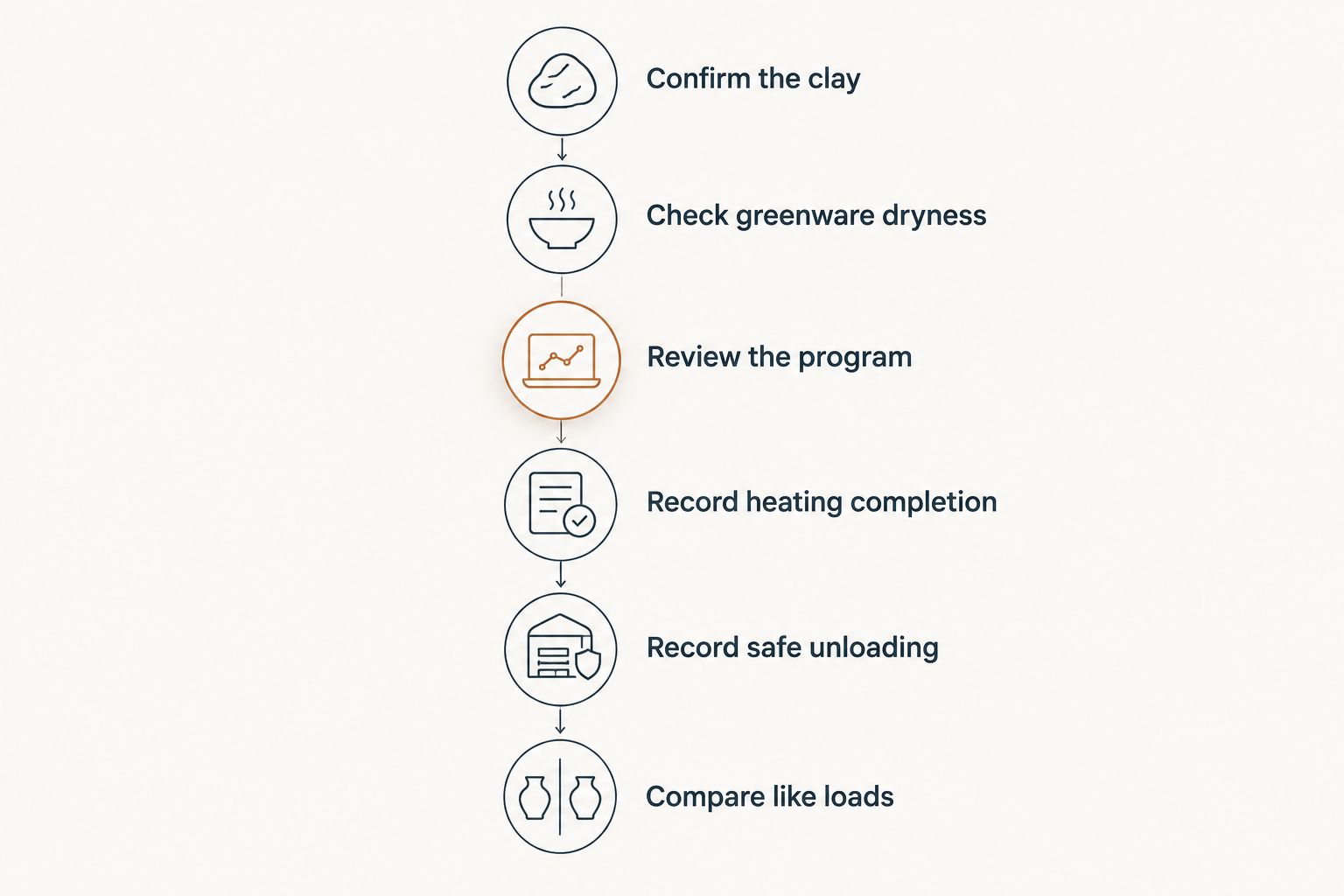
For your 2026 studio schedule, record these stages separately. The distinction prevents a finished heating program from becoming an unrealistic promise that students or customers can collect pottery immediately.
| Stage | What determines its duration | What tells you it is complete? |
|---|---|---|
| Drying before loading | Clay thickness, construction, and drying conditions | Greenware is thoroughly dry before firing |
| Optional preheat | The approved program and the condition of the load | The programmed preheat ends; it does not prove every piece was dry |
| Heating and any holds | Ramp rates, target cone, load, and kiln performance | The program completes without an unresolved fault |
| Cooling | Stored heat in the kiln, shelves, and pottery | The kiln reaches the manufacturer’s safe unloading condition |
| Inspection | Load size and the checks your studio performs | Ware and witness cones have been examined |
Use the guide to building a bisque firing schedule for greenware when you need to turn these stages into a repeatable workflow. Start with the kiln and clay instructions, then use your own firing records to establish turnaround time.
A short heating cycle is not automatically a successful bisque firing. You need sound pottery, suitable absorbency for your glazing process, and evidence that the load received the intended heatwork.
Scheduling only the controller’s estimated finish leaves cooling out of the plan. For a classroom or shared studio, that creates conflicts between unloading, glazing, and the next kiln load. Schedule access to the pottery, not merely completion of the heating program.
Build the estimate around your actual kiln and a comparable load. A record from thin bowls is not a reliable substitute for a load containing thick sculpture, even when both use the same target cone.
Your useful estimate is the observed interval from program start to safe unloading. Keep drying and handling as separate calendar tasks. That gives you a repeatable baseline without pretending every firing takes the same amount of time.
Choose a program for the condition and construction of the pottery, not for the shortest displayed duration. Controller labels are not interchangeable between manufacturers; check the manual before treating a setting called slow or medium as a specific firing recipe.
These approaches address different needs. None removes the requirement to dry the work first or follow the clay and kiln instructions.
| Approach | Best for | Advantage | Limitation |
|---|---|---|---|
| Manufacturer-recommended bisque program | Dry greenware that fits the program’s intended use | Provides an established starting point | Still requires checking the actual load and heatwork |
| Approved program with preheat | Loads for which the kiln instructions recommend preheating | Adds a controlled low-temperature stage | Extends occupancy and does not guarantee wet work is safe |
| Adjusted ramp-and-hold program | Experienced operators addressing a documented clay or load requirement | Allows deliberate control over individual stages | Incorrect settings can create firing defects or unsafe conditions |
Use the established program first; change it to solve an identified problem. Do not copy a custom schedule solely because another studio reports a shorter turnaround.
A load with consistent construction is easier to compare with previous firings. Use the clay’s recommended bisque conditions and the kiln manufacturer’s appropriate program, then inspect the results.
The benefit is repeatability. The limitation is that visual similarity does not make different clay bodies equivalent. Keep material identification in the record even when the pieces look alike.
Thick bases, bulky attachments, and uneven wall sections require attention during drying and firing. Do not assume the program used for thin cups is suitable for every sculptural form.
The practical next step is to check the construction against the clay and kiln guidance before loading. A cautious firing program cannot repair a poorly dried piece or guarantee that an unsuitable construction will survive.
Bisque firing duration changes when the material, program, load, or equipment changes. Treat these factors as separate checks rather than responding to every slow firing by increasing the heating rate.
For a 2026 firing log, note which of these factors changed. Otherwise, a longer cycle becomes an unexplained number rather than information you can use.
Water and changes in the clay require controlled heating. At standard atmospheric pressure, water boils at 212°F, or 100°C. That reference point is not a universal preheat setting or proof that moisture has safely escaped from thick pottery.
Steam generated inside insufficiently dried clay can damage the work. Give drying its own process, and follow the manufacturer’s instructions for any preheat. Do not turn a boiling-point fact into a firing recipe.
Clay also undergoes changes beyond the removal of free water. Quartz inversion occurs at approximately 1,063°F, or 573°C, and uneven temperature changes can contribute to cracking. The appropriate heating and cooling behavior depends on the material and ware—not just the displayed temperature.
A temperature reading describes conditions at the sensor; it does not prove that every part of every pot is at that temperature. This is why a reliable bisque process combines a suitable program, consistent loading, and inspection of the fired result.
The target cone tells you the intended heatwork, not a universal duration. Pyrometric cones respond to the combined effects of temperature and time, so the heating rate matters alongside the endpoint.
Use witness cones according to their manufacturer’s instructions and keep their results with the firing record. For your 2026 records, photograph or describe the cone response together with the program used.
Do not substitute a higher bisque endpoint simply to match another studio’s schedule. Bisque conditions affect the pottery’s strength and absorbency, which influence glaze application. Follow the clay and glaze guidance and evaluate the resulting ware.
A repeated program can take longer when the load changes or the kiln’s heating performance changes. Compare the new firing with a genuinely similar previous load before deciding the equipment has a fault.
Check the shelf arrangement, pottery mass, starting conditions, and program settings. An accidentally added hold or different speed selection is a different problem from a kiln that cannot maintain its programmed ramp.
If comparable loads show a persistent change, follow the manufacturer’s troubleshooting procedure. Do not compensate for a suspected electrical or element problem by rewriting the schedule. Shut the equipment down as instructed and have electrical work performed by a qualified professional.
Wait until the kiln meets its manufacturer’s safe opening and unloading instructions. Heating completion alone is not permission to lift the lid or remove the pottery.
Keep cooling in your turnaround estimate. Opening a hot kiln to meet a deadline exposes you to heat and can subject the pottery to abrupt temperature changes. Gloves do not make an unsafe unloading temperature acceptable.
In a shared studio, make the unloading condition part of the written operating procedure. Your 2026 calendar should identify who checks the kiln and who authorizes access, rather than assuming anyone can unload when the controller says complete.
ProKilnSupply is a kiln-only retailer for pottery buyers who need application and electrical-fit guidance. Start with your clay, largest pieces, typical batch, installation space, and available electrical service—not an advertised firing speed.
When discussing a pottery kiln with ProKilnSupply, provide those details and explain your turnaround needs. Ask how the proposed kiln, controller, and loading arrangement fit your intended bisque workflow.
Expert phone/text support and delivery guidance help you resolve purchase questions. Confirm the applicable manufacturer warranty, qualifying freight shipping, price-match terms, and financing eligibility before ordering. The limitation is straightforward: purchase support does not replace the operating manual or an electrician’s assessment of your installation.
How long does bisque firing take from start to unloading?
Bisque firing turnaround includes the programmed heating cycle, any preheat or holds, and cooling to the manufacturer’s safe unloading condition. Use records from comparable loads in your own kiln rather than a universal hourly estimate.
Does a kiln’s estimated firing time include cooling?
Do not assume the displayed firing estimate includes cooling. Check the controller manual and record safe unloading separately from heating completion.
Can I bisque fire pottery that still feels damp?
Dry greenware thoroughly before bisque firing. An approved preheat is not a guarantee that damp or unevenly dried pottery will fire safely.
Is a faster bisque program better for a busy studio?
A faster bisque program is appropriate only when it fits the clay, construction, load, and kiln instructions. Judge the result by sound ware and suitable heatwork, not heating duration alone.
Does thicker pottery need a different bisque schedule?
Thicker pottery requires particular attention to drying and the suitability of the firing schedule. Check the clay and kiln guidance before using a program established for thinner work.
Can I open the kiln when the controller says complete?
Open the kiln only when it meets the manufacturer’s safe opening instructions. A completed program marks the end of active heating, not necessarily safe handling.
Can ProKilnSupply help me choose a kiln for bisque firing?
ProKilnSupply provides kiln-fit guidance for pottery buyers. Explain your clay, piece dimensions, batch requirements, installation space, and electrical service before selecting a kiln.
Record the unloading time, not just the firing time. That small change turns your 2026 bisque log into a production-planning tool: it shows when pottery is available for inspection and glazing, rather than when the elements stop heating.
Keep the program, load description, witness-cone result, and unloading condition together. The fastest useful schedule is the one that repeatedly produces suitable bisqueware—not the one with the shortest number on the controller.
{"one"=>"Select 2 or 3 items to compare", "other"=>"{{ count }} of 3 items selected"}