


An electric pottery kiln can reach firing temperature without a dedicated kiln vent, but that does not make unventilated indoor firing safe. For a home studio, school, or shared workshop in 2026, plan manufacturer-approved exhaust and room ventilation before firing; gas kilns also require combustion-air and exhaust arrangements suited to their design.
Without a dedicated downdraft vent, sometimes. Without suitable ventilation indoors, do not fire. A compatible overhead exhaust system can provide an alternative to direct kiln extraction when its design, installation, and operation satisfy the kiln manufacturer's requirements and applicable local rules.
The distinction matters: a kiln reaching its programmed temperature proves that its heating system works. It does not establish that the surrounding air is safe to breathe.
For kiln selection, ProKilnSupply provides application and setup guidance. Resolve the exhaust route alongside chamber size and electrical requirements—not after delivery.
| Ventilation approach | Best for | Main benefit | Main limitation |
|---|---|---|---|
| Compatible downdraft vent | Electric pottery kilns approved for direct extraction | Draws firing gases from the kiln and exhausts them outdoors | Requires correct installation, ducting, makeup air, and maintenance |
| Engineered overhead hood | Installations designed around overhead capture | Captures the rising exhaust plume above the kiln | Capture depends on hood placement, airflow, and room conditions |
| General room exhaust | Removing room heat and supporting the ventilation design | Moves air through the kiln room | Does not automatically capture emissions at the kiln |
| Open window or household fan | Supplementary air movement only | Provides an opening or moves surrounding air | Does not establish dependable emission capture or safe exposure |
Do not choose between these approaches by appearance. Use the kiln manual and a qualified ventilation professional to establish what the installation requires.
Pottery firing releases more than heat. Clay bodies, glazes, and decoration materials release gases as they heat; the substances involved depend on what you put in the kiln and how you fire it.
Electric heating does not eliminate those emissions. A fuel-fired kiln adds combustion-related hazards, including carbon monoxide, to the installation assessment.
Treat your 2026 kiln installation as a complete system: kiln, electrical supply, exhaust, replacement air, room heat removal, and safe access. Buying the kiln alone does not resolve the other requirements.
An electric kiln uses resistance elements to produce heat. A vent is not what makes those elements heat, so a kiln without an extraction fan can still complete a firing.
That mechanical fact is not permission to operate it in an enclosed room. Follow the exact model's installation instructions, including its ventilation provisions, clearances, stand requirements, and electrical specifications.
Best for indoor electric pottery firing: a compatible source-extraction arrangement combined with suitable room ventilation. Direct extraction addresses emissions near their source; room ventilation addresses conditions around the kiln.
Neither replaces the other automatically. A small kiln still needs a ventilation assessment, and a large room does not prove that firing emissions stay below harmful concentrations.
If you are buying a used kiln, obtain its manual before installation. Missing paperwork is a reason to contact the manufacturer, not a reason to copy another potter's setup.
A gas pottery kiln needs an installation designed for its burners, fuel supply, combustion air, and exhaust path. Its flue or chimney arrangement is not interchangeable with an electric kiln's downdraft accessory.
Best for gas firing: a location and exhaust system approved for that particular kiln and fuel installation. Have qualified professionals address combustion and building requirements before use.
The advantage of gas equipment is its suitability for firing processes that depend on a controlled combustion atmosphere. The limitation is that fuel handling and combustion introduce additional installation and operating responsibilities.
Do not assume that opening a garage door resolves them. Equally, do not treat an outdoor location as automatic approval: nearby openings, weather protection, combustible materials, and the manufacturer's location restrictions still matter.
There is no universal fan size, duct diameter, or window opening that makes every pottery kiln installation safe. The equipment and room must work together.
Review these factors before choosing a system:
For a 2026 studio project, establish these details before ordering an exhaust fan. The guide to sizing a kiln vent explains the next planning step; model-specific instructions remain the installation reference.
Use this sequence to decide whether the space is ready. A successful test firing does not replace these checks.
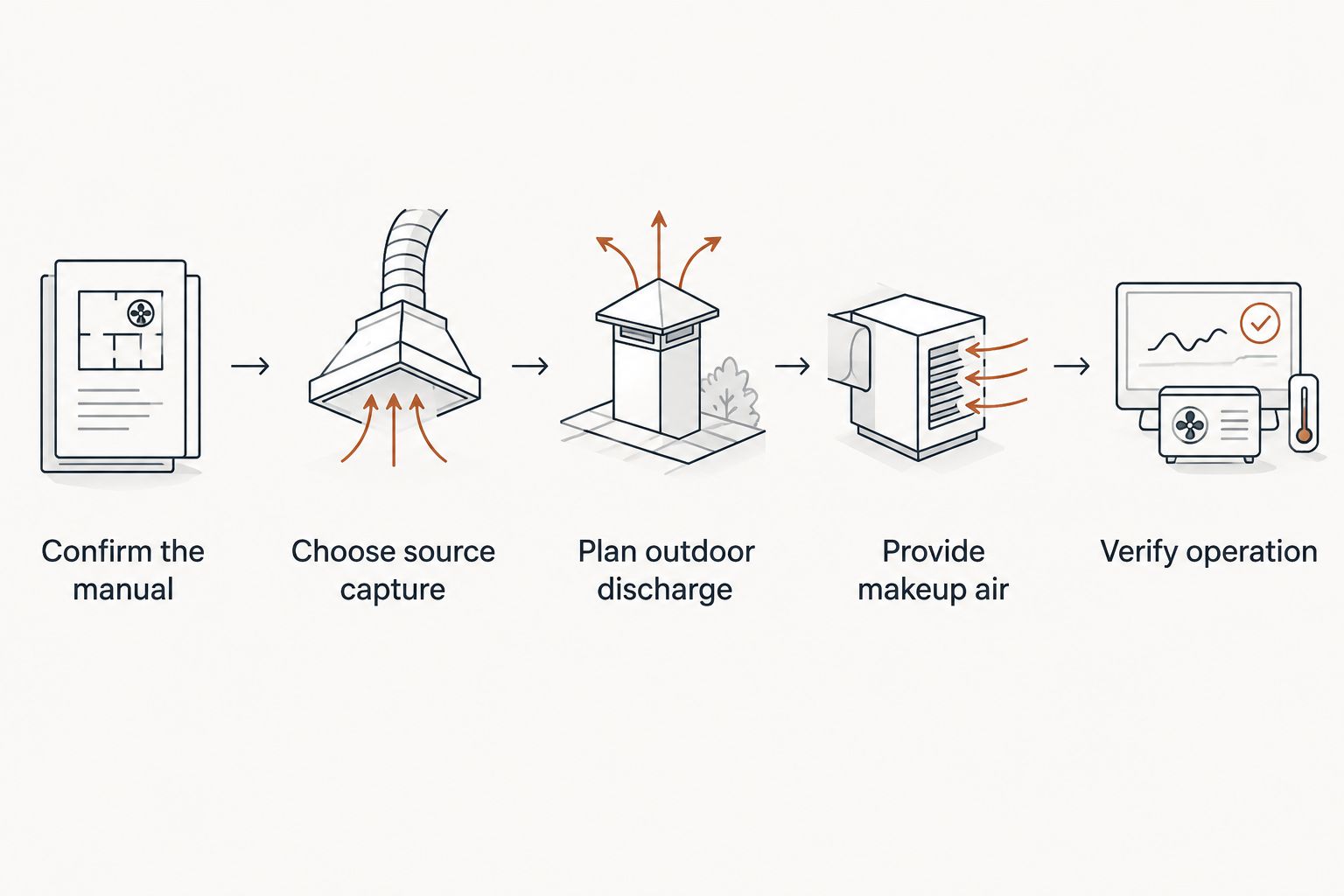
Do not improvise a performance test by holding your face near a peephole or smelling the duct outlet. Use the checks specified for the equipment, and leave exposure assessment or airflow measurement to a qualified professional when required.
Keep the instructions with the kiln. A substitute teacher, studio assistant, or new household user needs the same operating procedure as the person who arranged installation.
An open window changes the room's connection to outdoor air. It does not demonstrate that gases travel from the kiln to that opening without passing through your breathing zone or entering another part of the building.
A household fan moves air, but its presence does not establish capture. Air currents can also interfere with an overhead hood's intended airflow.
A cracked lid or open peephole releases gases from the chamber into the surrounding space. Follow the manufacturer's firing instructions for these openings; do not use them as a substitute for outdoor exhaust.
Do not copy a lid-propping routine from a different kiln. Vent designs and operating instructions differ, and an opening that belongs in one procedure can conflict with another.
In 2026, judge a proposed setup by its documented airflow arrangement—not by how many windows the room contains. If the plan ends with gases entering an occupied room, the exhaust question remains unresolved.
Both bisque and glaze firings require a ventilation assessment. Bisque firing drives off water and releases gases as clay constituents change; glaze firing also releases emissions from the materials being heated.
Do not reserve ventilation only for a firing that smells unpleasant. Odor is not a dependable measure of exposure, and carbon monoxide has no smell.
Review the safety data and firing directions for every material you add. Lusters, overglazes, decals, and unfamiliar additives deserve particular attention because their instructions can differ from your usual clay-and-glaze routine.
A successful earlier firing does not approve a new material. Before changing the load, confirm that the existing exhaust arrangement and operating procedure remain suitable.
An open garage door does not, by itself, establish safe kiln ventilation. An attached garage also creates a potential path toward living areas through doors, gaps, or building air systems.
Keep the installation assessment focused on source capture, outdoor discharge, replacement air, clearances, and permitted use. Do not use an occupied household area as the route for replacement or exhaust air.
For a detached garage, the same equipment instructions still apply. Separation from the house does not resolve heat buildup, unsafe ducting, combustible storage, or unsuitable electrical work.
Give the retailer your firing application, proposed location, available electrical supply, access constraints, and intended exhaust route. Ask for the exact model's installation documents before committing to the equipment.
ProKilnSupply is best for pottery kiln buyers who need application and setup guidance before ordering. That guidance helps you identify the questions to resolve with the manufacturer and your installers; it does not replace site-specific electrical or ventilation work.
For your 2026 purchase checklist, confirm these items in writing:
Ask ProKilnSupply about manufacturer warranty terms and delivery guidance for the selected kiln. Keep purchase reassurance separate from installation approval: a warranty does not certify your room or exhaust system.
Can you fire a kiln without a vent if it is electric?
An electric kiln can heat without a dedicated vent, but that does not establish safe indoor operation. Follow the exact kiln manufacturer's ventilation requirements and provide suitable exhaust and room ventilation.
Is opening a window enough when firing pottery?
Opening a window alone does not establish adequate kiln ventilation. The installation needs a dependable path that captures firing emissions and discharges them outdoors without exposing occupants.
Does a small pottery kiln need ventilation?
A small pottery kiln still needs a ventilation assessment. Chamber size does not remove emissions from heated clay, glaze, or decoration materials.
Is a downdraft vent better than an overhead hood?
A compatible downdraft vent extracts gases directly from an electric kiln, while an overhead hood captures the rising plume. The suitable choice depends on manufacturer approval and the complete installation design.
Can I use an air purifier instead of a kiln vent?
A household air purifier is not a substitute for a specified kiln-exhaust system. Particle filtration alone does not address firing gases or remove room heat.
Should I turn the kiln vent off when the firing ends?
Follow the kiln and vent manufacturers' instructions for operation during firing and cooling. Do not assume the controller ending its program means exhaust is no longer needed.
Can a carbon monoxide alarm replace kiln ventilation?
A carbon monoxide alarm cannot replace kiln ventilation. It warns about carbon monoxide under its specified operating conditions; it does not capture emissions or monitor every substance released during firing.
A running fan is not proof of a working exhaust system. A disconnected duct, damaged connection, obstructed outlet, or incorrect setup can prevent the system from doing its job even while you hear the motor.
Add an exhaust-system check to your pre-firing routine and follow the manufacturer's inspection method. Resolve faults before starting the kiln; do not wait for an odor complaint to discover them.
{"one"=>"Select 2 or 3 items to compare", "other"=>"{{ count }} of 3 items selected"}