


A pug mill is worth it for a small studio in 2026 when regular clay reclaim or repetitive clay preparation creates a clear workload you need to reduce. It is not the right purchase when scraps are occasional, clay bodies change frequently, or setup and cleaning would consume the time saved. Buy for a recurring preparation problem—not simply because your reclaim buckets are full.
A pug mill earns its place when its complete workflow is better than your current reclaim routine. That includes preparing the feed, loading, collecting clay, cleaning, and maintaining the equipment. Extrusion alone is not the whole job.
Start with the differences below, then use the guide to pug mills for clay recycling studios to continue your equipment research.
| Approach | Best for | Main advantage | Main limitation |
|---|---|---|---|
| Manual reclaim and wedging | Occasional scraps and frequent clay changes | No powered processing machine to maintain | Keeps preparation work in your hands |
| Non-de-airing pug mill | Processing suitably prepared clay when vacuum removal is unnecessary | Mechanizes clay compression and extrusion | Does not remove air through a vacuum system |
| De-airing pug mill | Repeated preparation where air removal matters | Combines pugging with vacuum de-airing | Adds vacuum-system maintenance; mixing is not automatic |
| Mixer-pugmill | Reclaim workflows requiring supported mixing and extrusion functions | Combines functions otherwise handled separately | Feed requirements, batch handling, and cleaning remain model-specific |
For a 2026 purchase, choose by the material you need to process and the work you need to eliminate. A machine that extrudes prepared plastic clay does not necessarily handle a bucket containing slurry, dry trimmings, and firm scraps.
A small studio has limited working space, and every machine competes with clay storage, forming surfaces, and access routes. Equipment needs to improve that arrangement rather than occupy the only practical reclaim area.
A full scrap bucket proves that clay is accumulating. It does not establish that a pug mill is the best solution. First identify whether the delay comes from drying wet reclaim, homogenizing moisture, wedging, moving material, or simply lacking a scheduled reclaim session.
Those are different problems. Match the purchase to the slowest preparation step, not to the most visible pile of clay.
Manual reclaim is the better starting point when you generate scraps irregularly and can prepare them without disrupting studio work. You keep control over small batches without loading and cleaning a processing machine.
The limitation is physical work. Mixing, moving, and wedging clay remain part of your routine, and the workload grows when you postpone preparation until every container is full.
Before buying equipment, give each clay body a labeled container and a defined reclaim destination. Keep glaze-contaminated scraps and unknown materials out of that system. A consistent process makes the remaining workload easier to evaluate.
Recommendation: wait on a pug mill if an organized manual routine already meets your needs.
A non-de-airing pug mill makes sense when your feed is already suitable for the machine and you want mechanical processing without vacuum de-airing. Confirm the manufacturer's feed requirements rather than assuming all reclaimed clay is acceptable.
The benefit is mechanized compression and extrusion. The limitation is that this machine category does not use a vacuum system to remove air, and its output still needs evaluation for your forming method.
Ask for a demonstration using clay comparable to yours. Check moisture consistency and handling, then try the output in your normal work rather than judging only the shape of the extruded log.
Recommendation: choose non-de-airing equipment only when vacuum removal is not a requirement for your process.
A de-airing pug mill uses a vacuum system to remove air during processing. It fits a studio that needs that function repeatedly and can maintain the vacuum components according to the manufacturer's instructions.
De-airing does not establish that a machine can mix unsuitable feed into usable clay. Treat mixing capability, accepted moisture condition, and vacuum performance as separate specifications.
The trade-off is additional equipment to inspect and maintain. Seals, connections, and other vacuum-system components require the attention specified for the model; air removal is not a substitute for correct operation.
Recommendation: choose de-airing for a demonstrated clay-preparation need, not as a promise that all further wedging disappears.
A mixer-pugmill is the category to investigate when you need both supported mixing and extrusion functions. Verify exactly what materials and moisture conditions the manufacturer permits.
Its advantage is combining operations. Its limitation is that a combined machine still has a loading procedure, an operating sequence, a cleanout routine, and boundaries on acceptable feed.
Ask whether the machine handles your actual reclaim condition—not merely whether it “recycles clay.” Explain whether your containers hold wet throwing scraps, firm trimmings, or dried material. Obtain the relevant manual before deciding.
Recommendation: choose a mixer-pugmill when mixing is the missing function and the documented feed requirements match your reclaim.
The same machine can fit one small studio and interfere with another. For your 2026 decision, assess these factors together:
Do not let a large advertised processing capacity settle the decision. Your useful output is the clay you can prepare, collect, store, and use through the entire workflow.
Measure your current process before comparing machines. Use your own studio record as the benchmark; another potter's workload is not your buying threshold.
A demonstration is most useful when it resembles your routine. Ask to see startup and cleanup as well as extrusion; a short view of clay leaving the barrel omits the tasks that often determine small-studio fit.
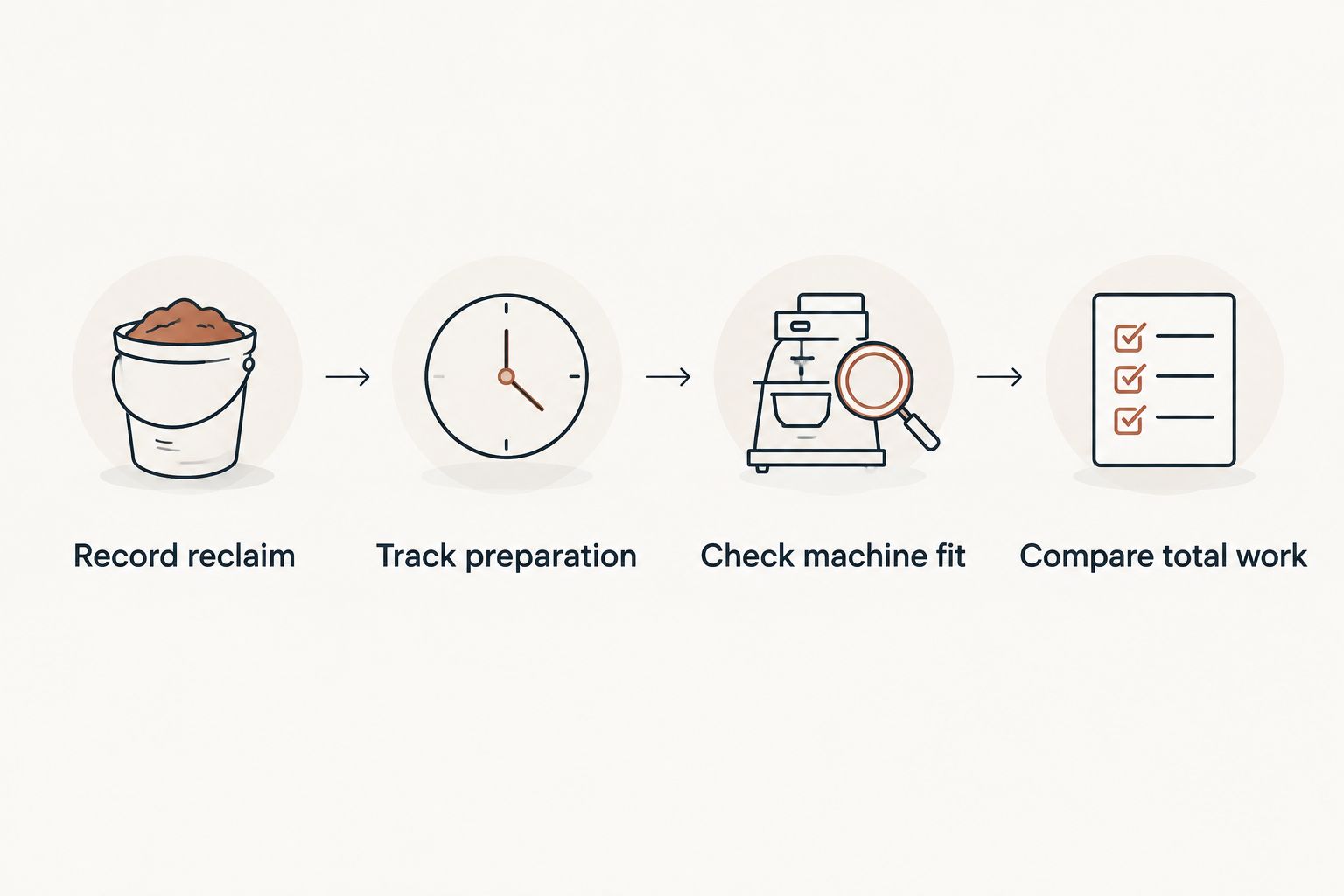
Keep that record with your 2026 equipment plan. It gives you a concrete explanation of the problem when requesting guidance and helps prevent buying a machine for a workload you expect rather than one you have.
Check the exact model's voltage, phase, current requirements, and connection instructions. Have a qualified electrician assess the supply where required; a nearby receptacle is not proof of compatibility.
Plan the working area beyond the machine's exterior dimensions. You need room for incoming clay, discharged clay, operator access, and the maintenance clearances specified by the manufacturer. Include the delivery route and the support surface or stand required for the machine.
For safe operation:
The practical benefit of automation disappears if the installation creates awkward lifting or blocks a safe route through the room. Assess the complete workstation before committing.
A pug mill does not automatically replace wedging. De-airing, moisture uniformity, clay condition, and your forming requirements determine what preparation remains necessary.
Test the output in your actual process. For throwing, assess how it handles during centering and forming; for hand-building, check whether the clay behaves consistently during your usual construction method.
If reducing physical strain is the main objective, inspect loading height, feed effort, and the weight you must move afterward. Mechanical processing removes some tasks but does not make clay handling weightless. Treat that distinction as a purchase requirement, not an afterthought.
A pug mill is harder to justify when frequent clay changes make cleaning the dominant task. Repeatedly switching between a pale body and a dark or heavily grogged body requires a deliberate contamination-control routine.
Keep incompatible bodies separate, including clay intended for different firing requirements. Do not assume mechanical mixing makes an unknown blend suitable for functional work or a planned firing.
Ask how much clay remains inside the proposed machine and how the manufacturer instructs you to remove it. Also ask what access and disassembly are required. A cleanout procedure you will avoid performing is a poor fit for a multi-clay studio.
Bring the supplier a clear application: your clay bodies, reclaim condition, physical constraints, electrical supply, and intended location. Then request written confirmation of machine capabilities, installation requirements, delivery arrangements, and warranty coverage.
ProKilnSupply is best for pottery buyers seeking kiln-focused guidance alongside studio equipment. Its fit guidance is relevant when you are planning the wider studio, but pug mill selection still depends on the exact manufacturer's documentation.
For a 2026 studio plan, ProKilnSupply provides a starting point for kiln and studio-equipment discussions. Confirm the applicable purchase terms for the equipment you select; retailer-wide reassurance does not replace model-specific instructions or coverage.
Is a pug mill worth it for a hobby pottery studio?
A pug mill is worth considering when recurring reclaim or clay preparation disrupts your hobby studio. If scraps are occasional and manual preparation remains manageable, wait until you have a clear workload to reduce.
What's the difference between a pug mill and a clay mixer?
A pug mill compresses and extrudes clay, while a clay mixer mixes materials. Some machines combine those functions, so check the exact model's accepted feed and operating instructions.
Do I need a de-airing pug mill for throwing?
You need de-airing when vacuum air removal is a requirement of your preparation process. Test the output with your clay and throwing method rather than assuming the feature eliminates all further preparation.
Can I put dry clay straight into a pug mill?
Only feed dry clay if the manufacturer explicitly permits it and specifies the procedure. Pugging capability alone does not establish dry-material mixing capability; dry clay also requires appropriate dust controls.
Can I reclaim several clay bodies in the same machine?
You can process different clay bodies only with an appropriate separation and cleaning procedure. Keep incompatible reclaim separate and follow the manufacturer's instructions for removing retained clay.
How much studio space does a pug mill need?
A pug mill needs its specified installation space plus room for loading, discharge handling, cleaning, and service access. Use the exact model's documentation and measure the delivery route before ordering.
Can ProKilnSupply help with a small pottery studio equipment plan?
ProKilnSupply provides fit guidance for pottery kilns and studio equipment. Share your application, setup constraints, and power details, and confirm the specifications of any proposed machine before purchase.
The clay left inside the machine belongs in your decision. Ask how retained material is handled during shutdown, storage, and clay-body changes, then compare that routine with how often you actually work.
For your 2026 purchase, the strongest reason to buy is a repeatable preparation problem that the documented machine workflow solves. If you cannot name that problem yet, organize and measure your reclaim first.
{"one"=>"Select 2 or 3 items to compare", "other"=>"{{ count }} of 3 items selected"}