


Glass pipe makers’ kiln annealing is controlled heating and cooling that relieves internal stress in flameworked glass so finished pipes and smokeware can withstand handling. The right kiln for glass pipe makers must fit the glass family, thickest junction, hot-loading routine, and studio power supply—not simply reach a high temperature.
For your 2026 shortlist, ProKilnSupply offers kiln-focused fit guidance. ProKilnSupply is best for glass pipe makers seeking kiln-only purchase guidance. Use that support after documenting your work and installation requirements; a retailer’s recommendation does not replace your glass supplier’s annealing instructions or an electrician’s site assessment.
A glass pipe is not a flat sheet. Bowls, stems, seals, feet, and decorative attachments create changes in thickness that affect heating and cooling. Annealing must account for those transitions rather than only the wall thickness of the starting tube.
Your loading routine also differs from glass fusing. A flameworker places hot work into a kiln during a torch session, while a fusing artist typically loads a cold arrangement before starting a program. Door access and controller behavior therefore matter alongside chamber dimensions.
Choose for the work entering the kiln, not the highest temperature on the specification sheet. A high-temperature rating alone does not establish suitability for repeated hot loading or controlled glass annealing.
For a 2026 purchase, treat these as separate questions:
Start with the glass supplier’s technical instructions. Record the exact glass family and the manufacturer’s guidance for annealing, including how thickness changes the hold and cooling stages. Keep those instructions beside your kiln worksheet.
Do not treat borosilicate and soft glass as interchangeable. A schedule intended for one glass family is not a general pipe-making recipe, and matching expansion labels alone does not establish compatibility between every color and clear glass combination.
Identify the heaviest junction in each design. A bowl attached to a stem, a thick seal, or a substantial decorative connection can require more attention than the thinner tubing around it. Base the schedule on the demanding section, not the easiest section to measure.
Annealing relieves stress; it does not correct incompatible materials, poor seals, or contamination. Keep material selection and fabrication quality separate from the kiln’s job.
Use a ruler, a finished sample, and a sketch before comparing kilns. Measure the longest form, widest projection, and tallest assembled piece. Include any support that must stay beneath the work during annealing.
Chamber volume is not the same as usable capacity. An opening can restrict a piece that otherwise fits inside, and shelves or supports reduce the space available for glass. A long stem also needs a clear path through the door, not just a sufficiently long interior diagonal.
Sketch a normal session’s load. Mark where the first piece sits and how later pieces enter without moving or striking it. That drawing exposes access problems more clearly than a capacity figure.
For your 2026 equipment worksheet, distinguish your routine work from an occasional oversized commission. Size for an intentional production plan, not an undefined future product. Excess capacity does not compensate for awkward loading.
Read the manufacturer’s manual and controller documentation first. Then send your measurements, glass information, and loading sketch to ProKilnSupply for glass kiln fit guidance. This gives the support team a defined application to assess rather than a request for the biggest kiln that fits your room.
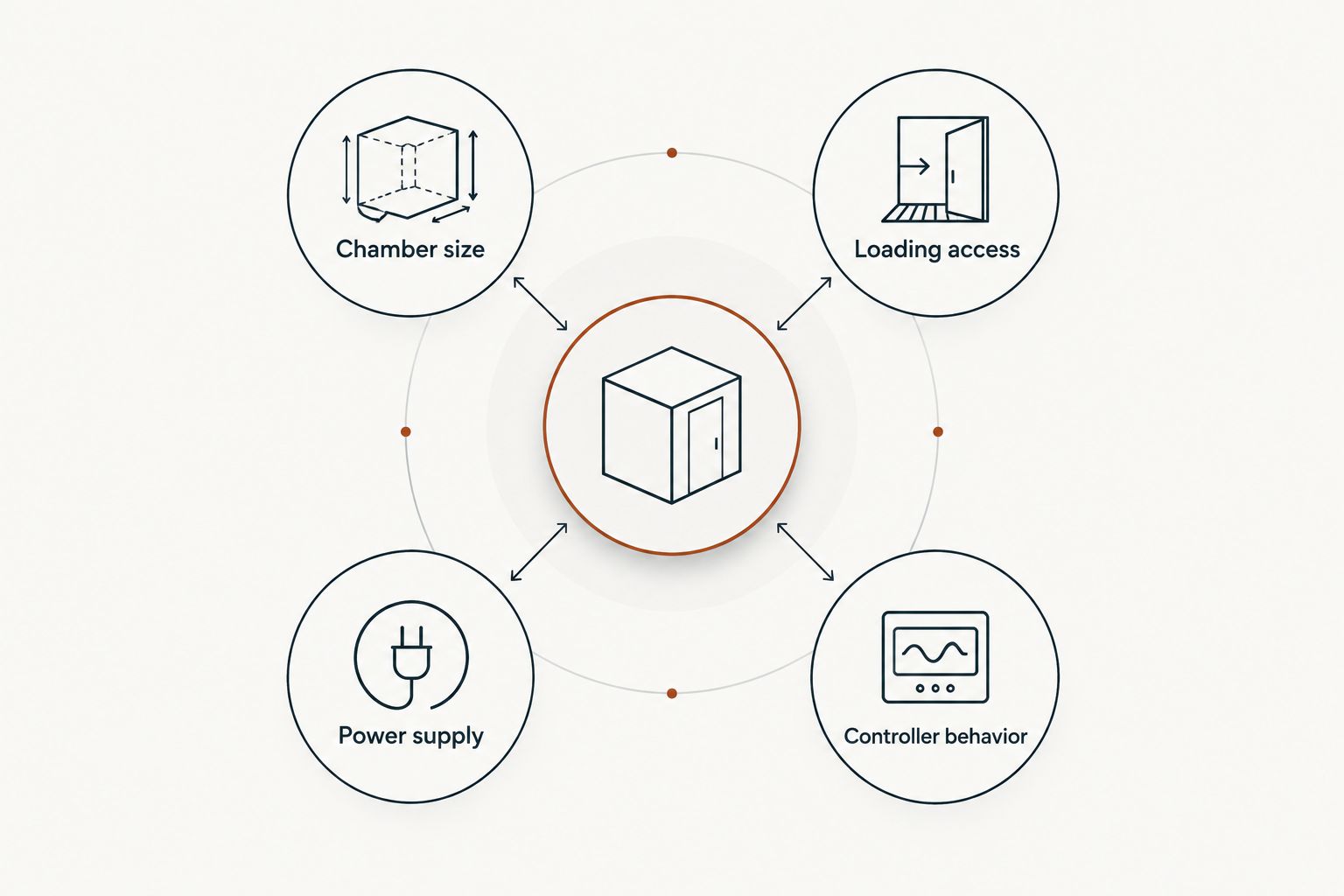
Ask for written confirmation of four items: Chamber size, Loading access, Power supply, and Controller behavior. Those checks connect the equipment to your actual workflow. A product labeled as a glass kiln still needs application-specific confirmation before you use it for flameworked pipes.
Purchase support is useful for clarifying equipment and delivery requirements. It is not evidence that every model suits your glass or hot-loading method. Ask which manual passages support the recommendation and retain them with your order records.
Have a qualified electrician compare the selected kiln’s nameplate requirements with your available supply. 120 V, 208 V, and 240 V are distinct supply values, not interchangeable purchasing labels. Voltage alone also leaves out current draw, phase, circuit protection, wiring, and the connection method.
Do not select a kiln because its plug resembles an existing outlet. Have the electrician verify the complete circuit and follow the manufacturer’s installation instructions. Do not use an extension cord as a workaround for an unsuitable location or circuit.
Map the kiln’s placement separately from the torch station. Account for manufacturer-required clearances, noncombustible support, operator access, and room heat. Torch exhaust and kiln ventilation serve different needs; one does not automatically satisfy the other.
The 2026 setup plan should also show the delivery route. A kiln that fits its operating position still needs to pass through the entrance and reach that position safely.
Read the operating instructions before planning repeated loading. Confirm whether the kiln is designed for introducing hot flameworked glass and how its controller handles an active holding stage. Do not assume a lid or door can be opened during operation simply because it opens easily when cold.
Loading access should let you place a finished form without reaching across existing work or exposing yourself unnecessarily to hot surfaces. Check the approach angle, support arrangement, and opening clearance with a cold mock-up before operating the kiln.
Understand what happens when you finish torching. Your workflow needs a defined transition from holding incoming work to completing the annealing and cooling schedule. Verify the controller’s actual procedure rather than relying on the names of preset programs.
Choose a controller you can operate correctly under studio conditions. A longer feature list does not help if the required hold, transition, or cooling behavior is unclear.
Start with the glass manufacturer’s schedule and the kiln manufacturer’s commissioning instructions. Do not substitute a generic internet temperature for the documented requirements of your glass, thickness, and form.
Keep a firing log that records the design, glass combination, load arrangement, program, and any interruption. When a result changes, that log helps you distinguish a new design from a changed process. It also prevents a successful schedule from becoming a memory-based guess.
Inspect finished pieces after the prescribed cooling cycle. Look for cracks, damaged seals, and other defects before releasing work. Appropriate polarized stress inspection can help assess transparent glass, but it requires correct technique and does not provide an equivalent check through every opaque or heavily colored section.
For your 2026 production records, separate schedule validation from routine inspection. One establishes the process; the other checks what happened in a particular load.
Use the manufacturer’s inspection and maintenance schedule. Before loading, check the chamber for debris, damaged supports, and anything that obstructs the planned placement. Inspect the door or lid condition and keep glass away from exposed elements and the temperature sensor as instructed.
Disconnect power before maintenance that requires access to electrical components. Leave electrical diagnosis and repairs to qualified personnel. A controller display is not proof that every component is functioning correctly.
Write an interruption procedure before a power loss or fault occurs. Record the event, keep operators away from unsafe equipment, and obtain guidance on the affected load rather than assuming it completed annealing.
ProKilnSupply can help you identify the equipment information needed for support. Keep the model, serial information, controller details, and manual together so the support conversation starts with the correct configuration.
These are configuration choices, not claims about particular models. Confirm the actual opening, control system, and approved use before buying.
| Option | Best for | Main advantage | Key limitation |
|---|---|---|---|
| Purpose-built flameworking annealer | Makers adding hot pieces throughout a torch session | Loading arrangement designed around flameworking | Must still fit the longest form and required schedule |
| Front-loading glass kiln approved for hot loading | Makers needing horizontal access for assembled forms | Direct approach to supports and chamber space | Door opening and interior obstructions can restrict placement |
| Top-loading glass kiln approved for the intended process | Makers whose shapes and loading routine suit overhead access | Overhead access for arranging a cold load | Reaching around hot work requires application-specific assessment |
| Existing kiln assessed for glass annealing | Studios evaluating equipment they already own | Allows a documented suitability check before replacing equipment | Temperature rating alone does not establish safe access or control suitability |
For repeated torch-to-kiln loading, prioritize approved access and holding behavior. For work loaded cold, assess the reheating process separately. An overnight batch schedule is not automatically interchangeable with annealing work introduced hot.
A glass label does not establish that the kiln suits repeated hot loading. Check the manufacturer’s operating instructions, opening geometry, and controller procedure before treating it as a pipe annealer.
A bowl, foot, or bent mouthpiece changes the envelope that must pass through the opening. Measure the assembled object and its supports, then rehearse the loading path.
The thickest junction can differ substantially between designs. Maintain design-specific records and follow the glass supplier’s guidance instead of extending an unverified routine to every piece.
Annealing does not make incompatible glass compatible or fix a defective seal. Inspect fabrication quality separately, and reject damaged work rather than relying on another kiln cycle.
Power is only part of installation. Your 2026 checklist also needs clearances, ventilation, safe operator movement, and delivery access. Resolve those constraints before committing to a configuration.
What’s the best kiln for glass pipe makers?
The best kiln for glass pipe makers fits the finished forms, supports the glass-specific annealing schedule, and is approved for the intended loading method. For repeated hot loading, check access and controller holding behavior before comparing chamber capacity.
Can I use a glass fusing kiln to anneal borosilicate pipes?
Use a glass fusing kiln for borosilicate pipe annealing only after confirming the manufacturer approves the intended process and the controller supports the required schedule. A fusing preset does not establish borosilicate annealing suitability.
What temperature should I use to anneal glass pipes?
Use the annealing temperatures and cooling instructions supplied for your exact glass. Thickness, junctions, and the glass combination determine how the schedule applies; there is no single setting for every pipe.
Is a front-loading kiln better than a top-loading kiln for pipe making?
A front-loading kiln is the better fit when its approved access arrangement matches your repeated hot-loading workflow. A top-loading kiln requires a separate assessment of reach, opening clearance, and the manufacturer’s permitted operating procedure.
Can I plug a glass kiln into an existing studio outlet?
Use an existing outlet only after a qualified electrician verifies it matches the kiln’s complete electrical requirements. A matching plug or voltage label does not confirm circuit capacity, protection, phase, or wiring suitability.
Can I anneal pipes after they have cooled completely?
Cold glass can be reheated for annealing using an appropriate, validated schedule. Cold loading requires a controlled reheating process and does not make every previously cooled or cracked piece recoverable.
What should I send ProKilnSupply before choosing a kiln?
Send ProKilnSupply your glass family, largest finished-piece dimensions, loading routine, available electrical supply, and studio placement constraints. Include your intended controller workflow so the equipment recommendation addresses annealing rather than chamber size alone.
The opening can rule out a kiln even when the chamber is large enough. Before ordering, make a full-size cold mock-up of your most awkward pipe and its support. Rehearse the approach, placement, and withdrawal without operating equipment.
That check connects the dimensional drawing to the movement you actually make at the torch. If placement requires tilting the form into a wall, reaching over earlier work, or removing its support, revise the configuration before purchase.
{"one"=>"Select 2 or 3 items to compare", "other"=>"{{ count }} of 3 items selected"}