


Metallurgy lab heat treating is controlled heating and cooling of metal specimens to produce or study changes in microstructure and properties. Choose a heat treating oven for metallurgy lab work by alloy, atmosphere, usable chamber space, electrical supply, and temperature verification—not maximum temperature alone.
A metallurgy experiment needs a defined thermal history. Annealing, hardening, tempering, and aging use different heating and cooling conditions; an oven that fits one operation does not automatically fit another. Specify the experiment before specifying the oven.
Research adds requirements that workshop buying guides often leave out: specimen identification, traceable measurements, repeatable loading, and records that connect the thermal cycle to later microscopy or mechanical testing. A controller display alone does not establish those conditions.
For your 2026 equipment shortlist, separate the retailer's fit guidance from your laboratory's acceptance work. ProKilnSupply sells heat-treating kilns and provides fit guidance; your lab must define the experimental tolerances, measurement method, and safety approval.
Start with a written requirements sheet rather than a model name. That sheet should let a supplier answer a precise question: can this configuration perform this process, with this load, in this facility?
Build the initial specification yourself from the alloy supplier's processing guidance and your approved research protocol. Record the material condition as well as the alloy designation. Prior cold work, previous heat treatment, and specimen geometry affect how you interpret the result.
Distinguish the oven setpoint from the required specimen exposure. A hold specified for the specimen is not automatically satisfied when the chamber sensor reaches its target. Define how your procedure establishes that the specimen has reached the required condition.
Keep separate requirements for heating, holding, transfer, and cooling. An oven supplies heat; it does not automatically supply a validated quench or a controlled cooling rate.
For a 2026 research program, organize the requirements sheet under these headings:
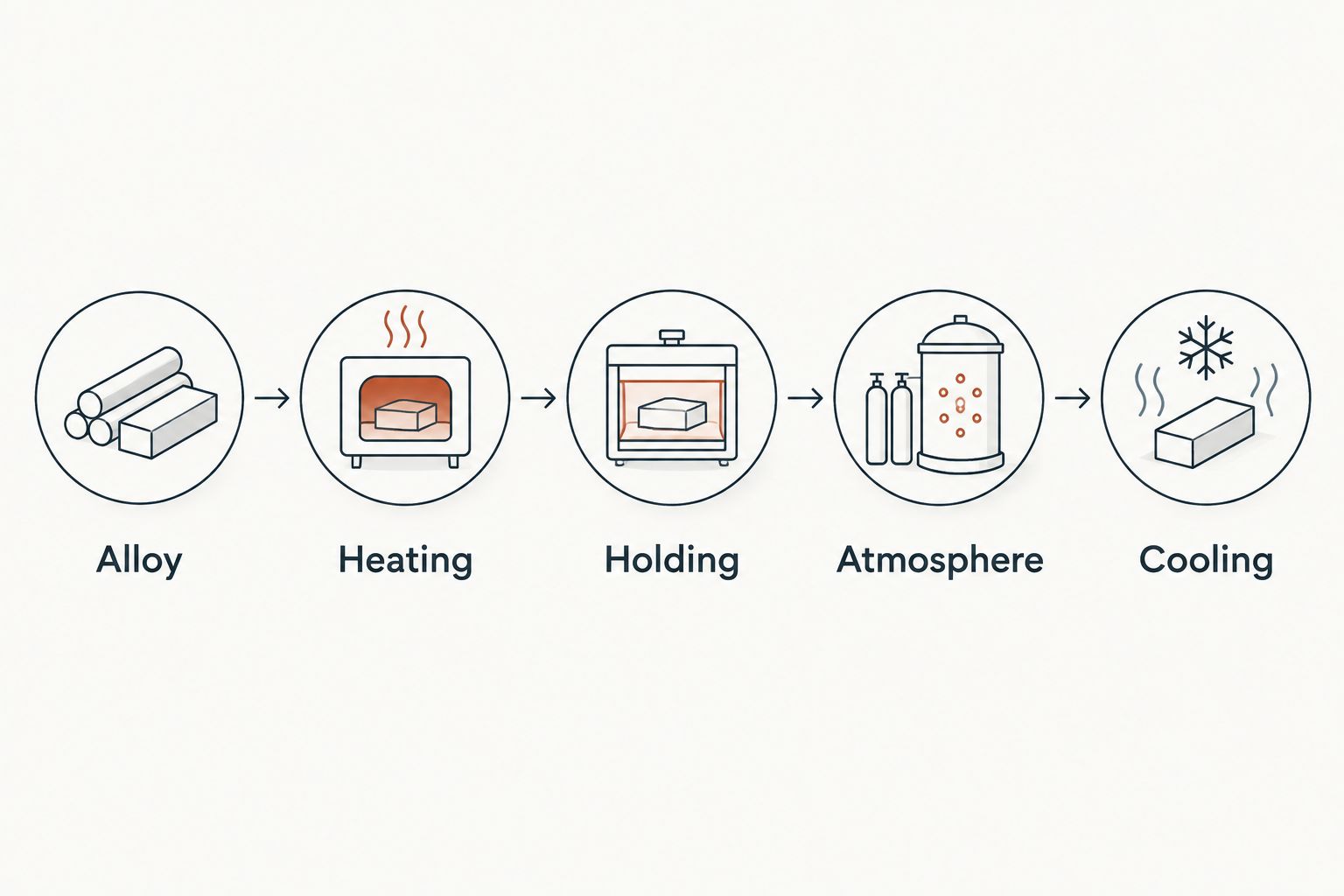
Review the controller manual and measurement documentation before requesting extra equipment. Identify what the controller measures, where its sensor sits, and what happens when a program is interrupted. Those details determine whether the program matches your protocol.
Controller resolution is not temperature accuracy, and temperature accuracy is not chamber uniformity. A display with small increments does not demonstrate that every specimen experiences the same temperature.
Plan an independent verification method suited to your research tolerances. Use suitable calibrated instrumentation and assess the intended working region, including representative loading conditions. Do not assume an empty-chamber check establishes loaded performance.
Define acceptance criteria before commissioning so an unexpected result has a clear disposition.
Make a physical mock-up first. Use cold specimens, racks, and handling tools to check loading and unloading without an energized oven. Measure length, width, and height, then account for the manufacturer's required separation from elements and chamber surfaces.
The usable working region is more important than total chamber volume. A specimen that physically fits can still sit outside the region your lab has verified. Fixture mass also belongs in the assessment because the fixture heats alongside the specimens.
ProKilnSupply heat treating oven fit guidance gives you a faster way to narrow the catalog once you have specimen dimensions, process requirements, and facility details. It does not replace your loaded-temperature assessment.
Ask for the exact configuration rather than treating a model designation as a chamber specification.
Have your facilities team identify the available supply before selecting an oven. A receptacle's appearance is not enough: voltage, phase, circuit capacity, grounding, and the manufacturer's connection requirements all matter.
A 120V oven and a 240V oven require matching supplies; an adapter is not a substitute for the correct electrical installation. The listed Evenheat KH 414 and Evenheat KH 418 knife ovens specify 120V and 2200°F in their product titles. Those figures identify electrical and temperature characteristics, not demonstrated research performance.
For a 2026 purchase request, attach the manufacturer's electrical documentation to the facilities review. Let a qualified electrician establish circuit and connection requirements. Do not assign a breaker size from voltage alone.
Determine whether oxidation or decarburization would compromise your measurements before choosing an air-fired oven. Heated metals can react with the surrounding atmosphere. Surface changes matter especially when the research examines hardness near the surface, chemistry, or thin specimens.
An electric heating system does not establish an inert environment. Likewise, a gas connection does not establish a specified oxygen level, gas composition, or vacuum capability. Request the actual atmosphere-control design and its operating documentation.
If your protocol requires controlled gas or vacuum, shortlist equipment designed for that process. Protective wrapping belongs only in a procedure that permits it; it is not a universal replacement for atmosphere control.
Do not buy an air oven and assume you can convert it into an atmosphere furnace.
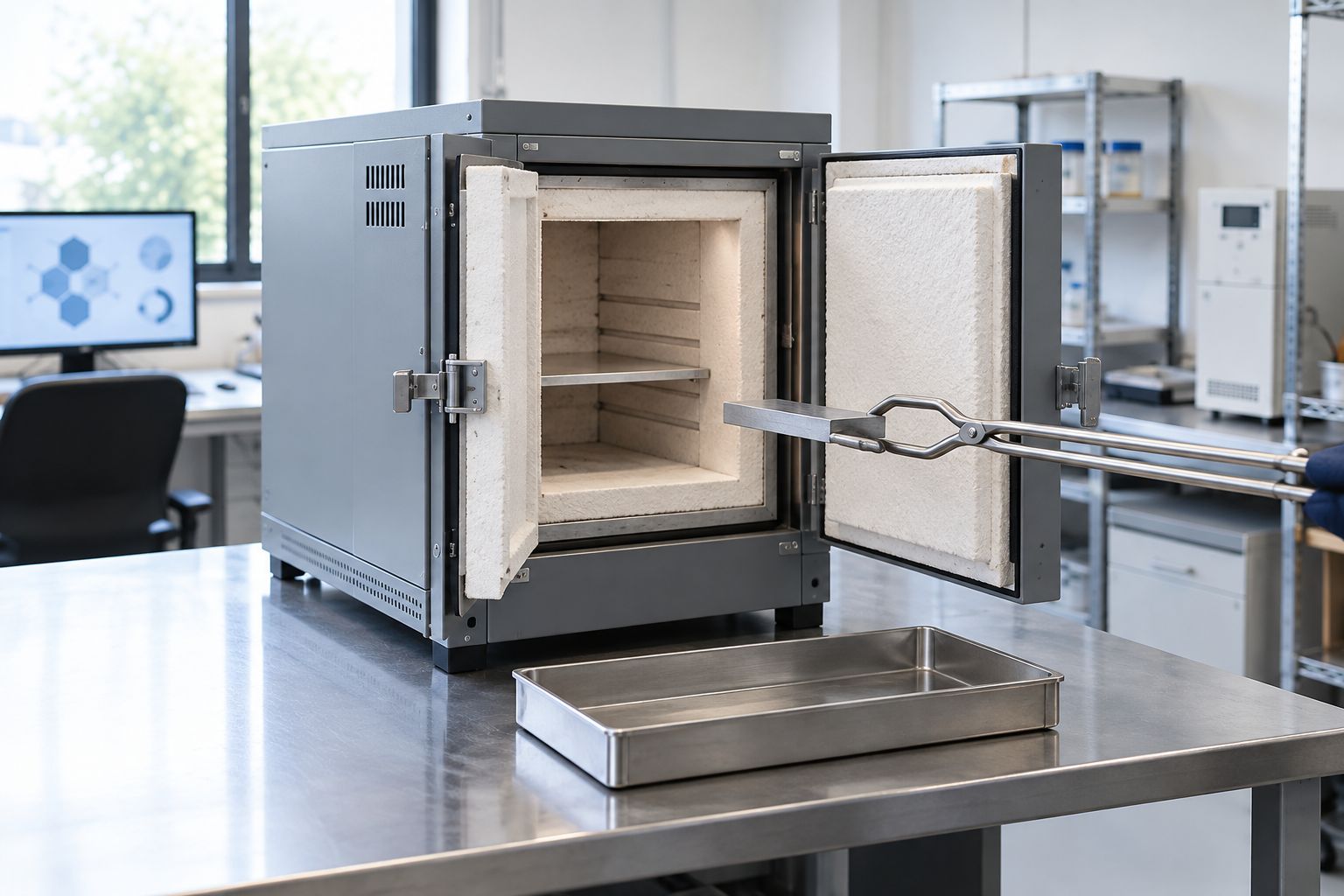
Walk through the complete transfer route with cold tools and specimens. Check the door movement, operator position, receiving area, and any approved quench station. The safest layout is one your laboratory has reviewed for the actual treatment and load.
Transfer and cooling belong in the experimental record because they affect the thermal history. A programmed hold cannot compensate for an undocumented delay between removal and cooling.
Do not select handling tools solely because they are sold for kilns. The grip must suit the specimen, and the tool and protective equipment must suit the exposure. Keep combustible materials and unrelated work out of the approved hot-work area.
Establish how the specimen remains identifiable after heating. Labels that work at room temperature do not automatically survive the treatment.
Create the record template yourself before the first research run. Include specimen identity, alloy condition, program revision, loading arrangement, measurement equipment, and cooling method. A spreadsheet or laboratory notebook is sufficient if it preserves the information your protocol requires.
Commission the oven according to its manufacturer instructions, then perform the laboratory's acceptance checks. Separate equipment commissioning from experimental qualification: successful heating does not demonstrate that the research process meets its tolerances.
For ongoing work, define what triggers another check. Sensor replacement, controller changes, repairs, and a substantially different load configuration deserve review against your verification plan.
Your 2026 equipment file should explain what the oven can demonstrate, not simply what it can display.
Choose the equipment class first, then evaluate individual models. The following options serve different purposes; none wins every metallurgy application. For your 2026 shortlist, use these boundaries to avoid comparing equipment that performs fundamentally different jobs.
| Option | Best for | Main advantage | Key limitation |
|---|---|---|---|
| Air-fired heat treating oven | Processes that permit exposure to air | Direct heating workflow without a process-gas system | Does not prevent oxidation or decarburization |
| Dedicated tempering oven | Tempering protocols within its documented operating range | Keeps a separate station for a defined process | Not a substitute for every higher-temperature treatment |
| Evenheat KH 414 Knife Oven | Buyers evaluating a 120V knife-oven candidate for compatible metal specimens | Listed with a 2200°F temperature rating | Chamber fit, atmosphere, records, and uniformity need separate confirmation |
| Evenheat KH 418 Knife Oven | Buyers considering another 120V knife-oven configuration | Listed with a 2200°F temperature rating | The listing does not establish laboratory qualification |
| Controlled-atmosphere furnace | Treatments requiring a defined gas environment | Supports atmosphere-dependent processing when appropriately configured | Requires gas-system and safety assessment |
| Vacuum furnace | Protocols that explicitly require vacuum processing | Provides the specified vacuum environment when appropriately designed | Adds vacuum-system requirements and operational complexity |
| External heat treatment service | Labs without a suitable approved in-house installation | Avoids installing equipment for an outsourced process | Requires agreement on processing records and specimen traceability |
The Evenheat KH 414 and Evenheat KH 418 belong on a shortlist only when their documented configurations match your experiment. Their 120V supply and 2200°F rating do not establish temperature uniformity, atmosphere control, data export, or suitability for a particular alloy schedule.
ProKilnSupply lists both heat treating oven candidates below. Compare the current manufacturer documentation, ask for fit confirmation, and keep the purchase decision conditional on your laboratory's requirements.
What's the best heat treating oven for a metallurgy lab?
The best heat treating oven for a metallurgy lab is the configuration that meets its alloy, atmosphere, specimen-fit, power, and temperature-verification requirements. Choose the equipment class first; a knife oven is a candidate only when its documented capabilities match the protocol.
Can a knife-making oven be used for metallurgy research?
A knife-making oven can serve metallurgy research when its configuration and verified performance meet the experiment's requirements. Do not infer chamber uniformity, controlled atmosphere, or research documentation capability from the product category.
Is a 2200°F rating enough to choose a lab oven?
A 2200°F rating is not enough to choose a lab oven. You must also confirm the working temperature range, loaded performance, specimen access, atmosphere, and cooling procedure.
Do metallurgy labs need an inert-atmosphere furnace?
Metallurgy labs need an inert-atmosphere furnace when their protocols require an appropriate controlled gas environment. Air-fired ovens remain candidates for processes that permit exposure to air and the resulting surface changes.
Can I connect a 240V oven to a 120V outlet?
A 240V oven requires a matching electrical supply, not a 120V outlet with an adapter. Have a qualified electrician review the exact manufacturer's voltage, phase, current, and connection requirements.
How do I check whether my oven temperature is accurate?
Check oven temperature with suitable independent calibrated instrumentation under a defined verification procedure. Assess the intended working region and representative loading conditions; controller resolution alone does not establish accuracy or uniformity.
What should I send a retailer before ordering a lab oven?
Send the alloy process, temperature range, specimen and fixture dimensions, atmosphere requirements, electrical supply, and required records. ProKilnSupply offers kiln-specialist fit guidance, while laboratory acceptance criteria remain your responsibility.
What records should accompany a heat-treated research specimen?
A heat-treated research specimen should have an identifiable record of material condition, heating program, loading arrangement, temperature verification, transfer, and cooling. Preserve deviations and connect the treatment record to subsequent microscopy or mechanical testing.
Write the rejection criteria before approving the purchase. A laboratory gains more from a clear boundary on acceptable performance than from an impressive maximum-temperature rating.
For your 2026 purchase file, state what would make the equipment unsuitable: an atmosphere mismatch, an unverified working region, inadequate specimen access, or records that cannot support the experiment. Send those boundaries with your requirements sheet. That turns the buying decision into a documented fit assessment rather than a guess based on a product title.
{"one"=>"Select 2 or 3 items to compare", "other"=>"{{ count }} of 3 items selected"}

