


Best default for an equipped pottery studio: Olympic Freedom 2823HE. Best for wide, deep loads: Olympic 3031HE. Best for lift-off loading: Olympic TopHat 2827E. Best for rolling-cart production: Olympic FL42E Car Kiln. These electric kilns for pottery belong on your 2026 shortlist when your firing work and electrical service justify a large kiln; ProKilnSupply provides kiln-fit guidance before you order.
A kiln must fit your clay and glaze system, your actual loads, and your building. A large chamber solves nothing if your electrician cannot supply the required service or you cannot safely load the bottom shelf.
This 2026 shortlist focuses on large ceramic kilns with stated specifications, not small beginner models. ProKilnSupply is best for pottery kiln buyers who need specialist fit guidance before ordering. If you make occasional small batches, start with a smaller-kiln assessment rather than treating these production-oriented options as automatic upgrades.
Use these criteria before comparing models:
For your 2026 purchase, reject any model that fails a required criterion. An attractive loading system cannot compensate for incompatible power or insufficient clearance for your work.
The order below follows distinct buying situations. It does not imply that the largest kiln is the best kiln for every potter.
| Kiln | Best for | Standout feature | Stated electrical requirement | Key limitation |
|---|---|---|---|---|
| Olympic Freedom 2823HE | Equipped studios planning for repairs | Ceramic kiln package with repair kit | 240V / 48A | Package contents need confirmation; not a household-outlet choice |
| Olympic 3031HE | Wide, deep ceramic loads | Oval chamber, 42 inches wide and 33.5 inches deep | 240V / 85A | Deep loading and substantial electrical demand |
| Olympic TopHat 2827E | Lift-off loading access | Bell-style ceramic kiln | 240V / 64A | Installation must accommodate the lifting arrangement |
| Olympic FL42E Car Kiln | Rolling-cart production loading | Front-loading chamber with rolling cart | 240V / 160A | Substantial service requirement and cart-access needs |
All four models carry a stated maximum of 2350°F, Cone 10. Confirm the exact configuration and manufacturer documentation before purchasing; those ratings do not establish identical firing behavior or throughput.
The Olympic Freedom 2823HE is an electric ceramic kiln package with a repair kit. Its stated specifications are 240V, 48A, and a maximum temperature of 2350°F, Cone 10, with a one-year warranty.
Best for: An equipped pottery studio that wants repair planning included in its kiln purchase. It is the default starting point among these four because it combines the stated ceramic firing rating with a repair package and the lowest listed amperage in this comparison—not because it fits every studio.
Olympic Freedom 2823HE pros:
Olympic Freedom 2823HE cons:
Ask which replacement parts the package contains and which repairs require qualified service. A repair kit does not prevent failures or replace safe electrical work.
Verdict: Buy when the chamber, electrical configuration, and confirmed package contents fit your studio.
The Olympic 3031HE is an oval electric ceramic kiln with a stated interior measuring 42 inches wide, 30 inches front-to-back, and 33.5 inches deep. Its listed configuration requires 240V and 85A, with a maximum rating of 2350°F, Cone 10.
Best for: Potters whose wide or deep work determines the kiln purchase. The chamber dimensions give you a concrete starting point for checking larger forms and shelf layouts.
Olympic 3031HE pros:
Olympic 3031HE cons:
Do not equate the chamber's width with the diameter of a usable shelf. Furniture, wall clearance, and the shape of the chamber determine the actual loading envelope.
Verdict: Buy for work that needs its documented chamber dimensions, after confirming safe loading access and power.
The Olympic TopHat 2827E is a bell-style, lift-off ceramic kiln. Its stated interior is 28¼ inches wide and 27 inches deep; the listed electrical requirement is 240V and 64A.
Its maximum rating is 2350°F, Cone 10, and its stated warranty is one year. The loading arrangement—not a higher temperature claim—is the reason to put it on your shortlist.
Best for: Ceramic artists who want a lift-off chamber arrangement for loading their work.
Olympic TopHat 2827E pros:
Olympic TopHat 2827E cons:
Confirm how the lifting system operates and what space it needs throughout its movement. Check the complete installation envelope, not only the footprint when closed.
Verdict: Buy when lift-off access solves a specific loading problem and the room supports the mechanism.
The Olympic FL42E Car Kiln is a front-loading production kiln with a rolling cart. Its stated requirements are 240V and 160A, with a maximum rating of 2350°F, Cone 10, and a one-year warranty.
Best for: A production pottery operation that specifically needs cart-based loading. Treat the cart workflow as the buying reason, not as an accessory you will find a use for later.
Olympic FL42E Car Kiln pros:
Olympic FL42E Car Kiln cons:
Map the cart's working area before choosing the kiln location. Include the route used to bring greenware to the loading area and remove fired work.
Verdict: Buy only when your production process and electrical service justify a cart kiln.
Use these product cards to distinguish the named configurations. Before ordering through ProKilnSupply, confirm voltage, phase, controller, furniture, vent compatibility, warranty terms, and delivery requirements for the exact unit.


The 2026 ranking follows application fit: repair planning, wide and deep work, lift-off access, then cart-based production. The comparison uses the stated model specifications and package descriptions, not measured firing tests.
No model earns a claim for faster firing, lower energy consumption, or more uniform results here. Those conclusions require comparable evidence. Choose the loading method and usable chamber first, then eliminate configurations your building cannot support.
Give your electrician the exact manufacturer's electrical documentation. Voltage, phase, current draw, connection method, and required circuit protection must agree with the ordered configuration; a receptacle's appearance does not establish compatibility.
For a 2026 studio expansion, evaluate workshop subpanel installation costs alongside the kiln circuit, feeder capacity, and existing workshop loads. A subpanel adds distribution points; it does not, by itself, increase the building's available electrical capacity.
Do not use the table's amperage figures as breaker-sizing instructions. Your electrician must use the manufacturer's requirements and applicable electrical code.
Plan kiln exhaust and room ventilation before locating the unit. Follow the kiln and vent manufacturers' instructions for compatible equipment, duct routing, clearances, and replacement air.
Keep combustibles outside required clearances. Do not substitute an open window for a documented ventilation plan or assume that an electric kiln produces no firing emissions.
Measure the complete route from unloading point to installation position. Door openings, turns, thresholds, floor conditions, and handling equipment all matter.
Ask ProKilnSupply for delivery guidance before ordering. Establish who handles unloading and final placement rather than assuming freight delivery includes moving the kiln into your studio.
Start with the work you fire most often, then check the occasional large piece. Buying around a hypothetical future sculpture can leave you with an awkward kiln for your normal production.
Use this sequence:
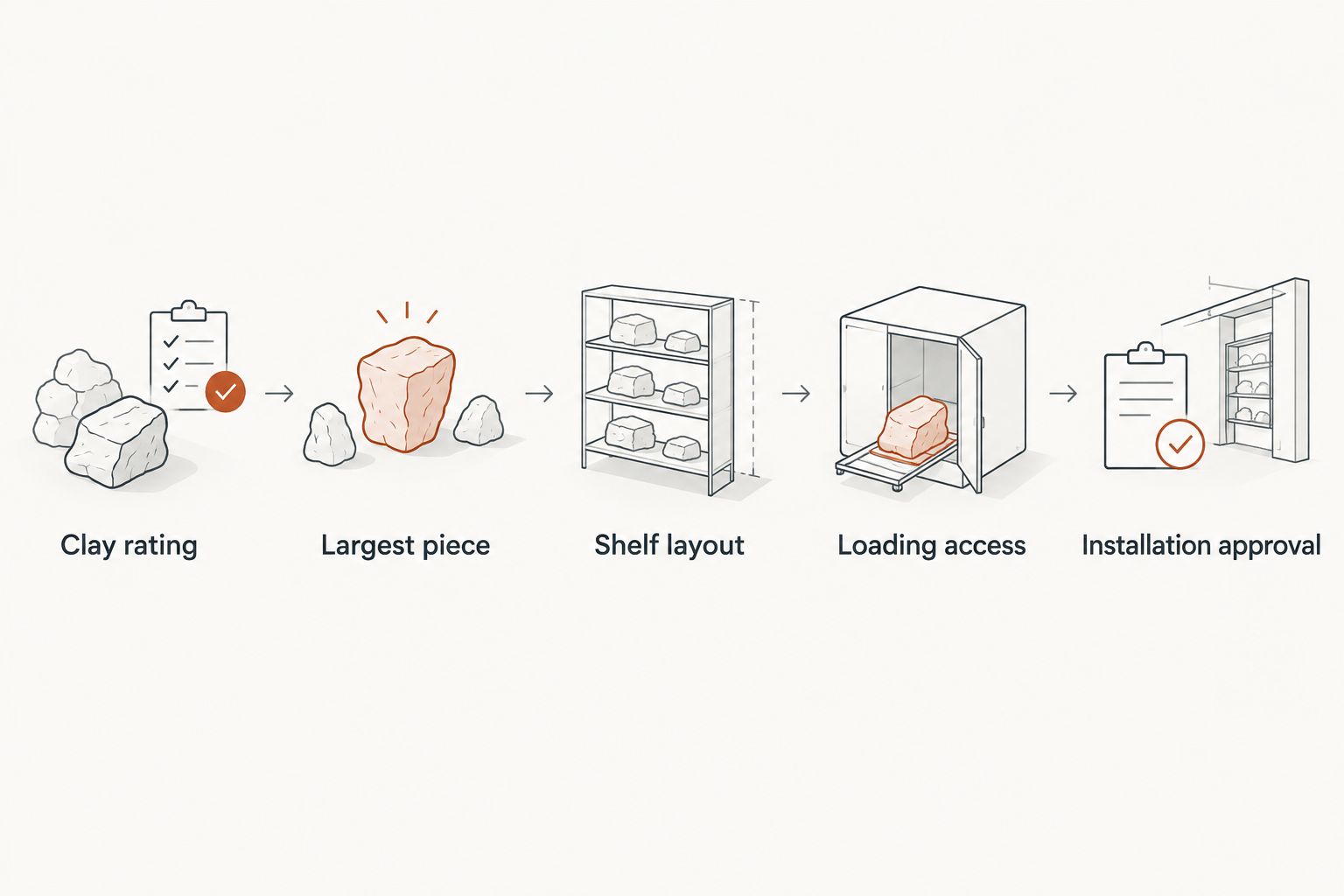
A paper shelf layout is useful, but a physical mock-up also exposes reach problems. Reproduce the planned shelf height without handling a hot kiln or entering an unsafe setup, and check access before purchase.
Choose Olympic Freedom 2823HE as the default for an equipped studio comparing these four models. Verify its usable chamber and repair-kit contents before making the decision final.
Choose Olympic 3031HE when documented width and depth drive the purchase. Choose Olympic TopHat 2827E when lift-off access solves your loading problem. Choose Olympic FL42E Car Kiln when rolling-cart production is already part of your operating plan.
For a first home studio in 2026, do not force a choice from this large-kiln shortlist. Ask for a smaller ceramic kiln assessment using your firing range, typical load, room, and available power.
What's the best electric kiln for a pottery studio in 2026?
Olympic Freedom 2823HE is the default among these four large studio options when its chamber and installation requirements fit your work. Its stated specifications include 240V, 48A, a Cone 10 maximum rating, and a repair-kit package.
Which electric pottery kiln is best for wide pieces?
Olympic 3031HE is the wide, deep-load choice in this comparison. Its stated interior measures 42 inches wide, 30 inches front-to-back, and 33.5 inches deep; confirm shelf dimensions and operating clearance before ordering.
Is the Olympic TopHat 2827E better than a conventional loading design?
Olympic TopHat 2827E is the better fit when its lift-off loading arrangement solves your access problem. Confirm lifting clearance and operating requirements rather than choosing it for a temperature advantage.
Can these pottery kilns run on a standard household outlet?
These four listed configurations require 240V, not a standard 120V household outlet. Have a licensed electrician assess the exact kiln documentation and building service before purchase.
Does a Cone 10 rating mean I should fire all pottery to Cone 10?
No, your clay and glaze specifications determine the firing target. A kiln's maximum rating does not make every clay body or glaze suitable for that firing range.
Is a glass kiln a substitute for an electric pottery kiln?
A glass kiln is not an automatic substitute for a pottery kiln. Confirm ceramic firing suitability, temperature rating, loading arrangement, and manufacturer instructions for the clay process you intend to use.
What should I confirm before ordering an electric pottery kiln?
Confirm material compatibility, usable shelf space, electrical configuration, ventilation, loading access, and delivery arrangements. Also verify controller details, included accessories, and manufacturer warranty terms for the exact configuration.
The piece that fits the chamber does not necessarily fit the loading path. Check handles, shelf placement, door or chamber movement, and your own reach before ordering. A practical loading demonstration can eliminate the wrong kiln before installation begins.
{"one"=>"Select 2 or 3 items to compare", "other"=>"{{ count }} of 3 items selected"}