


Best overall for beginner fusing: a programmable glass-fusing kiln, with the Paragon FiberFuse 16 as a model to evaluate. Best for mixed-media work: the Paragon Caldera XL. Skip a pottery-first kiln for glass-only projects. Start with your glass layout, available power, and installation space; ProKilnSupply provides expert phone/text support and delivery guidance to help check the fit before ordering.
A beginner glass artist needs controlled heating and cooling, not simply a chamber that gets hot. Fusing joins compatible glass through heat; annealing and controlled cooling address stresses that develop as the work cools.
For your 2026 purchase, start with what you intend to make repeatedly. Pendants, coaster layouts, and slumped bowls place different demands on shelf area and vertical clearance. A kiln that accommodates the flat blank does not necessarily accommodate its slumping mold.
Buy for the complete project, including its support and mold—not just the cut glass. Then confirm electrical requirements and the manufacturer's installation instructions before choosing a model.
Use these criteria to judge any candidate before treating a model name as a recommendation:
A higher maximum temperature does not replace any of these checks. Likewise, a compact exterior does not prove that a kiln suits a countertop or a normal household circuit.
This 2026 shortlist separates dedicated fusing, mixed-media work, and pottery-first use. The order reflects those applications—not a measured comparison of firing performance.
| Item | Best for | Standout feature or purpose | Key limitation |
|---|---|---|---|
| Paragon FiberFuse 16 Glass Fusing Kiln | Dedicated beginner glass-fusing shortlist | Explicitly identified as a glass-fusing kiln | Confirm shelf dimensions, controller, and electrical configuration before choosing |
| Paragon Caldera XL Dual-Media Multipurpose Kiln | Beginners planning mixed-media work | Dual-media purpose with expanded vertical capacity and modular design | Extra vertical capacity does not establish usable flat-glass shelf area |
| Olympic 1414HE Test Kiln | Pottery-first artists evaluating occasional glass work | Ceramic test kiln rated to cone 10 | High-temperature capability alone does not establish suitability for your glass process |
The Paragon FiberFuse 16 is identified as a glass-fusing kiln, making it the application-matched starting point in this comparison. Evaluate it first when your plan centers on fused glass rather than pottery or heat treating.
The next decision is configuration. Confirm the actual shelf dimensions, included controller, electrical requirements, and loading instructions; do not interpret the number in the model name as a guaranteed project dimension.
Paragon FiberFuse 16 pros:
Paragon FiberFuse 16 cons and checks:
Best for: A beginner whose primary application is fused glass and who wants a dedicated-glass candidate to assess first.
Before ordering, send your largest intended layout and mold dimensions to the retailer. Ask for confirmation against the recommended shelf and loading clearances, not just the chamber measurements.
Verdict: Hold until shelf fit, firing control, and power requirements are confirmed; then choose it if those checks match your glass-only plan.
The Paragon Caldera XL Dual-Media Multipurpose Kiln is described as a dual-media kiln with expanded vertical capacity and modular design. That makes it a different purchasing proposition from a dedicated glass-fusing model.
Consider the Caldera XL when your studio plan includes more than flat glass. Identify each intended process first, then confirm that the exact configuration supports it; “multipurpose” is not permission to fire any material.
Paragon Caldera XL pros:
Paragon Caldera XL cons and checks:
Best for: An artist with a defined mixed-media plan, rather than a vague intention to try everything later.
Ask ProKilnSupply to check each intended application separately. Include the shelf, supports, and mold in that discussion so the chamber is evaluated as a working system.
Verdict: Hold for a confirmed mixed-media fit; skip it as an automatic upgrade if your work is exclusively flat glass.
The Olympic 1414HE is a ceramic test kiln, not the default recommendation for a beginner buying only for fused glass. Its listed specifications include 240- or 208-volt configurations, inside dimensions of 14.5 inches wide by 13.5 inches deep, and a cone 10 rating of 2350°F/1260°C.
Those specifications establish its ceramic firing capability. They do not establish the correct shelf layout, heating arrangement, controller setup, or firing schedule for your glass project.
Olympic 1414HE pros:
Olympic 1414HE cons and checks:
Best for: A pottery-first artist who also wants to investigate occasional glass work with manufacturer guidance.
If your 2026 studio plan is glass-only, remove unnecessary ceramic temperature capability from your decision criteria. Put shelf access, programmable cooling, and glass-process suitability ahead of the hottest specification.
Verdict: Skip for a glass-only first purchase; hold for manufacturer-confirmed mixed use if pottery is your main application.
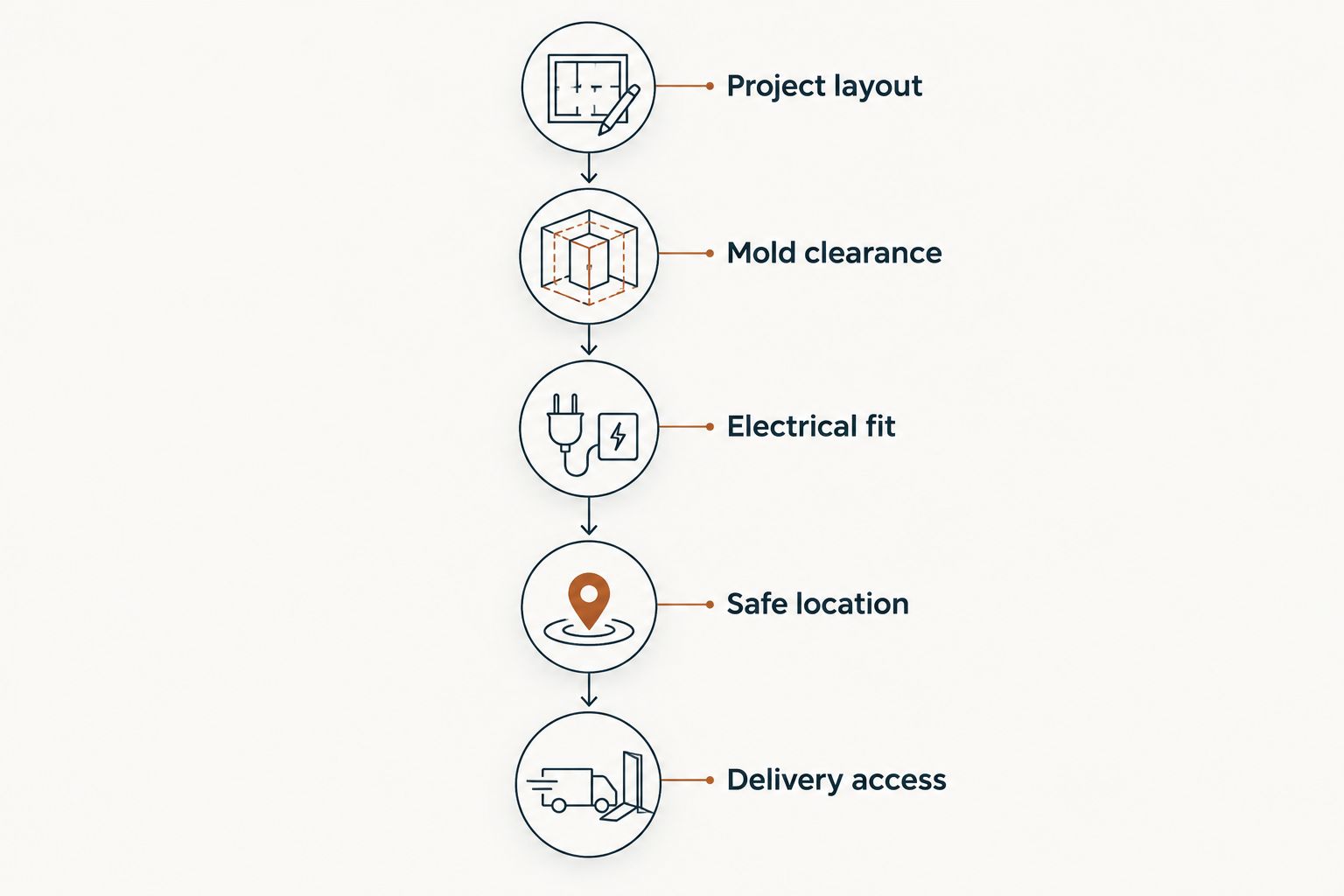
A small kiln still needs a suitable installation. Work through these checks in order so you do not choose a model around an outlet or shelf that cannot support the intended setup.
Make a full-size paper template of your largest planned glass blank. Arrange templates for the smaller pieces you expect to fire together, using the spacing required by the relevant instructions.
Compare that layout with the recommended shelf—not the outside dimensions of the kiln. Avoid promising yourself a particular batch size until the layout fits on paper.
If slumping is part of your plan, measure the mold as well as the glass. Include shelf thickness and supports when checking the loading arrangement.
A chamber that accepts a flat blank is not automatically suitable for the mold used in the next firing. Check both stages before committing to the kiln.
Give a qualified electrician the specification sheet for the exact kiln configuration. Ask the electrician to confirm supply voltage, circuit requirements, receptacle compatibility, and applicable installation requirements.
Do not treat 120 volts as proof of plug-anywhere convenience or assume a 240-volt receptacle is suitable because its shape looks familiar. The complete electrical requirements determine the installation.
Follow the kiln manufacturer's requirements for the supporting surface, clearances, ventilation, and operating environment. Keep the loading area accessible without turning the hot kiln into a traffic obstacle.
For a school or shared studio, identify who is permitted to program, start, inspect, and unload the kiln. A written operating procedure matters even when the equipment is small.
Measure the route to the installation location, including doors and turns. Establish how the kiln will move from the delivery point to its final position before arranging delivery.
Ask ProKilnSupply about delivery guidance and qualifying freight shipping. Confirm the applicable manufacturer warranty, price-match terms, and financing eligibility separately from the technical fit.
For your 2026 small glass kiln purchase, ask how the controller handles heating rates, holds, annealing, and controlled cooling. Request the operating instructions before ordering and check whether you understand how to enter and review a schedule.
Use firing guidance from the glass manufacturer for the specific glass, thickness, and process. A schedule for a thin fused piece is not automatically suitable for thicker work or a different glass system.
Do not copy a firing schedule solely because the example looks like your project. Record the glass used, layup, schedule, and result so later adjustments have a clear reference.
Cooling also affects when you can unload and begin another firing. Plan your work around the complete cycle rather than the time taken to reach the top temperature, and follow the manufacturer's unloading guidance.
The ranking puts application fit first: dedicated glass fusing, defined mixed-media work, then pottery-first use. Shelf fit, controller suitability, electrical compatibility, loading access, and support remain the purchase gates for every candidate.
This is an application-based shortlist, not a claim that one kiln heats faster, fires more evenly, or lasts longer than another. A model moves from shortlist to purchase only after its exact configuration passes your project and installation checks.
For a glass-only beginner, start with a dedicated programmable glass-fusing kiln and evaluate the Paragon FiberFuse 16 first. Choose the Paragon Caldera XL only when its mixed-media purpose matches work you actually intend to make.
Do not choose the Olympic 1414HE merely because its temperature rating exceeds what your glass project needs. Its strongest stated application in this comparison is ceramic testing.
ProKilnSupply is best for small glass kiln buyers who need expert fit guidance before ordering. Bring your project dimensions, mold dimensions, electrical information, and installation details to that conversation.
What's the best small glass kiln for a beginner in 2026?
A dedicated programmable glass-fusing kiln is the best starting category for a glass-only beginner. Evaluate the Paragon FiberFuse 16 against your shelf layout, mold clearance, electrical supply, and controller requirements before ordering.
Is the Paragon Caldera XL better for beginners than a dedicated glass kiln?
The Paragon Caldera XL is the better candidate when you have a defined mixed-media plan. Its dual-media purpose, expanded vertical capacity, and modular design do not automatically make it a better fit for flat-glass-only work.
Can I use a pottery kiln to fuse glass?
A pottery kiln requires confirmation of glass-process suitability before you use it for fusing. Check the heating arrangement, controller, shelf setup, and firing guidance with the kiln manufacturer; maximum temperature alone is not enough.
Can a small glass kiln run on a regular household outlet?
Only a kiln whose complete electrical requirements match that circuit and receptacle belongs on that outlet. Have a qualified electrician check the exact model configuration rather than relying on its compact size.
What size glass kiln do I need for coasters and pendants?
Choose the kiln around the usable shelf layout for your intended pieces. Make full-size templates and include the spacing required by the kiln and glass instructions before deciding on capacity.
Do I need a taller kiln for glass slumping?
You need enough usable clearance for the mold, glass, shelf, and supports. Check the complete loading arrangement; fitting the flat glass blank does not establish that the slumping setup fits.
Does a programmable controller make glass firing automatic?
A programmable controller follows the schedule you enter; it does not establish that the schedule is correct for your glass. Use material-specific guidance, check the program before starting, and follow the kiln manufacturer's operating instructions.
Check the mold before you choose the kiln. Beginners often plan around the flat fused piece, but the later slumping setup changes the required clearance. Put the blank, mold, shelf, and supports on your buying checklist now—not after your first successful fuse.
{"one"=>"Select 2 or 3 items to compare", "other"=>"{{ count }} of 3 items selected"}