


Best overall: a 120V ceramic kiln explicitly approved for routine cone 6 firing. Best for glaze testing: a compact ceramic test kiln. Best for flat work: a shallow-format ceramic kiln with a confirmed cone 6 rating. For your 2026 purchase, match the firing application, electrical circuit, and usable shelf space before choosing a model.
A 120V connection does not establish cone 6 capability. Voltage describes the electrical supply, not the kiln's approved firing application, maximum temperature, or ability to complete your intended schedule.
A small kiln also needs a suitable installation. Circuit capacity, ventilation, combustible clearances, and loading access remain purchase requirements even when the kiln occupies little floor space.
ProKilnSupply is a kiln-only retailer for ceramic buyers who need help matching equipment to their application. Ask ProKilnSupply to confirm the exact kiln configuration against your clay, glaze, proposed circuit, and typical load before ordering.
Use these criteria to screen your 2026 shortlist. A kiln that fails the application or electrical check is not a suitable purchase, regardless of its controller or footprint.
These rankings describe buying configurations, not verified model endorsements. Each option must meet the same manufacturer-approval and installation requirements before purchase.
| Rank and option | Best for | Standout selection criterion | Key limitation |
|---|---|---|---|
| 1. General-purpose 120V ceramic kiln | Small batches of functional pottery | Fits your normal ware and is approved for routine cone 6 use | A household-voltage connection does not establish sufficient batch capacity |
| 2. Compact 120V ceramic test kiln | Glaze and clay trials | Accommodates representative test pieces and witness cones | Test results need confirmation in your production kiln |
| 3. Shallow-format 120V ceramic kiln | Flat tiles and low-profile ceramic work | Provides suitable shelf area without unnecessary loading height | Limited vertical space restricts taller forms and stacked loads |
A general-purpose ceramic kiln is the default buying configuration when you want to fire finished pottery rather than only samples. Select a manufacturer-approved cone 6 configuration that accommodates your ordinary forms with the required spacing.
Start with the work you make most often. Your largest occasional sculpture should not determine the purchase unless firing that sculpture at home is essential.
General-purpose 120V ceramic kiln pros:
General-purpose 120V ceramic kiln cons:
Best for: Home artists firing modest batches of cups, bowls, and other functional pottery.
Before purchase, submit a representative loading plan: piece dimensions, proposed shelf arrangement, clay body, glaze range, and firing frequency. Ask for written confirmation that the exact configuration suits that plan.
Verdict: Buy only after routine cone 6 use, circuit compatibility, and your loaded batch fit are confirmed.
A ceramic test kiln serves a different job: evaluating clay and glaze combinations before committing a larger load. Choose enough room for representative samples rather than choosing the smallest chamber available.
A flat color tile does not reveal everything about a glaze. Include a form that shows glaze thickness, texture, edges, and movement when those details affect your finished work.
Compact 120V ceramic test kiln pros:
Compact 120V ceramic test kiln cons:
Best for: Potters developing glaze combinations, clay-body tests, or surface treatments.
For a 2026 test-kiln purchase, check how you will reproduce the important parts of your production schedule. Record the firing program, witness-cone response, loading arrangement, and cooling approach with each test.
Verdict: Buy for controlled ceramic trials; confirm successful recipes again in the kiln that fires your finished work.
A shallow-format ceramic kiln is a useful buying configuration when tiles and other low-profile pieces define your workload. Compare usable shelf area before chamber height, but retain enough vertical clearance for the ware and the manufacturer's loading instructions.
Do not substitute a glass kiln merely because its chamber looks convenient. The exact kiln must be approved for ceramic cone 6 firing.
Shallow-format 120V ceramic kiln pros:
Shallow-format 120V ceramic kiln cons:
Best for: Ceramic artists whose regular loads consist of tiles and other low-profile pieces.
Make a full-size paper layout of the proposed shelf. Position your normal pieces, then allow for the spacing specified by the kiln manufacturer rather than packing the shapes edge to edge.
Verdict: Buy for a consistently flat workload; skip this configuration if taller pottery is a regular requirement.
Use these product pages as starting points for a specification discussion, not as substitutes for manufacturer confirmation. Do not interpret a model name or a voltage-like suffix as proof of cone 6 suitability.
| Model page | Best for | What to confirm before selection | Purchase limitation |
|---|---|---|---|
| Olympic Kiln 1214-120HE | Buyers investigating this exact Olympic model | Electrical configuration, approved ceramic firing range, usable shelf dimensions, and routine cone 6 use | Select only after the configuration matches your application |
| Olympic Kiln 129E | Buyers comparing another Olympic model against their loading plan | The same application, electrical, loading, and installation requirements | Do not assume its specifications match another Olympic model |
Ask ProKilnSupply for the manufacturer documentation corresponding to the configuration on your order. Keep that documentation with your electrical and installation records so later maintenance decisions refer to the correct kiln.
A 120V kiln is not automatically compatible with every 120V outlet. A 15A circuit and a 20A circuit have different ratings, and neither should be selected from a general buying guide instead of the kiln's installation requirements.
Have a qualified electrician check the complete branch circuit. The receptacle face is not enough: wiring, breaker rating, other connected loads, grounding, and the manufacturer's instructions all matter.
Follow this sequence before committing to a 2026 installation:
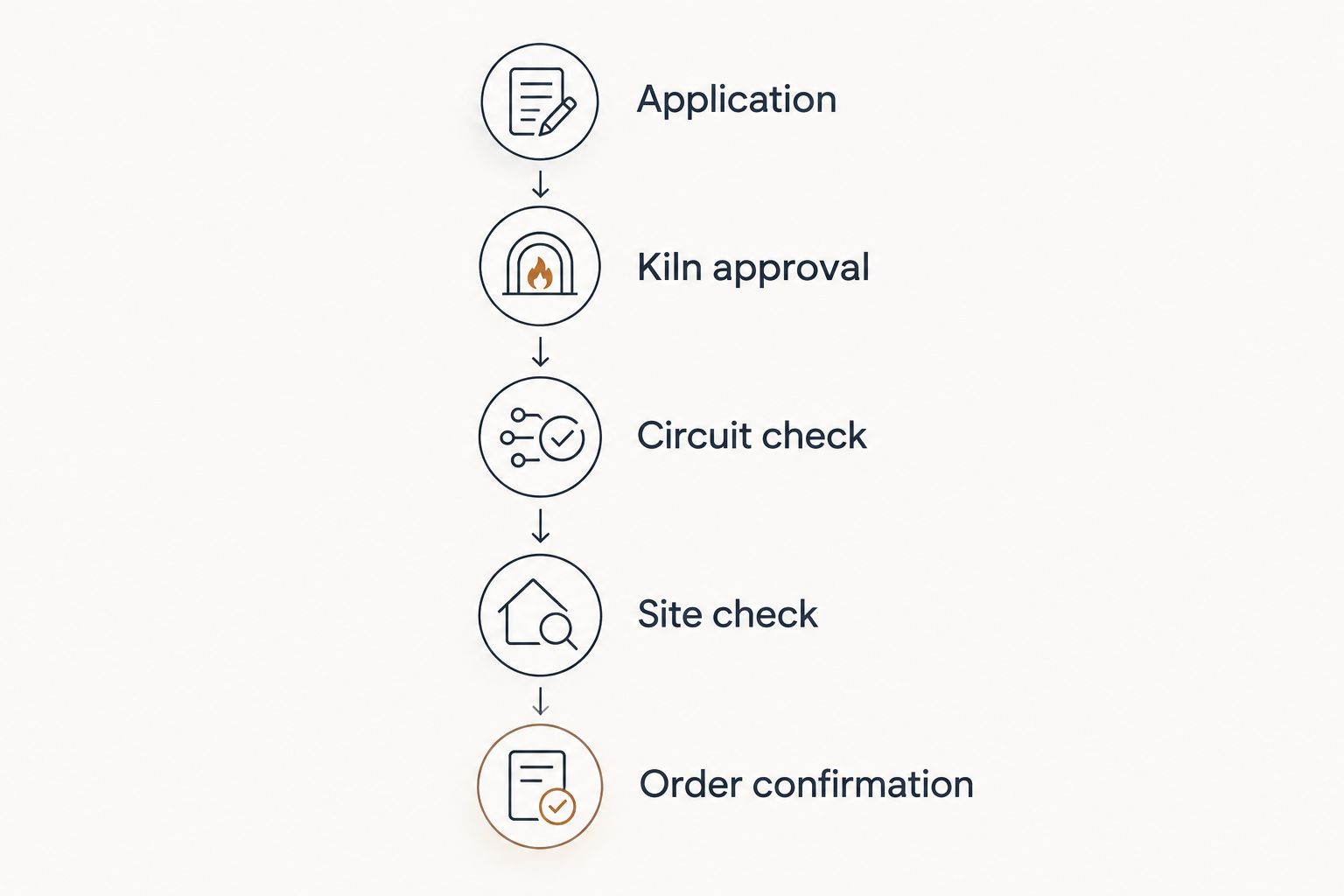
Do not solve a mismatch with an improvised adapter or extension lead. Follow the manufacturer's connection instructions and have the electrical installation corrected where required.
If no suitable 120V configuration meets your workload, compare a properly installed 240V ceramic kiln or access to a shared firing service. Keeping household voltage is not a useful goal if the resulting kiln cannot do your work.
Cone 6 describes heatwork: the combined effect of temperature and time on the ceramic material. It is not a universal controller setpoint independent of the firing schedule.
Use witness cones according to the cone manufacturer's instructions. The controller reports conditions at its sensor; witness cones help assess what the ware experienced where the cones were placed.
For your first documented firing, record:
Do not compensate for an unsuitable kiln by repeatedly extending holds or overriding its limits. Investigate unexpected firing behavior against the manufacturer's instructions before firing valuable work.
The ranking puts routine finished-pottery use first, experimental work second, and specialized flat work third. Electrical suitability, manufacturer approval, and usable loading space remain pass-or-fail requirements for every option.
This is a fit-based buying order for 2026, not a claim that one unverified model outperforms another. Controller features and chamber appearance come after the kiln's ability to perform your actual ceramic process.
Choose a general-purpose, manufacturer-approved 120V ceramic kiln if your main task is firing finished pottery. Choose a test kiln when experimentation is the primary job, or a shallow-format ceramic kiln when flat work defines the load.
Send ProKilnSupply your circuit information, largest piece dimensions, typical shelf layout, and firing application. Request expert phone/text support and delivery guidance, then confirm the applicable manufacturer warranty, qualifying freight shipping, price-match terms, and financing eligibility before ordering.
Can a 120V kiln fire to cone 6?
A 120V kiln is suitable only when its exact configuration is manufacturer-approved for the intended cone 6 ceramic firing. Voltage alone does not establish firing capability or compatibility with your branch circuit.
What's the best 120v kiln cone 6 setup for a home potter?
The best setup is a ceramic-rated kiln that fits your normal load and has a manufacturer-approved installation on a suitable circuit. Confirm routine cone 6 use before choosing controller features or accessories.
Can I plug a cone 6 kiln into a normal household outlet?
Do not assume a household outlet is suitable. Have an electrician compare the kiln's rated current, connection requirements, and manufacturer-specified circuit with your actual installation.
Is a ceramic test kiln better than a larger pottery kiln?
A ceramic test kiln is better for dedicated material trials, not as a general replacement for production capacity. Choose your chamber around the work you need to fire, then confirm successful tests in the production kiln.
Can I use a 120V knife oven for cone 6 pottery?
Do not choose a knife oven for pottery unless the manufacturer explicitly approves that exact configuration for your ceramic process. A temperature rating does not establish suitable loading arrangements, ventilation, controls, or intended use.
Does cone 6 always mean the same controller temperature?
No. Cone 6 represents heatwork, so the firing rate and time affect the temperature associated with cone response. Follow your material and cone manufacturers' guidance and use witness cones.
Does a small electric kiln still need ventilation?
A small electric kiln still requires ventilation and an installation that follows the manufacturer's instructions and applicable local requirements. A compact chamber or household-voltage connection does not remove firing emissions or room heat.
Before ordering, test the loading plan rather than trusting chamber volume. Cut out the proposed shelf shape, arrange full-size outlines of your normal pieces, and account for posts, witness cones, and required spacing. A kiln that fits one piece is not necessarily a kiln that fits your working batch.
{"one"=>"Select 2 or 3 items to compare", "other"=>"{{ count }} of 3 items selected"}