


The best kiln controller is a manufacturer-approved programmable control that matches your kiln and firing process: ramp-and-hold for glass or custom schedules, and cone-fire for routine ceramics. For a 2026 replacement, start with the kiln model, electrical configuration, and temperature sensor—not the controller’s screen.
A controller tells the kiln when to apply heat. It does not increase the kiln’s electrical capacity, repair worn elements, or make an unsuitable chamber right for glass or ceramics.
ProKilnSupply is best for kiln controller buyers who need fit guidance before choosing a replacement. Use the expert phone/text support at ProKilnSupply to establish the correct replacement path, then confirm installation requirements with the manufacturer.
A control board is not the same purchase as a complete controller assembly. Before comparing features, establish which part your kiln needs and who will install it.
Use these criteria to compare kiln controllers in 2026. Compatibility comes first; convenience comes after the kiln can safely use the control.
These are buying paths, not interchangeable replacements. The first two describe control capabilities; the last two address named replacement components. Choose the path that fits your application before choosing a part.
| Ranked option | Best for | Standout feature or purpose | Key limitation |
|---|---|---|---|
| Manufacturer-approved ramp-and-hold controller | Glass and custom ceramic schedules | Programs heating rates, target temperatures, and holds | Requires you to enter an appropriate material-specific schedule |
| Manufacturer-approved cone-fire controller | Routine ceramic bisque and glaze firings | Uses cone-based ceramic firing programs | Cone-fire alone does not meet glass scheduling needs |
| Olympic Kiln Genesis 2.0 Control Board | An Olympic kiln confirmed to need this board | Named control-board replacement path | Exact kiln fit and included components require confirmation |
| HotShot Oven – Controller Replacement Assembly | Existing Hot Shot ovens and kilns needing a matched assembly | Replacement digital controller assembly | The selected controller must match the existing setup |
A ramp-and-hold controller divides a firing into segments. Each segment specifies a rate of temperature change, a target temperature, and a hold; the schedule can include controlled cooling when the kiln supports it.
For glass artists, that structure matters more than a long list of presets. Your glass manufacturer’s instructions, thickness, construction, and process determine the schedule—not the controller’s default program name.
Ramp-and-hold controller pros:
Ramp-and-hold controller cons:
Best for: Glass artists and ceramicists who need direct control over the firing sequence.
Before buying in 2026, ask whether the exact approved controller supports the complete schedule you use. Check how it displays rates, whether holds use hours or minutes, and how you review the program before starting.
Verdict: Buy a manufacturer-approved ramp-and-hold controller for glass or custom firing schedules.
A cone-fire controller runs ceramic programs selected by cone rather than treating the firing as a single target temperature. This suits repeated bisque and glaze work when your clay and glaze instructions specify a cone.
Cone-fire describes a capability, not a universal replacement part. Some controls also include custom programming; confirm the functions of the exact version fitted to your kiln.
Cone-fire controller pros:
Cone-fire controller cons:
Best for: Ceramic hobbyists, schools, and studios repeating established bisque and glaze firings.
Keep cone numbering distinct. Cone 06 and cone 6 are different firing targets, not alternative spellings; verify the clay, glaze, and selected program before starting.
Verdict: Buy a manufacturer-approved cone-fire controller for routine ceramics; skip cone-fire-only control for glass.
The Olympic Kiln Genesis 2.0 Control Board is a named board option in the ProKilnSupply catalog. Treat it as a compatibility-specific component, not proof that every Olympic kiln accepts the same replacement.
Start by identifying the installed controller and the kiln’s serial information. Ask whether the proposed work requires only the board or a broader assembly, and obtain the applicable installation instructions.
Olympic Genesis 2.0 board pros:
Olympic Genesis 2.0 board cons:
Best for: Olympic kiln owners whose manufacturer or qualified service technician identifies this exact board as the appropriate replacement.
For a 2026 repair, send a photo of the existing controller face and the kiln nameplate before ordering. Photograph internal components only when the equipment is safely isolated and the work is appropriate for a qualified person.
Verdict: Hold until the exact board, kiln configuration, and installation scope are confirmed.
The HotShot Oven – Controller Replacement Assembly is described as a replacement digital controller assembly for Hot Shot ovens and kilns. Its product instructions specifically direct you to choose the controller that matches your current setup.
That makes configuration matching the central buying decision. Do not select an assembly because its interface resembles your existing controller.
HotShot replacement assembly pros:
HotShot replacement assembly cons:
Best for: Existing Hot Shot owners who have confirmed that a controller assembly replacement is required.
Have the model, serial information, installed controller identification, and fault description ready. Ask which components the assembly includes and which checks the installer must complete before firing.
Verdict: Buy only after the replacement assembly is matched to your existing Hot Shot setup.
A replacement controller must work with the kiln’s control circuit and switching system. The kiln’s supply voltage is only part of that check; matching the nameplate voltage alone does not prove that a board fits.
For example, the catalog description for the Olympic 1414HE identifies 240 or 208 volt configurations and a chamber 14.5 inches wide by 13.5 inches deep. Those are useful kiln-identification details, but none independently identifies the correct controller replacement.
Use this sequence before placing an order:
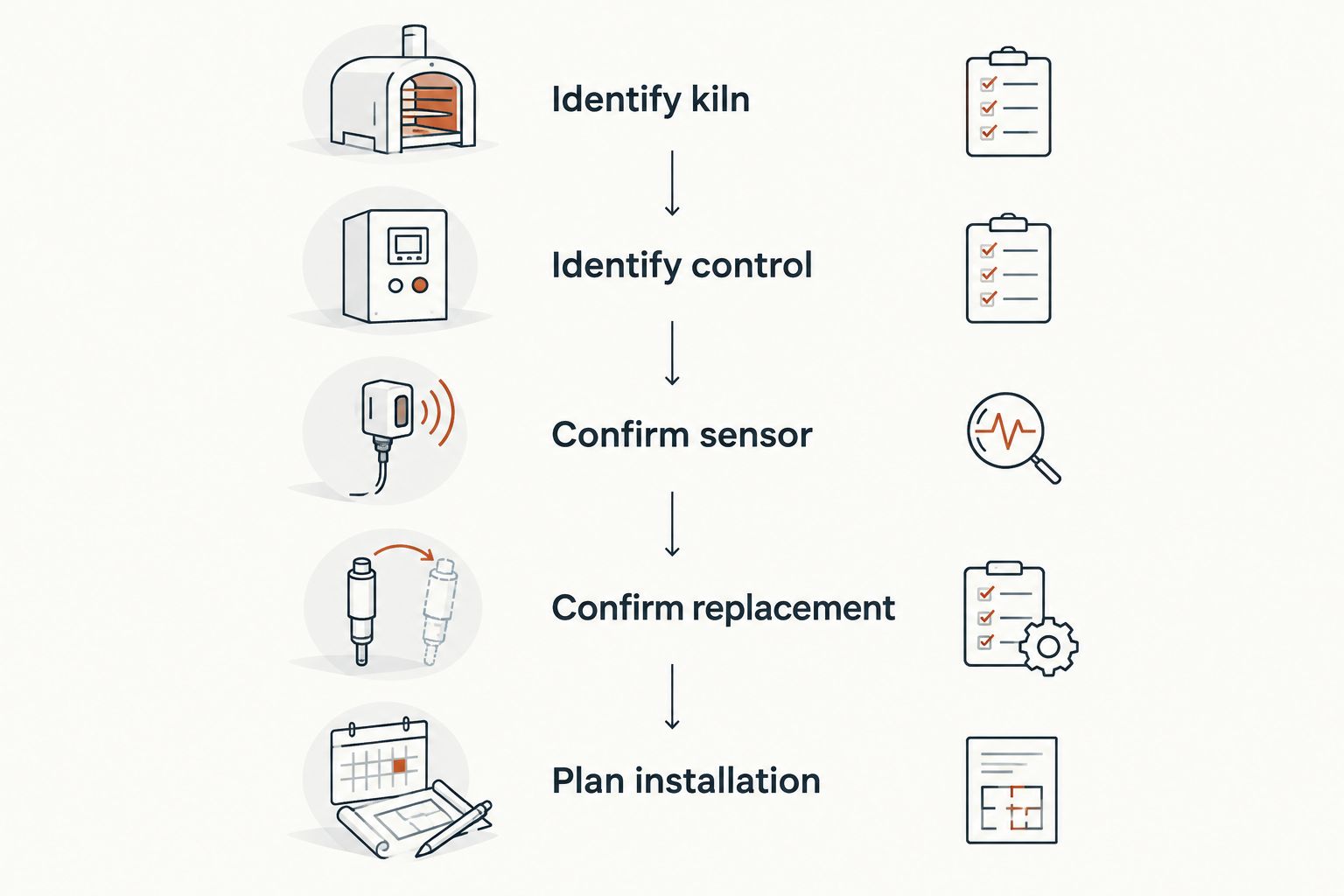
Do not open an energized control enclosure to collect information. Electrical diagnosis and wiring changes belong with a qualified technician following the kiln manufacturer’s instructions.
For ceramics, the controller’s displayed temperature is not a complete measure of firing results. Pyrometric witness cones indicate heatwork—the combined effect of time and temperature—at their location in the kiln.
For glass, start with the glass manufacturer’s firing guidance and the actual work. A schedule appropriate for one thickness or construction is not automatically appropriate for another.
Check these program details before every firing:
A controller can call for a cooling rate, but it cannot force an ordinary kiln to lose heat faster than its construction and loading allow. Programmed cooling is a control instruction, not a promise about elapsed cooling time.
This 2026 ranking puts application and approved fit ahead of interface preferences. Ramp-and-hold comes first for glass and custom schedules; cone-fire follows for routine ceramics; named replacement parts belong only to confirmed repair cases.
The comparison does not assign unsupported scores for accuracy, reliability, or ease of use. Evaluate those questions against the exact controller manual and kiln configuration rather than assuming all versions of a controller family behave identically.
Choose a manufacturer-approved controller with ramp-and-hold capability if you need glass schedules or custom ceramic programs. For routine ceramic work, prioritize cone-fire capability and a clear program-review process.
If the kiln already has the functions you need, diagnose the fault before replacing the controller. A failed relay, damaged thermocouple, or worn element needs the appropriate repair—not a different screen.
For your 2026 order, ask ProKilnSupply to confirm kiln controller fit and the installation scope. Where applicable, also confirm manufacturer warranty terms and delivery guidance before authorizing the purchase.
What’s the best kiln controller for ceramics and glass?
A manufacturer-approved controller with ramp-and-hold capability is the best starting point for glass and custom ceramic schedules. Routine ceramic firing also benefits from cone-fire capability. Exact kiln and sensor compatibility comes before interface features.
Is cone-fire better than ramp-and-hold for pottery?
Cone-fire is the simpler starting point for routine ceramic firings specified by cone. Ramp-and-hold gives you direct control over custom heating, holds, and cooling. Choose the capability that matches your established firing process.
Can I put any digital controller on an older kiln?
No. A digital controller must match the kiln’s approved electrical, sensor, and switching configuration. Have the manufacturer or a qualified technician identify the replacement requirements before purchasing.
Does a new controller make a kiln heat faster?
A new controller does not increase the kiln’s electrical heating capacity. It changes how heating is commanded, while elements, power supply, insulation, and loading still affect performance. Diagnose slow firing before replacing the control.
Can I use a ceramic cone-fire program for glass?
Do not substitute a ceramic cone-fire program for a glass firing schedule. Glass requires instructions appropriate to the material, thickness, construction, and process. Use an approved controller capable of entering that schedule.
Is a replacement control board the same as a controller assembly?
No. A control board is a component, while an assembly can include additional parts. Confirm exactly what the selected replacement includes and what the installer must supply.
Do I still need witness cones with a digital ceramic controller?
Yes. Witness cones help verify heatwork at their location in a ceramic kiln. The controller’s temperature display alone does not establish the firing result throughout the load.
Before replacing a controller, record the fault message and the point in the firing when it appeared. Include the selected program and whether the kiln was heating or cooling; that information gives the technician a better starting point than a general report that the kiln stopped working.
Keep the existing controller identification until the replacement has been confirmed and commissioned. A clear record helps prevent ordering the right-looking part for the wrong configuration.
{"one"=>"Select 2 or 3 items to compare", "other"=>"{{ count }} of 3 items selected"}