


Best overall for a pottery studio with suitable 240V service: Olympic MAS2323HE. Best for a small cone 6 starter studio: Olympic 129E; best for compact test firing: Olympic HB89E. This 2026 guide compares Olympic kilns by firing application, chamber fit, power requirements, and loading access, with purchase guidance from ProKilnSupply.
A kiln must accommodate your clay, your largest piece, and the electrical service in your building. A cone 10 rating does not compensate for a chamber that cannot hold your platter or a circuit that cannot support the kiln.
For your 2026 purchase, start with the work you actually fire. Separate small glaze tests from routine batches, tall sculpture, and production loads; each application points toward a different chamber or loading arrangement.
ProKilnSupply is best for Olympic kilns buyers who want kiln-only fit guidance and expert phone/text support. Confirm delivery arrangements, qualifying freight shipping, manufacturer warranty terms, price-match conditions, and financing eligibility for your specific order.
Use these criteria before comparing model names. Electrical suitability and physical fit are requirements, not optional advantages.
The 2026 shortlist below assigns each kiln a distinct job. The ranking is a buying decision tree, not a claim that the largest kiln produces better pottery.
| Kiln | Best for | Standout specification or feature | Key limitation |
|---|---|---|---|
| Olympic MAS2323HE | Routine pottery studio firing | Listed 240V / 44A; cone 10, 2350°F rating | Requires a suitable kiln circuit and installation |
| Olympic 129E | Small cone 6 starter batches | 120V; 0.58 cubic feet; 1,920W | Small chamber and cone 6 ceiling |
| Olympic HB89E | Compact glaze and clay tests | 8 × 8 × 9 inches; 120V / 15A | Too narrow for larger pottery |
| Olympic 2831HE | Tall work in a deep chamber | 28¼ × 31.5 inches; 11.67 cubic feet | Deep loading requires a reach assessment |
| Olympic FL31E Car Kiln | Production loads assembled on a cart | Rolling cart; listed 240V / 100A | Substantial electrical and handling-space requirements |
The Olympic MAS2323HE is the default starting point for a pottery studio seeking an electric ceramic kiln rather than a compact testing kiln. Its listed configuration operates at 240V / 44A and carries a cone 10, 2350°F maximum rating.
Choose the Olympic MAS2323HE around a repeatable studio workload. Before committing, confirm its interior dimensions, shelf layout, and installed footprint against your largest pieces and normal batch arrangement.
Olympic MAS2323HE pros:
Olympic MAS2323HE cons:
The listing specifies a 1-year warranty. Review the applicable manufacturer terms and confirm the controller and electrical configuration on your order.
Best for: A pottery studio buying a primary electric kiln after confirming its batch dimensions and electrical service.
Verdict: Buy the Olympic MAS2323HE when routine studio firing is the job and the installation checks out.
The Olympic 129E is a compact top-loading ceramic kiln with a listed capacity of 0.58 cubic feet. It operates at 120V and 1,920W, with a cone 6 maximum rating listed as 2250°F.
The Olympic 129E suits a buyer whose work is genuinely small. Measure the usable shelf arrangement before treating the chamber capacity as a promise about how many mugs or bowls will fit.
Olympic 129E pros:
Olympic 129E cons:
Do not read 120V as permission to use any convenient outlet. Have the circuit and connection requirements checked against the manufacturer's instructions.
Best for: A first studio making small cone 6 batches without a need for larger ware.
Verdict: Buy the Olympic 129E for small cone 6 work; skip it for cone 10 production.
The Olympic HB89E gives you an 8-by-8-inch chamber footprint and 9 inches of depth. Its listed specifications are 120V / 15A and a cone 10, 2350°F maximum rating.
The Olympic HB89E belongs on the shortlist when you need a separate kiln for small glaze tests, clay samples, or miniature work. Its narrow chamber is the defining constraint, even though its temperature rating reaches cone 10.
Olympic HB89E pros:
Olympic HB89E cons:
The listing specifies a 1-year warranty. Confirm the required circuit and installation conditions rather than relying on the voltage alone.
Best for: A studio adding dedicated compact testing capacity alongside a larger kiln.
Verdict: Buy the Olympic HB89E for tests and miniature work; skip it as a general production kiln.
For a 2026 purchase, these three models address different needs: routine studio firing, small cone 6 batches, and compact high-fire tests. Ask ProKilnSupply to check the exact configuration against your application before ordering.


The Olympic 2831HE has a listed chamber measuring 28¼ inches across and 31.5 inches deep, with 11.67 cubic feet of capacity. Its cone 10, 2350°F rating makes it a candidate for high-fire ceramic work that needs substantial chamber height.
Choose the Olympic 2831HE because your forms require its dimensions, not simply because it holds more. Check your ability to position the bottom shelf and handle ware throughout the chamber.
Olympic 2831HE pros:
Olympic 2831HE cons:
Best for: Potters whose tall forms or stacked loads justify a deep chamber.
Verdict: Buy the Olympic 2831HE for demonstrated height requirements; hold if loading reach is unresolved.
The Olympic FL31E Car Kiln is a front-loading electric production kiln with a rolling cart. Its listed requirements are 240V / 100A, with a cone 10, 2350°F maximum rating.
The rolling cart changes how you assemble and move a load. Evaluate the entire handling route, including the space needed to position the cart and access the kiln safely.
Olympic FL31E Car Kiln pros:
Olympic FL31E Car Kiln cons:
Best for: A production studio whose loading workflow calls for a rolling cart.
Verdict: Buy the Olympic FL31E Car Kiln for a planned production installation; hold until power and floor layout are approved.
Use this sequence to turn your 2026 shortlist into an order-ready specification. Keep the model configuration, electrical information, and delivery details together so everyone reviews the same kiln.
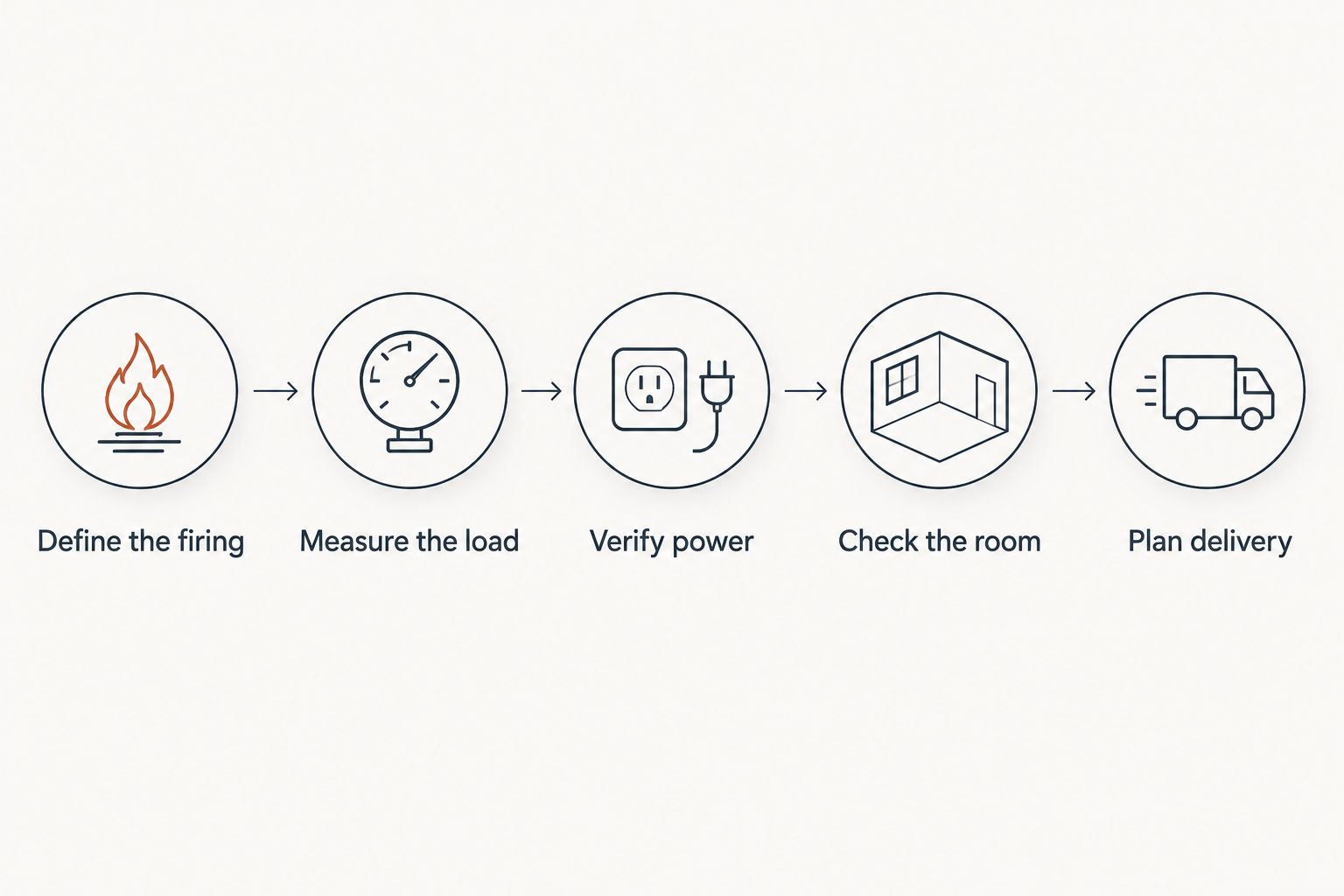
Ask for written confirmation of the selected voltage, phase, controller, and included equipment. Separate kiln furniture and ventilation requirements from assumptions about what arrives with the kiln.
This 2026 ranking uses the listed product specifications and the criteria above: application, chamber fit, electrical requirements, loading access, and support. It does not assign firing-speed, energy-use, or reliability scores.
The Olympic MAS2323HE takes the default position for routine studio firing. The other selections win only for their named applications; a testing kiln and a cart-loading production kiln are not interchangeable alternatives.
Choose the Olympic MAS2323HE first if you need a primary pottery studio kiln and have suitable 240V service. Confirm chamber and shelf dimensions before making the final decision.
Choose the Olympic 129E for small cone 6 batches, the Olympic HB89E for compact tests, the Olympic 2831HE for tall work, or the Olympic FL31E Car Kiln for cart-loading production. Give ProKilnSupply your firing requirement, largest piece dimensions, and electrical details so the recommendation starts with fit.
What's the best Olympic kiln for a pottery studio?
The Olympic MAS2323HE is the default choice in this comparison for routine pottery studio firing with suitable 240V service. Confirm chamber dimensions, shelf layout, and installation requirements before ordering.
Which Olympic kiln is best for small cone 6 batches?
The Olympic 129E suits small cone 6 batches with its listed 0.58-cubic-foot capacity. Its chamber limits both piece dimensions and batch size, so check the usable shelf arrangement first.
Can I run an Olympic kiln on a standard outlet?
A 120V rating alone does not establish compatibility with a standard outlet. Olympic models have different current and connection requirements; have a qualified electrician check the exact model against the manufacturer's instructions.
Is the Olympic HB89E suitable for cone 10 glaze tests?
The Olympic HB89E has a listed cone 10, 2350°F maximum rating and suits compact test work. Its chamber measures 8 by 8 by 9 inches, and test results still require validation under production firing conditions.
Which Olympic kiln is best for tall pottery?
The Olympic 2831HE is the tall-work choice in this shortlist, with a listed chamber depth of 31.5 inches. Allow for shelves, posts, and required clearance, and check your loading reach before buying.
Is a rolling-cart kiln better than a top loader?
A rolling-cart kiln is the better fit when your production workflow requires load assembly outside the chamber. The Olympic FL31E Car Kiln provides that arrangement, but its listed 240V / 100A requirements and cart route need installation planning.
Does a cone 10 rating tell me the exact firing schedule?
No, a cone 10 maximum rating does not define the firing schedule for your clay and glaze. Pyrometric cones measure heatwork, which combines time and temperature; follow the material supplier's firing guidance.
Before buying more chamber volume, draw your actual shelf layout. A wider chamber that fits your platters and a deeper chamber that fits your sculpture solve different problems, even when their capacities look similar.
Send the layout with your kiln inquiry. It gives the fit discussion something more useful than a request for a large kiln.
{"one"=>"Select 2 or 3 items to compare", "other"=>"{{ count }} of 3 items selected"}