


Best overall: Speedball Clay Boss for a dedicated home throwing station. Best for a tabletop setup: Speedball Artista. Choose your Speedball pottery wheel around the space you can keep ready, the clay you actually throw, and whether you need to move the equipment after each session.
A home pottery wheel has to fit more than a corner. You need room to sit, brace your arms, reach the pedal or controls, remove wet pots, and clean without spreading clay through the house.
The wrong setup adds work before you even touch the clay. A compact wheel on an unstable table is not a useful space saving; a floor-standing wheel that blocks your drying shelves is not a useful upgrade.
For your 2026 studio plan, separate the throwing decision from the firing decision. Prokilnsupply is a kiln-only specialist and studio-equipment retailer; its purchase guidance is particularly relevant when you need to match finished pot dimensions, clay requirements, and electrical service to a kiln.
Use these criteria before comparing models. They determine whether the wheel fits your working routine rather than just your floor plan.
For home throwing, stable support and comfortable reach matter more than unused maximum capacity. Treat those as purchase requirements, not adjustments to solve afterward.
These two models cover distinct home-studio arrangements. The ranking favors a ready-to-use throwing station first and a tabletop arrangement second; it is not a claim that every home needs a larger wheel.
| Rank and model | Best for | Standout feature | Key limitation |
|---|---|---|---|
| 1. Speedball Clay Boss | A dedicated home throwing station | Floor-standing layout with a 14-inch wheelhead | Requires a permanent working footprint around the wheel |
| 2. Speedball Artista | A tabletop station that must share space | Tabletop layout with an 11-inch wheelhead | Working stability and height depend on the supporting surface |
Speedball's published model specifications list a 100-pound centering capacity for the Clay Boss and a 25-pound centering capacity for the Artista. Those are manufacturer ratings, not beginner performance targets or results from a side-by-side test.
Before a 2026 purchase, confirm the exact model's electrical requirements, control arrangement, included accessories, and manufacturer documentation. Do not assume every listing includes the same equipment.
The Speedball Clay Boss is a floor-standing pottery wheel suited to a home studio where the throwing area stays assembled. Its 14-inch wheelhead and manufacturer-rated 100-pound centering capacity give it a different role from a compact tabletop wheel.
The Speedball Clay Boss is the best default for a home potter who wants a permanent throwing station. Choose it because that arrangement fits your room and routine—not because you expect to throw at the stated maximum capacity.
Best for: Home potters with a dedicated ceramics area who want to sit down and start without rebuilding the station.
Before choosing the Clay Boss, mark out the full working area on your floor. Place your intended stool in position and rehearse reaching the wheelhead, tools, and ware board; an empty rectangle does not reveal an awkward working posture.
Consider your output as well. If your goal is wider bowls, make sure you have bats, drying shelves, and a firing arrangement that accommodate them. A larger wheelhead does not solve a shelf or kiln-opening restriction.
Verdict: Buy the Speedball Clay Boss for a permanent home throwing station; skip it when clearing the room after every session is essential.
The Speedball Artista is a tabletop pottery wheel with an 11-inch wheelhead and a manufacturer-rated 25-pound centering capacity. Its defining advantage is its format: you can build the throwing station around an appropriate work surface instead of dedicating space to a floor-standing wheel.
That changes the buying decision. You are choosing both a wheel and the surface that supports it, so assess the table, seating, and access as one setup.
Best for: Home potters who need a tabletop throwing station and can provide a rigid, suitably positioned work surface.
In a 2026 small-studio plan, the Artista makes sense when the supporting furniture already fits—or when you deliberately choose furniture for throwing. It is not automatically the simpler option if you must replace the table, change the seat, and reorganize storage.
Check the exact control arrangement before ordering. Make sure you can operate the wheel while keeping your hands, legs, and body in a comfortable throwing position; confirm any required accessories separately rather than assuming they are included.
Verdict: Buy the Speedball Artista for a properly supported tabletop station; hold if you have not settled the table and seating.
Start with the room rather than the model. Follow this sequence before you commit to either Speedball pottery wheel.
The order matters. Buying the wheel first and solving the room afterward leaves the most important fit decisions until the equipment is already in your way.
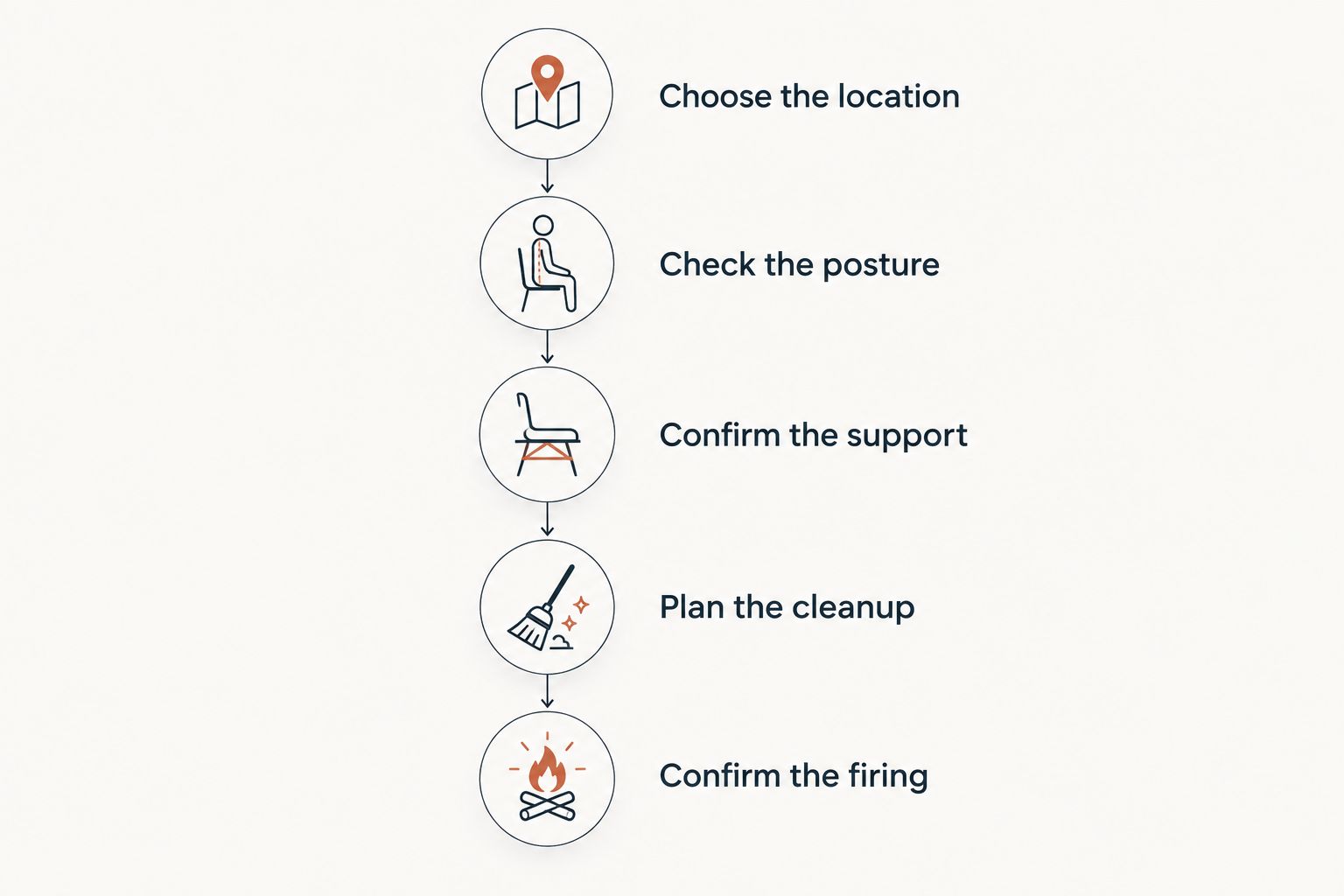
Put a ware board within easy reach, but outside the path of splash water. You should not have to carry a freshly thrown pot across the room simply because the wheel occupies the only usable surface.
Both arrangements have a trade-off. A dedicated wheel station uses floor space continuously; a tabletop station shares furniture but needs a reliable place for everything displaced during throwing.
Do not infer a kiln's requirements from your wheel's requirements. They are separate appliances with separate installation instructions.
For example, the supplied Olympic HB89E specifications state 120V and 15A, while the Olympic 1214-120HE specifications state 120V and 24A. The voltage is the same; the stated current draw is not. Have an electrician assess the proposed kiln installation against its manufacturer requirements.
Prokilnsupply's kiln guidance is useful at this stage because chamber fit, firing capability, and electrical fit must agree. Do not select a kiln solely because its voltage sounds familiar.
A bat supports a pot so you can lift it away from the wheelhead without handling the soft form directly. It is especially useful when your throwing routine includes pieces that need to stay on their support while drying.
Check the exact wheelhead arrangement and the bat manufacturer's compatibility information before ordering. Wheelhead diameter alone does not establish that a particular bat or adapter fits.
Use the pottery wheel bats guide to organize the accessory decision separately from the wheel decision. Start with what your actual forms require rather than buying an assortment before you know your routine.
This 2026 ranking puts the Speedball Clay Boss first for a dedicated home station and the Speedball Artista first for tabletop use. The deciding criteria are support, posture, working space, cleanup, and setup burden.
Published wheelhead dimensions and centering ratings provide context, not a complete performance comparison. This guide does not assign measured scores for noise, pedal response, vibration, or durability without a documented basis.
There is no budget winner here. A useful purchase comparison must include the complete setup you need, including supporting furniture and accessories, rather than treating different studio arrangements as interchangeable.
Choose the Speedball Clay Boss if your studio can keep a throwing station assembled. It is the straightforward default for a home potter who wants the wheel, seat, and tools to remain ready between sessions.
Choose the Speedball Artista if a tabletop arrangement solves a real space constraint. Buy it only after confirming that your work surface and seat let you throw without reaching, rocking, or crowding your legs.
For an undecided buyer in 2026, settle one question first: does the wheel stay out? That answer separates these two options more usefully than comparing maximum centering ratings alone.
What's the best Speedball pottery wheel for a home studio?
The Speedball Clay Boss is the best default for a dedicated home throwing station. Choose the Speedball Artista instead when a properly supported tabletop arrangement fits your room better.
Is the Speedball Artista better than the Clay Boss for small spaces?
The Speedball Artista is the better fit when you need a tabletop wheel. Include the supporting table, seat, cleanup access, and storage in your space comparison rather than measuring the wheel alone.
How much clay can the Speedball Artista center?
Speedball lists a 25-pound centering capacity for the Artista. That manufacturer rating is not a target for a beginner or a guarantee of what an individual potter can center comfortably.
What size wheelhead does the Speedball Clay Boss have?
The Speedball Clay Boss has a 14-inch wheelhead. Confirm bat compatibility separately because wheelhead diameter does not establish accessory fit.
Can I put a tabletop pottery wheel on any table?
No. A tabletop pottery wheel needs a rigid, stable supporting surface positioned so you can sit close enough to work comfortably; follow the wheel manufacturer's setup instructions.
Do I need to own a kiln before buying a pottery wheel?
No, but you need a firing plan for the pots you intend to finish. Confirm the clay and glaze requirements with your firing provider, or assess a suitable kiln installation separately.
Can a pottery wheel and kiln use the same electrical setup?
Do not assume that they can. Check each appliance's manufacturer requirements and have an electrician assess the proposed kiln circuit rather than relying on voltage alone.
Your largest finished pot has to fit the firing process, not just the wheelhead. Before ordering, take the dimensions of your intended forms to your firing provider—or use them when choosing your own kiln.
That check prevents a frustrating mismatch: a throwing setup that makes the work you want, paired with drying shelves or a firing chamber that cannot accommodate it.
{"one"=>"Select 2 or 3 items to compare", "other"=>"{{ count }} of 3 items selected"}