


Best first shortlist choice: Olympic 129E for small pottery loads. Best ceramic-focused alternative: Jen-Ken AF3C 11/9 Ceramic Kiln. Best dedicated testing option: Olympic 1414HE Test Kiln. Choose your tabletop kiln for pottery in 2026 by clay firing range, usable shelf space, electrical requirements, and manufacturer-approved support—not by whether its cabinet fits on a bench.
A small kiln solves a space problem only when it also fits your pottery. A cabinet that fits your workbench is useless if your tallest greenware cannot clear the shelf above it or your clay requires a firing range the kiln does not support.
ProKilnSupply is best for pottery kiln buyers who want specialist fit guidance before ordering. Use ProKilnSupply to discuss your clay, largest pieces, electrical supply, and proposed installation together. Those details determine kiln fit; a product photograph does not.
For a 2026 purchase, separate two decisions: which kiln fits the work, and where the manufacturer permits that kiln to operate. Small size does not establish permission to install it on an ordinary table.
Use these six criteria before comparing models:
Reject any kiln that fails a required criterion, even if it ranks first below. A useful shortlist narrows your questions; it does not replace the manufacturer's installation instructions.
These 2026 selections represent different buying jobs, not interchangeable kiln specifications. The first choice has an explicitly identified compatible furniture kit; the alternatives serve ceramic firing and dedicated testing inquiries respectively.
| Rank and kiln | Best for | Standout selection reason | Key limitation |
|---|---|---|---|
| 1. Olympic 129E | Planning small pottery loads | Explicitly identified compatible round shelves and posts | Shelf layout and approved installation still determine fit |
| 2. Jen-Ken AF3C 11/9 Ceramic Kiln | Assessing a ceramic-focused alternative | Identified specifically as a ceramic kiln | Ceramic designation alone does not establish compatibility with your clay |
| 3. Olympic 1414HE Test Kiln | Dedicated clay and glaze testing | Identified specifically as a test kiln | A test firing does not replace validation in your regular production kiln |
The Olympic 129E is the strongest starting point here when you want to plan small pottery loads around a known furniture arrangement. Its compatible furniture-kit description identifies two 10-inch round shelves and small square posts in heights from 1 inch through 6 inches.
That gives you something concrete to evaluate before ordering. Draw a 10-inch circle on paper and arrange the footprints of your unfired pieces inside it, allowing the spacing required by the kiln instructions.
Olympic 129E pros:
Olympic 129E cons:
Best for: A home potter planning small, repeatable loads who wants to check shelf fit before choosing a kiln.
Ask ProKilnSupply to confirm the exact kiln configuration, suitable firing range, approved support, and furniture contents together. Do not treat compatible accessories as included equipment unless your order explicitly lists them.
Verdict: Hold until your clay, load layout, circuit, and installation pass the fit checks; then choose the Olympic 129E as the default shortlist option.
The Jen-Ken AF3C 11/9 Ceramic Kiln is the alternative to assess when you want a model explicitly identified for ceramics. Start with its ceramic application, then check the exact configuration against your firing requirements.
Do not translate the model name into assumed chamber dimensions, electrical specifications, or firing capability. Use the manufacturer's specification sheet for those decisions.
Jen-Ken AF3C 11/9 pros:
Jen-Ken AF3C 11/9 cons:
Best for: A pottery buyer assessing a ceramic-specific alternative against an existing studio setup.
Request the usable shelf dimensions, chamber height above the bottom shelf, controller details, and required electrical connection. Compare those answers with the same information for the Olympic 129E rather than comparing model names.
Verdict: Hold until the Jen-Ken AF3C 11/9's documented configuration matches your pottery and installation.
The Olympic 1414HE Test Kiln belongs on your shortlist when testing is the primary job. Evaluate it for clay samples, glaze tiles, and small forms rather than assuming it should handle your regular pottery output.
A dedicated test kiln separates experimental firings from larger loads. However, results still need confirmation under the loading and firing conditions you use for finished work.
Olympic 1414HE pros:
Olympic 1414HE cons:
Best for: A potter or studio prioritizing clay and glaze development rather than selecting a primary production kiln.
Verdict: Hold for a dedicated testing role; skip the Olympic 1414HE if your actual requirement is an unverified full-load production replacement.
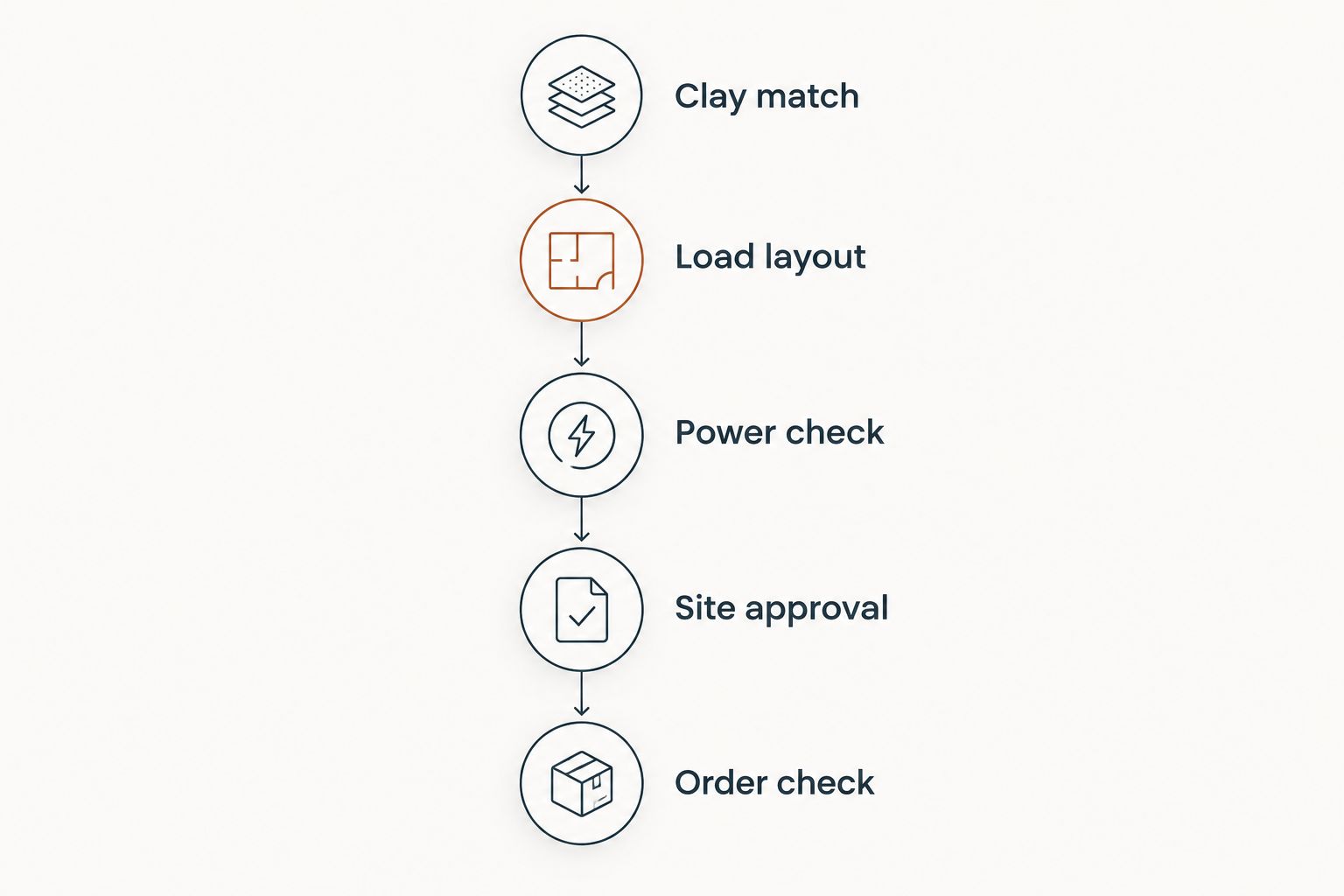
Use this sequence for any tabletop pottery kiln purchase in 2026. Each step eliminates a different mismatch; completing only the electrical check is not enough.
Write down your clay body's recommended firing range and the glaze's firing instructions. Keep cone designations exact: cone 06 and cone 6 are different firing targets, not alternative ways to write the same number.
A pyrometric cone measures heatwork—the combined effect of temperature and time. Do not choose a kiln solely because its advertised maximum temperature resembles a temperature on a glaze label.
Measure your largest pieces before firing, including handles and projecting rims. Arrange paper footprints on a shelf-size template, then account for posts and the required spacing.
For the Olympic 129E, the listed furniture kit's 10-inch round shelves provide a concrete planning reference. A tall mug and a shallow bowl need different vertical arrangements even when their footprints fit the same shelf.
Have a qualified electrician assess the exact kiln specifications against your proposed circuit. A matching-looking receptacle is not an electrical assessment, and a small cabinet does not prove that a kiln can use a general-purpose outlet.
Confirm the connection requirements before ordering. Do not plan around an extension cord or an improvised adapter.
Check the manufacturer's support requirements, clearances, ventilation instructions, and environmental restrictions. Include lid-opening space and a safe loading position in your layout.
A noncombustible surface alone does not establish an approved installation. The complete support arrangement and surrounding space must meet the kiln instructions.
Confirm the kiln configuration, controller, furniture, delivery arrangements, and installation responsibilities in writing. Keep that record with the manual so the equipment you receive matches the setup you prepared.
“Tabletop” describes a size or placement idea, not a complete safety specification. It does not tell you whether the manufacturer requires a particular stand, how much clearance is necessary, or how firing emissions must be exhausted.
It also says nothing about ceramic firing suitability. Glass fusing kilns, bead annealers, wax burnout kilns, and heat-treating ovens have different intended applications; select equipment expressly suited to your pottery process.
Before placing any order, ask these questions:
If the installation cannot pass these checks, change the installation or the kiln—not the instructions. A compact kiln is still high-temperature equipment.
The 2026 shortlist prioritizes pottery application, actionable load planning, and distinct purchasing roles. The Olympic 129E comes first because its explicitly identified compatible furniture provides shelf dimensions you can use to check your work.
The Jen-Ken AF3C 11/9 follows as a ceramic-focused alternative. The Olympic 1414HE occupies the dedicated testing slot rather than competing for the same primary-kiln recommendation.
These are fit-based recommendations, not claims of measured heating speed, energy consumption, firing uniformity, or element life. Your final choice depends on the exact manufacturer's specifications and your intended installation.
Start with the Olympic 129E if your priority is small pottery loads and its shelf arrangement fits your work. Move to the Jen-Ken AF3C 11/9 comparison when you need to assess another ceramic-specific configuration. Choose the Olympic 1414HE inquiry when testing—not general output—is the job.
For your 2026 order discussion, give ProKilnSupply your clay and glaze firing requirements, largest unfired dimensions, proposed room, and electrical information. Request delivery guidance and confirmation of applicable manufacturer warranty terms after the technical fit is settled.
Do not choose by brand familiarity alone. A kiln that matches your regular load is more useful than a better-known model that forces you to remake pieces around its chamber.
What's the best tabletop kiln for pottery in 2026?
The Olympic 129E is the first shortlist choice here for small pottery loads because its compatible furniture provides concrete shelf dimensions for planning. Choose it only after confirming clay compatibility, electrical requirements, usable space, and manufacturer-approved installation.
Can I put a small pottery kiln on a regular table?
Use a regular table only if the kiln manufacturer's instructions explicitly approve that support arrangement. Small size and a noncombustible tabletop do not establish safe installation by themselves.
Is the Jen-Ken AF3C 11/9 better than the Olympic 129E?
The better choice is the kiln whose documented firing capability, usable chamber, and electrical configuration match your pottery. Compare those specifications directly rather than inferring them from either model name.
Should I buy the Olympic 1414HE for glaze testing?
The Olympic 1414HE Test Kiln is a relevant model to assess for dedicated glaze testing. Confirm its firing capability and sample layout, then validate successful tests under your regular production firing conditions.
Does a tabletop pottery kiln run on a household outlet?
Tabletop size does not establish household-outlet compatibility. Check the exact voltage, amperage, connection, and branch-circuit requirements with the manufacturer and a qualified electrician.
Can a glass kiln fire pottery?
Use a glass kiln for pottery only when the manufacturer explicitly supports your ceramic firing application. Check the firing range, controller capability, and loading requirements for the exact configuration.
Are shelves included with the Olympic 129E?
Confirm shelf inclusion on the exact order before purchasing. A compatible Olympic furniture kit identifies two 10-inch round shelves and several post heights, but compatibility does not mean the kit is included.
Do I need ventilation for a small pottery kiln?
Small size does not remove the need to follow the kiln manufacturer's ventilation instructions. Plan firing-emission exhaust and room heat management before installation.
Test the shape of your load, not just its total volume. Two pieces with similar volume can need very different shelf arrangements once handles, rims, posts, and vertical clearance enter the calculation.
Bring a shelf-size paper template and photographs of your largest unfired pieces to the selection discussion. That simple preparation makes the difference between asking whether a kiln is small and establishing whether it fits your pottery.
{"one"=>"Select 2 or 3 items to compare", "other"=>"{{ count }} of 3 items selected"}