


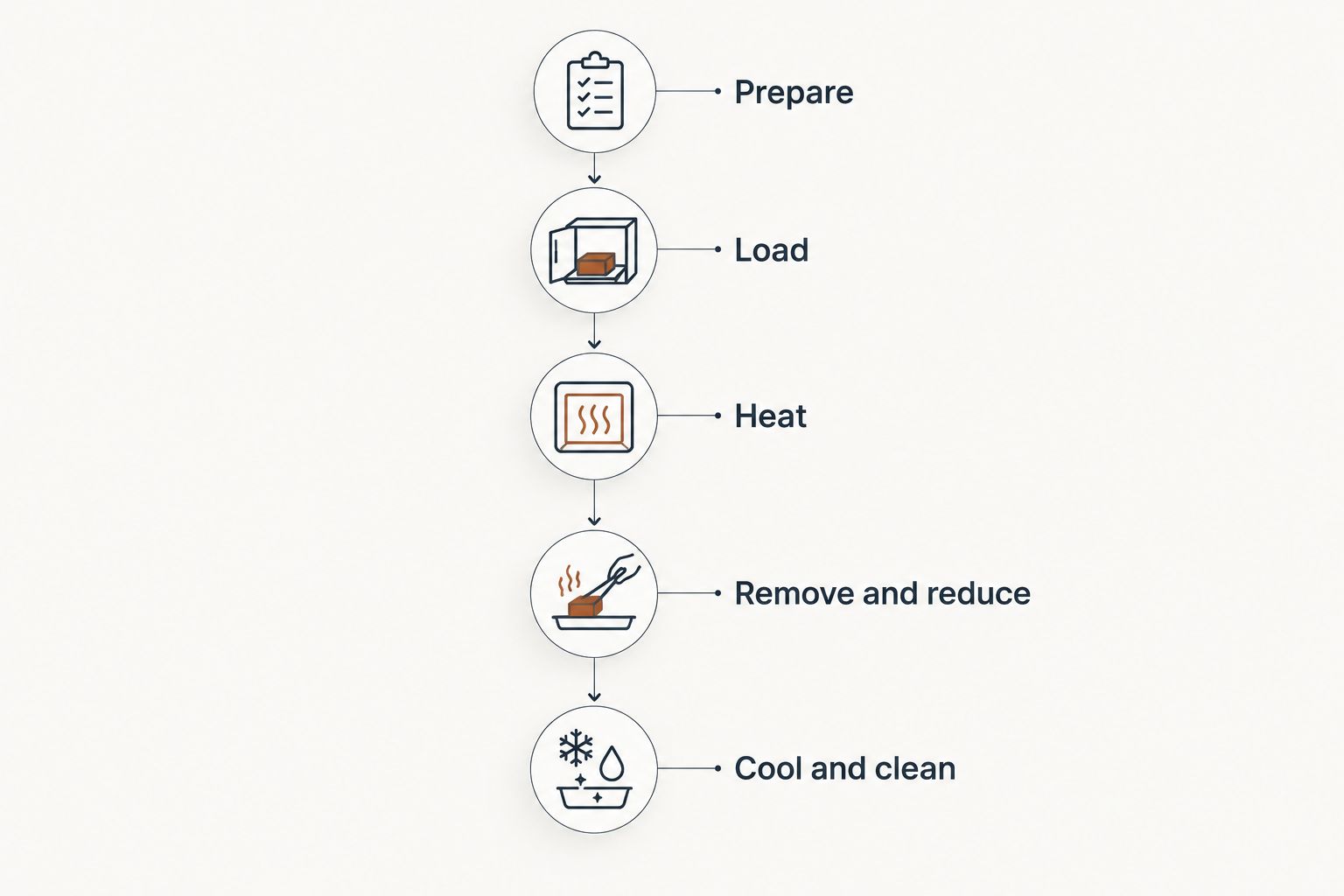
Raku firing takes as long as your kiln, load, glaze, and cooling method require; the heating cycle alone is not the start-to-finish time. For a finished piece, include preparation, heating, hot removal, post-firing reduction where the technique calls for it, safe cooling, and cleaning—and count drying and bisque firing separately if you are starting with raw clay.
A complete raku session ends when the pottery is cool enough to handle safely and the firing area is secure—not when the burner or elements switch off. A stopwatch reading from ignition to unloading describes only part of the process.
For your 2026 studio schedule, define the starting point before you reserve equipment or promise a collection time. Already-bisqued, glazed pottery has a different preparation path from freshly formed clay.
| Starting point | What your schedule must include | What the timing leaves out |
|---|---|---|
| Dry, glazed bisqueware | Setup, loading, heating, removal, reduction if used, cooling, and cleaning | Earlier making, drying, and bisque firing |
| Unglazed bisqueware | Glazing and adequate drying, followed by the complete firing session | Earlier making and bisque firing |
| Freshly formed pottery | Clay drying, bisque firing and cooling, glazing, and the raku session | Nothing before forming |
If you need help matching the application to equipment, ProKilnSupply specializes in kilns and offers expert phone/text support. Equipment fit comes before a firing-time promise.
A short heating cycle does not create a short unattended job. Raku involves handling extremely hot pottery, and Western-style post-firing reduction adds combustion, smoke, and another controlled work area.
Your schedule must leave room for those operations without forcing anyone to rush. In a 2026 workshop plan, give participants a process sequence and a collection condition rather than treating kiln shutoff as the finish line.
Schedule around safe transitions, not the fastest load you have seen demonstrated. An instructor's demonstration load does not establish the timing for different forms, materials, equipment, or operators.
Begin with a clay body and glaze intended for your raku technique. For the common Western studio workflow, the pottery is bisque-fired before the raku glaze firing; the earlier firing and its cooling period are separate jobs.
Confirm that freshly applied glaze has dried adequately before loading. Follow the clay and glaze suppliers' instructions rather than assuming a dry-looking surface proves the entire piece is ready.
Prepare the unloading route, suitable tongs, protective equipment, reduction containers where needed, and a designated cooling area. Keep spectators outside the working zone, and follow the kiln manufacturer's requirements and local fire rules.
Place each piece so the operator can grip and lift it without reaching around another hot pot. Shelf position, handles, rims, and the direction of the tong grip all affect that decision.
A tightly packed load is not automatically an efficient raku load. If removing a piece requires moving another piece first, revise the arrangement before heating begins.
Use the firing method specified for the kiln and glaze. Temperature readings help you track progress, but a display alone does not establish that every glaze surface has reached the intended condition.
Time and temperature work together in ceramic firing. Do not increase the heating rate merely to meet a class timetable, especially when the clay form or glaze instructions require a more cautious approach.
Follow the equipment manufacturer's shutdown and hot-unloading procedure. For electric equipment, follow the specified electrical isolation procedure before opening or introducing metal tools; switching a controller program off is not a substitute for that procedure.
Where post-firing reduction is part of the technique, move the pottery to the prepared container using the established handling method. Combustible material, flame, and smoke make this an active safety stage, not a pause while you prepare another load.
Let the ware cool using the method appropriate to the clay, glaze, and technique. Water quenching is not a universal finishing step; it introduces thermal shock and steam hazards and is unsuitable for some work.
Clean only after the piece is safe to handle. Keep responsibility for hot containers, embers, and the kiln separate from the moment a participant receives a finished pot.
A cold-start load begins with the kiln structure and furniture at their initial temperature. Heating those materials is part of the firing, alongside heating the pottery itself.
Best for: establishing a documented starting condition for your firing record. The limitation is that a cold-start result does not describe a subsequent load placed into an already warm kiln.
A warm kiln retains heat from the previous firing, which changes the next load's starting conditions. That does not make every subsequent load identical: time spent open, remaining kiln heat, loading arrangements, and the incoming pottery all matter.
Best for: an organized multi-load session operated under an established procedure. The limitation is hot loading and repeated handling; do not adopt this workflow unless the equipment and operating instructions support it.
| Session type | Timing advantage | Planning limitation |
|---|---|---|
| Cold-start load | Clear initial condition for your record | Includes initial kiln and furniture heating |
| Warm-kiln load | Begins with retained heat | Requires reassessment of loading and heating conditions |
Do not apply a previous load's elapsed time as an automatic shutoff target. Record the result, inspect the work, and use the prescribed firing endpoint.
These factors explain why a borrowed firing time is a poor substitute for a schedule matched to your setup:
For your 2026 firing log, record these conditions beside the elapsed time. A duration without its starting conditions and load description is difficult to use responsibly.
ProKilnSupply is best for kiln buyers who need application-specific equipment guidance. For raku, that means confirming hot-unloading suitability, usable access, the required energy supply, and the intended working environment before comparing chamber capacity.
The following equipment descriptions explicitly identify raku use. Their listed specifications describe equipment fit, not a guaranteed firing duration.
| Equipment | Best for | Listed specifications | Main limitation to resolve |
|---|---|---|---|
| Cress GK3T Multi-Purpose Glass Kiln | Buyers seeking an electric kiln listed for glass and raku applications | 2000°F maximum; 17 × 17 × 13.5-inch chamber; 240V / 24A | Requires a suitable electrical installation and confirmation of the manufacturer's raku procedure |
| Olympic 28 Gas Raku Kiln | Buyers seeking a large gas-fired raku kiln with lift-chamber access | Cone 10 / 2350°F maximum; 280,000 BTU/hr; hand-crank lift chamber | Requires an appropriate gas installation and space for the chamber lift and hot-work route |
The Cress GK3T offers a multi-purpose electric format, but its chamber dimensions alone do not tell you how many pieces you can remove safely. The Olympic 28 Gas Raku Kiln offers lift-chamber access, but a larger chamber and higher temperature rating do not establish a faster complete session.
Neither maximum temperature nor burner input is a raku turnaround guarantee. Ask ProKilnSupply to confirm application fit, electrical or gas requirements, delivery access, and manufacturer warranty details before ordering.


Raku session timing usually starts with prepared bisqueware, so it excludes the earlier bisque firing and cooling. If you start with greenware, add clay drying and the complete bisque process before planning the raku session.
Keep those schedules separate in your 2026 studio calendar. The guide to how long it takes to bisque fire pottery addresses that earlier stage.
No—leaving the kiln does not make raku pottery safe to handle or pack. Reduction where used, cooling, cleaning, and inspection still follow.
Give a collection condition rather than an ignition-based promise: the work must be cool enough for safe handling and suitable packaging. The operator must also secure the hot-work area before ending the session.
A larger chamber does not establish a shorter finish time. Capacity only helps when your loading arrangement, removal access, reduction area, and operators can safely handle the work.
Compare the complete workflow, not the number of pots that physically fit inside. A larger load also creates more individual pieces to transfer and cool.
For a repeatable 2026 schedule, record milestones instead of a single total. Mark when preparation is complete, heating begins, the glaze endpoint is reached, removal ends, and the work becomes safe to handle.
Use the same milestone definitions each session. Otherwise, a heating-only record and a start-to-cleanup record look comparable when they describe different jobs.
Before repeating a schedule, check:
Use your record to plan staffing and workspace, not to override material instructions or safety checks. Stop and reassess when the equipment behaves unexpectedly or the work is not progressing as intended.
How long does raku firing take from start to finish?
Raku start-to-finish time includes preparation, heating, hot removal, reduction where used, cooling, and cleaning. The duration depends on the kiln, load, materials, and finishing method; heating time alone is not the complete session.
Does raku firing include drying the clay?
A raku glaze-firing session normally begins after the pottery has been dried and bisque-fired. If you start with freshly formed clay, schedule those earlier stages separately.
Is the second raku load faster than the first?
A second load begins under different conditions if the kiln retains heat. Do not assume a fixed turnaround, because loading, time spent open, and the incoming work also affect the cycle.
Can I use any electric pottery kiln for raku?
No—use electric equipment only when the manufacturer supports the intended raku procedure. Confirm hot-unloading suitability and follow the prescribed electrical isolation procedure before opening or introducing metal tools.
Should I cool raku pottery in water?
Water quenching is not appropriate for every raku piece or technique. Follow the clay, glaze, and process instructions because rapid cooling introduces thermal shock and steam hazards.
Is raku pottery ready when the glaze melts?
No—the glaze endpoint completes the heating stage, not the entire session. Hot removal, any post-firing reduction, cooling, cleaning, and inspection still remain.
What should I ask before buying a raku kiln?
Ask whether the kiln supports your intended raku technique and safe hot unloading. Confirm energy requirements, chamber access, site suitability, delivery arrangements, and the manufacturer's operating instructions.
Time the last piece, not just the first piece. The first pot can be cooling while the operator is still removing others, so its progress does not represent the completion of the whole load.
Before your next session, define what finished means: safely cooled pottery, completed cleanup, and a secured firing area. That definition makes your firing record useful.
{"one"=>"Select 2 or 3 items to compare", "other"=>"{{ count }} of 3 items selected"}