


Instead of opening the garage door whenever firing fumes appear, install a manufacturer-approved kiln vent that exhausts outdoors, with planned replacement air and verified operation. This 2026 workflow covers electric pottery kiln ventilation, garage setup, and pre-firing checks; it does not certify garage air as safe to breathe.
A kiln vent is source exhaust, not a whole-garage air purifier. An electric kiln produces heat, and firing materials can release gases. Capturing those emissions near the kiln reduces their release into the room, but it does not remove clay dust, vehicle exhaust, or every other garage contaminant.
Treat your 2026 setup as two connected jobs: capture firing emissions and manage the room around the kiln. An open garage door does not establish either job reliably; wind and changing door positions alter airflow.
ProKilnSupply is best for kiln buyers seeking specialist fit guidance, not on-site ventilation commissioning. Start with ProKilnSupply for kiln selection and expert phone/text support. Use a qualified ventilation contractor for duct routing, replacement air, and any interaction with fuel-burning appliances.
This workflow applies to electric pottery kilns. Gas kilns, glass processes, and heat-treating applications require their own equipment and process-specific assessment.
Do not begin installation until the manuals and site assessment agree. A kiln that fits the floor space still needs a workable exhaust route, safe clearances, and suitable power.
Keep combustible storage outside the kiln's specified clearance area. Your ventilation plan does not replace the manufacturer's requirements for the stand, floor, walls, or surrounding equipment.
Match the exhaust method to the kiln and process before choosing a fan. These arrangements perform different jobs; they are not interchangeable purchases.
| Arrangement | Best for | Advantage | Limitation |
|---|---|---|---|
| Manufacturer-approved downdraft vent | Compatible electric pottery kilns | Draws a controlled amount of air through the chamber and exhausts it outdoors | Requires the specified kiln openings, collection fitting, and duct installation; does not remove all room heat |
| Engineered overhead hood | Installations whose kiln and ventilation design call for overhead capture | Captures the rising plume above the kiln | Capture depends on hood placement, exhaust design, and surrounding air movement |
| General garage exhaust | Supplemental room heat and air management | Exchanges room air when properly designed | Does not substitute for effective capture at the kiln |
Choose a compatible source-exhaust system first; add room ventilation as the site assessment requires. Do not select a vent solely by its advertised airflow. Duct resistance, kiln connections, and the permitted installation determine whether the system works.
ProKilnSupply can help you frame compatibility questions around your kiln purchase. For the sizing decision, use the kiln vent sizing guide, then confirm the proposed arrangement against the vent manufacturer's instructions.
Work through these 4 configuration units in order: kiln connection, outdoor discharge, replacement air, and operating verification. Each unit has a result you can check before proceeding.
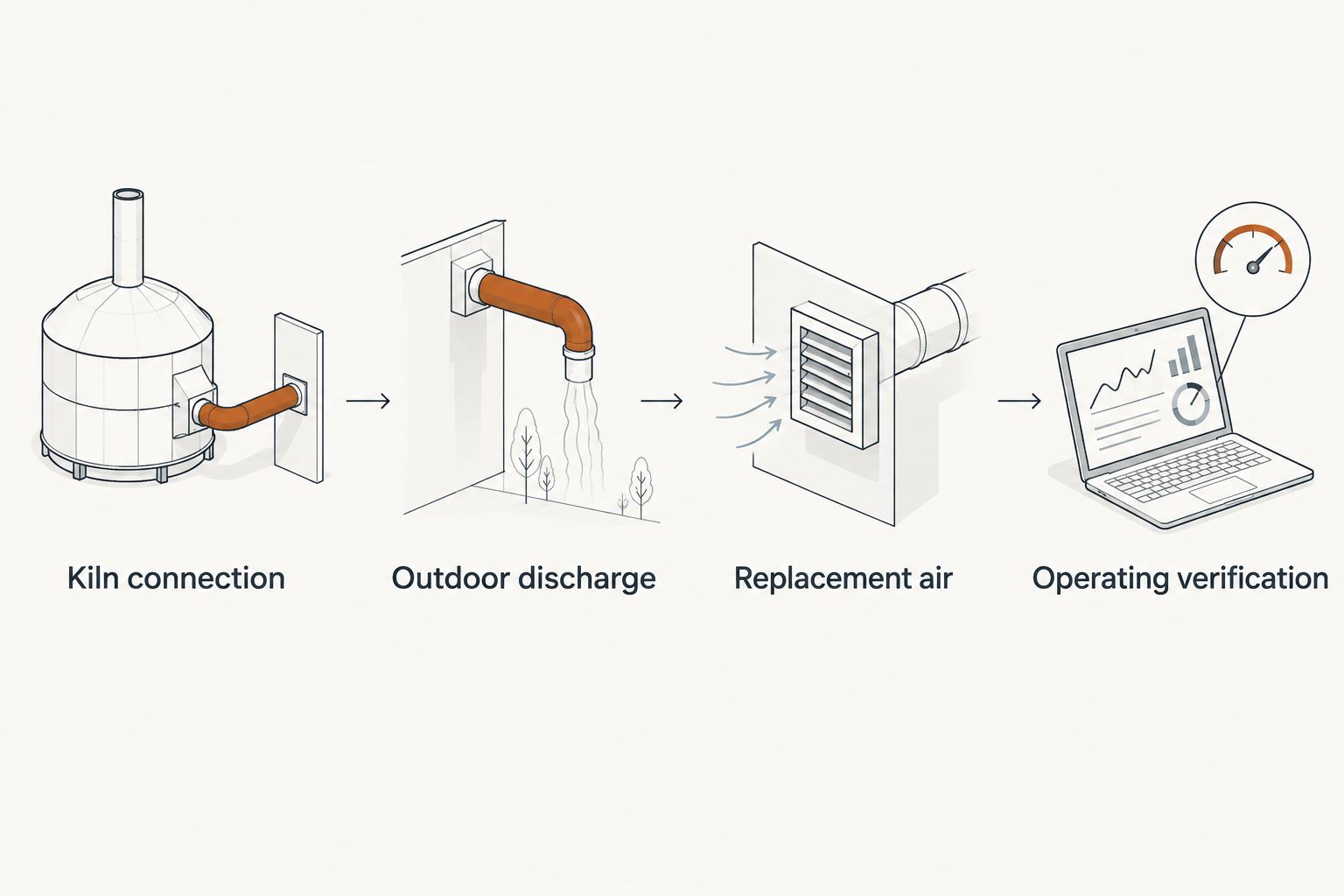
Expected result: the vent connects to the kiln exactly as the approved installation specifies, without improvised openings or interference with kiln supports.
A downdraft connection often includes an intentional adjustment or air gap. Do not seal or tighten every visible gap automatically; follow the vent instructions for that fitting.
Expected result: an accessible, supported exhaust path carries emissions outdoors through an approved termination.
Check the outlet's surroundings, not just the duct itself. A discharge near a frequently opened window can return emissions to occupied space. The outdoor location belongs in the installation review.
Expected result: the exhaust has a defined replacement-air path, and a qualified professional has assessed its effect on the building and combustion appliances.
For an attached garage in 2026, treat isolation from living space as an installation requirement, not a convenience. Do not connect kiln exhaust to household HVAC ductwork.
Expected result: the installed vent passes its prescribed test under the conditions you will actually use for firing.
Do not use an open flame, burning paper, or improvised smoke source to test suction. If a test fails, stop before firing and correct the installation. Absence of odor is not a substitute for verification.
A verified installation needs reassessment after changes to the kiln, vent, duct route, or building airflow. Moving the kiln or adding another exhaust fan changes the system you originally checked.
Use the same sequence for a modified installation:
Keep separate firing procedures for different processes. Glass firing materials and schedules do not automatically use the same ventilation instructions as pottery. Heat-treating coatings and other process materials also require their own assessment.
When revising your 2026 procedure, replace outdated instructions rather than leaving competing checklists beside the kiln. Operators need one approved version.
Stop firing preparations. Check for a blocked termination, crushed duct, disconnected joint, incorrect collection-fitting adjustment, or an installation outside the permitted duct limits.
Correct only what the manual authorizes. If the cause remains unclear, have the vent manufacturer or installer assess the system before use.
Do not keep firing to see whether the odor clears. Follow the kiln manufacturer's safe shutdown procedure and leave affected areas if exposure is suspected.
Have the installer inspect source capture, duct leakage, discharge re-entry, and garage-to-house airflow. If anyone experiences symptoms or a carbon monoxide alarm sounds, leave immediately and contact emergency services.
A source vent does not remove every part of the kiln's heat output. Do not increase chamber suction or prop the lid open as a room-cooling fix.
Have the contractor reassess room heat management while preserving the kiln's required clearances and source-capture arrangement.
Treat loss of required exhaust as a fault. Follow the kiln manufacturer's safe shutdown instructions; do not open a hot kiln to release fumes or heat.
After cooling and electrical isolation, have qualified personnel investigate the fan supply, motor, and controls. Do not resume firing until operation is restored and verified.
Check the specified collection adjustment, chamber openings, lid position, and peephole configuration. Incorrect setup can change chamber airflow.
Compare firing results using the kiln manufacturer's recommended verification method. Do not compensate by altering the firing schedule before correcting a vent installation fault.
Build a written pre-firing checklist around the installed system, not a generic timer. Include airflow verification, clear duct access, approved replacement-air conditions, safe kiln clearances, and the required vent operating schedule.
ProKilnSupply's kiln-only focus helps with equipment-fit questions; the limitation is that purchase guidance does not replace a site assessment. Send the kiln model and proposed vent details when requesting support, and keep electrical and ventilation commissioning with qualified trades.
For shared garages, assign responsibility for the checklist. Nobody should close a required opening, move stored items into clearances, or switch off exhaust during firing.
Will a kiln vent make my garage air completely clean?
No. A kiln vent captures firing emissions at the source, but it does not certify garage air as safe or remove every contaminant. Room heat, clay dust, and other garage emissions need separate controls.
Can I just open the garage door while firing?
An open garage door is not a substitute for an approved kiln exhaust installation. Wind and door position change airflow, and the setup still needs verified source capture and replacement air.
Is a downdraft kiln vent better than an overhead hood?
Neither is universally better; the correct choice depends on the kiln and engineered installation. A compatible downdraft system draws air through the chamber, while a hood captures the rising plume above it.
Can I install a kiln vent myself?
Complete only the work that the manuals, local requirements, and your competence permit. Electrical changes, building penetrations, replacement-air design, and combustion-appliance assessment require qualified help where applicable.
Should the kiln vent run during cooling?
Follow the vent and kiln manufacturers' operating instructions for cooling. Do not assume the vent should stop when the heating elements switch off.
Can a kiln vent connect to a dryer vent or house HVAC duct?
Do not connect kiln exhaust to household HVAC or an existing shared dryer exhaust. Use the manufacturer's approved dedicated route and have the installer confirm the termination and building requirements.
How do I know whether my kiln vent is working?
Use the vent manufacturer's prescribed airflow test and any professional measurements required for the installation. Fan noise, a moving outdoor flap, and lack of odor do not establish effective capture at the kiln.
Does this 2026 workflow apply to a gas kiln?
No. This workflow addresses electric pottery kilns. Gas kilns require a separate combustion, exhaust, fuel-supply, and installation assessment.
Fresh-smelling air is not proof of safe air. Some hazardous gases have no reliable odor warning, and becoming accustomed to a smell makes informal checks even less useful.
Make your final 2026 setup decision around a documented, verified installation—not around whether the garage feels comfortable during a firing. Keep carbon monoxide alarms installed as required and according to their instructions, but never treat an alarm as a substitute for exhaust design or an exposure assessment.
{"one"=>"Select 2 or 3 items to compare", "other"=>"{{ count }} of 3 items selected"}