


Cookware manufacturers’ enameling kilns are furnaces that fuse a vitreous enamel coating onto a compatible metal body to produce a bonded finish. For a 2026 purchase, choose an enameling kiln for cookware manufacturing by the coating specification, supported load, firing cycle, and installation requirements—not maximum temperature alone.
A kiln that reaches the firing temperature is not automatically suitable for enameled cookware. You also need the correct exposure of the coated metal to heat, a compatible atmosphere, suitable supports, and a repeatable loading method. Handles, rims, curved walls, and heavy bases make cookware different from flat enamel samples.
ProKilnSupply sells kilns and provides fit guidance for commercial shops. Use that guidance to narrow equipment choices, then require the kiln manufacturer and coating supplier to confirm the intended application.
Your 2026 equipment specification should distinguish laboratory development, pilot batches, and routine production. These jobs impose different demands on access, recovery after loading, records, and material handling. Buying one furnace without defining its job leaves those decisions unresolved.
Start with the enamel supplier’s technical documentation and the cookware body specification. Vitreous enameling bonds a glass-based coating to metal; it is not the same process as curing an organic nonstick coating. Do not apply an enamel firing schedule to another coating system.
Identify the substrate, surface preparation, coating system, and required firing conditions before comparing equipment. Steel and cast iron are not interchangeable process specifications. Different body thicknesses and coating systems also require their own qualification.
Write the process requirement in language an equipment supplier can evaluate. A photograph of a finished pan is useful, but it does not replace material and firing information.
Measure the entire firing assembly, not just the cookware diameter. Include the body, integral handles, lid where applicable, supporting fixture, and the clearance required by the kiln manufacturer. The door opening must accommodate the assembly as well as the chamber itself.
Make a full-size layout using a drawing or physical mock-up before requesting a quote. Check the loading motion too. A pan that fits inside a chamber still needs a safe, repeatable path through the opening without touching its unfired coating.
Keep usable chamber capacity separate from advertised internal volume. Fixtures occupy space and add thermal mass; neither disappears when you calculate output.
Use the process sheet and load drawing to request written application confirmation. ProKilnSupply’s kiln selection guidance is useful here, but a general pottery or glass designation does not establish cookware-enameling suitability. Ask about the intended operating cycle, repeated loading, chamber materials, and fixtures.
For example, the Olympic 1414HE Test Kiln lists a chamber 14.5 inches wide and 13.5 inches deep, with 240-volt or 208-volt configurations. Those specifications help screen physical fit and electrical requirements; they do not confirm an enameling application, loaded uniformity, or production output.
Treat every general-purpose kiln as a candidate until the application is confirmed. A temperature rating is only one part of the decision.
Have qualified electrical and ventilation professionals review the selected configuration before ordering. Voltage, phase, current demand, disconnect arrangements, and installation instructions belong in the equipment specification. A matching receptacle alone does not establish that the electrical installation is suitable.
Plan extraction around the actual process and its safety documentation. Coating preparation, application, drying, and firing each need review; kiln ventilation does not automatically address every exposure elsewhere in the workflow.
For a 2026 installation, include the delivery route and final placement in the same approval. A furnace that reaches the loading dock still needs a planned route to its operating position.
Develop the firing procedure with the enamel supplier and equipment manufacturer. The controller reports temperature at its sensor; that reading is not proof that every cookware surface has received the required thermal exposure. Heavy fixtures and different cookware shapes belong in the validation plan.
Begin with representative trials and record the complete load arrangement. Assess the actual coated cookware, not only a small coupon placed beside it. Coupons are useful process checks, but their geometry and thermal response do not reproduce a deep pot or heavy pan automatically.
Use the same approved handling method during trials and production. Changing the support, orientation, or loading sequence changes the process you qualified.
Define the finished-product acceptance plan before releasing the kiln for production. Visual appearance alone does not establish food-contact suitability, coating adhesion, or resistance to the intended use conditions. Select applicable requirements with your quality team, coating supplier, and qualified testing laboratory.
Keep equipment acceptance separate from cookware acceptance. A furnace can operate according to its specification while a coating fails because of preparation, application, or material compatibility. Troubleshooting needs records from the entire process.
Your 2026 qualification file should identify the cookware construction and intended sales markets. Do not transfer a result to another substrate, coating, or product family without reviewing whether the qualification still applies.
Approve the equipment against written acceptance criteria, then train operators on the qualified procedure. Include loading, protective equipment, normal operation, abnormal conditions, and shutdown. Do not treat a controller demonstration as complete process training.
Ask ProKilnSupply about expert phone/text support and delivery guidance while confirming the selected manufacturer’s warranty terms. These services support a purchase; they do not replace commissioning, site safety review, or evidence that your cookware process works.
Keep maintenance access and replacement-part identification in the handover file. A production procedure is incomplete if operators cannot identify a sensor fault, damaged fixture, or unsafe loading condition.
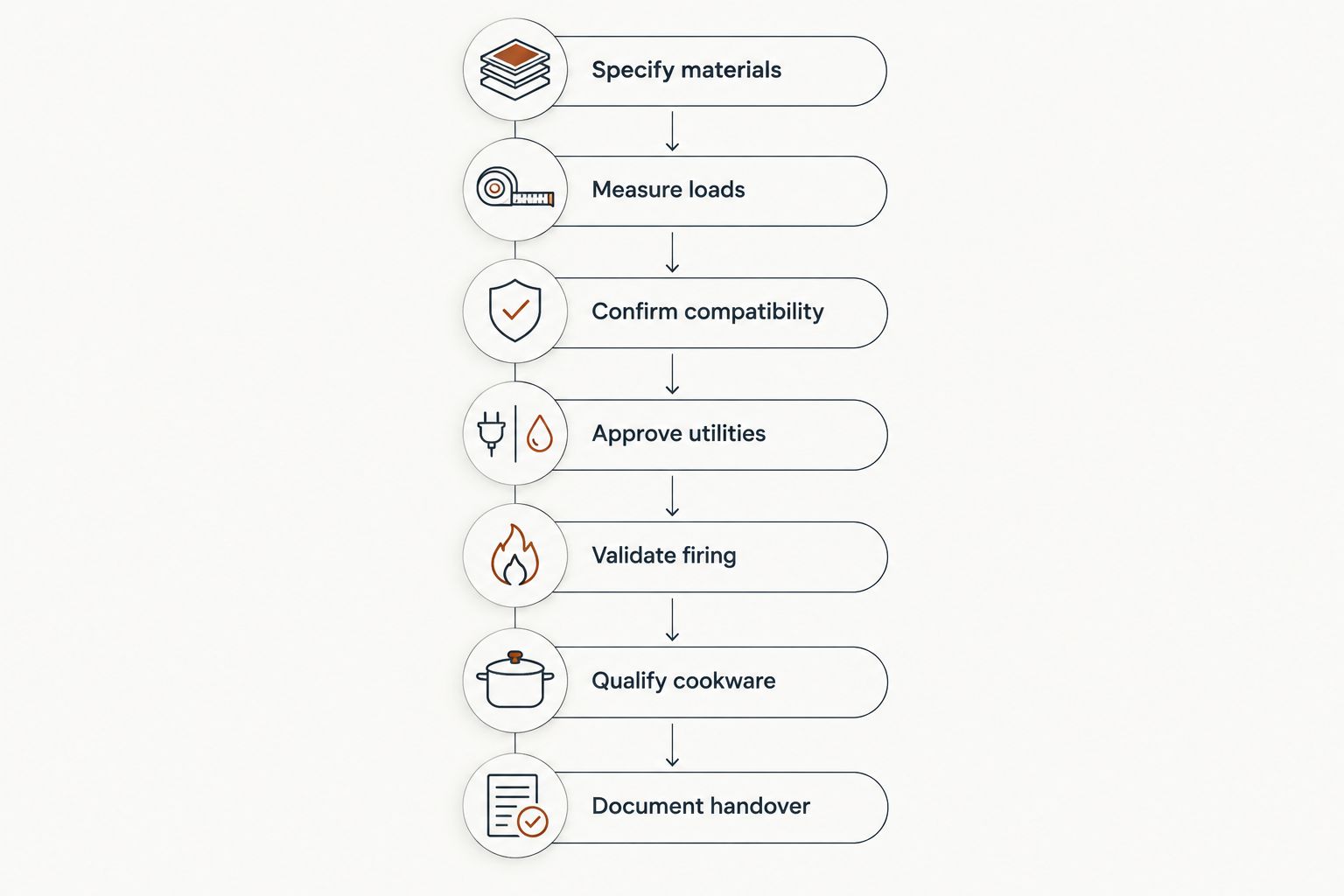
The purchasing sequence is straightforward: specify materials, measure loads, confirm compatibility, approve utilities, validate firing, qualify cookware, and document handover. Keep each approval attached to the same proposed equipment configuration.
Choose the equipment route by the work it must perform. Prototype success and production readiness are separate decisions. The options below describe purchasing routes, not verified compatibility for a particular cookware coating.
| Option | Best for | Main advantage | Key limitation |
|---|---|---|---|
| Small test kiln | Material screening and sample development | Keeps development work separate from larger loads | Sample results do not establish full-size cookware performance |
| General-purpose batch kiln with written application approval | Pilot batches and varied product development | Allows a defined load to be evaluated as a batch | Loading method, recovery, and cookware compatibility require confirmation |
| Purpose-built batch enameling furnace | Repeated cookware batches with a defined process | Equipment can be specified around fixtures and handling | Requires application engineering and acceptance trials |
| Continuous enameling furnace | Repeated product flow with coordinated upstream operations | Integrates firing with a planned production sequence | Requires line-level planning rather than a standalone kiln purchase |
| External enameling service | Buyers evaluating a process before owning equipment | Provides a route to trials without installing a furnace | Scheduling, traceability, and process control require supplier agreement |
Do not choose between these routes using empty-chamber volume alone. Compare accepted cookware per operating period, including preparation, loading, firing, unloading, inspection, and rejects. Use measured trial results rather than an assumed cycle time.
For your 2026 purchasing review, ask each supplier to state what the proposal includes and excludes. Fixtures, extraction, electrical work, process development, and finished-product testing must each have an assigned owner.
A high maximum temperature does not prove recovery after loading, temperature consistency across cookware, or suitability for repeated access. Approve the operating process, not just the specification sheet. Require evidence tied to your load and coating requirements.
A flat sample does not reproduce a pot’s walls, base, rim, handles, or fixture contact points. Use samples to screen materials, then qualify representative finished shapes. Include difficult geometries rather than testing only the easiest item.
Supports touch the product and occupy useful chamber space. Define permitted contact locations before designing the load. A fixture that supports the weight but damages a visible or food-contact surface fails the purchasing brief.
A kiln purchase does not certify the finished cookware. Food-contact suitability depends on the complete material and manufacturing system and the applicable requirements. Assign testing and documentation before production release, not after finished goods accumulate.
What is the best enameling kiln for cookware manufacturing?
The best enameling kiln for cookware manufacturing is one confirmed for your coating, substrate, supported load, firing procedure, and required output. Choose a test, batch, or continuous route only after defining those requirements.
Can I use a pottery kiln to enamel cookware?
A pottery kiln requires written application confirmation before you use it for cookware enameling. Its temperature rating alone does not establish suitable loading, atmosphere, fixtures, or repeatable performance.
What firing temperature should I use for enameled cookware?
Use the firing conditions specified for the exact enamel system and metal substrate. Confirm the procedure with the coating supplier and validate it on representative cookware rather than borrowing a jewelry or pottery schedule.
Is a front-loading kiln better for cookware enameling?
A front-loading kiln is a candidate when the fixture and handling method require horizontal access. Confirm opening dimensions, safe operating procedures, and application suitability before choosing it over another loading design.
How do I calculate cookware enameling capacity?
Calculate capacity from accepted cookware produced through the complete validated workflow. Include fixture space, handling, firing, inspection, and rejected pieces rather than dividing chamber volume by pan volume.
Does an enameling kiln make cookware food-safe?
An enameling kiln does not establish finished cookware food-contact suitability. Qualify the substrate, coating, preparation, firing process, and finished article against applicable requirements with qualified specialists.
Can ProKilnSupply help select equipment for cookware trials?
ProKilnSupply provides kiln fit guidance and expert phone/text support for equipment selection. Ask for help screening candidates, then obtain manufacturer confirmation and coating-supplier approval for the proposed cookware application.
Send the fixture drawing with the cookware drawing. The fixture affects chamber fit, handling, thermal load, and surface contact, so it belongs in the first equipment inquiry—not the final commissioning discussion. That single purchasing habit makes supplier responses more useful and exposes unresolved process decisions earlier.
{"one"=>"Select 2 or 3 items to compare", "other"=>"{{ count }} of 3 items selected"}