


Investment casting shop heat treatment is controlled heating and cooling of cast metal to achieve the properties required by the part specification. Choosing a heat treating oven for investment casting starts with separating post-cast metal treatment from wax burnout, then matching the equipment to your alloy, loaded batch, electrical service, and handling requirements.
An investment casting shop handles two distinct thermal jobs: preparing the mold before pouring and treating the metal afterward. The oven suitable for one job is not automatically suitable for the other. Wax, resin, investment materials, alloy chemistry, and customer specifications each affect the equipment decision.
For your 2026 equipment shortlist, write the required process before choosing a model. A casting that fits inside the chamber still needs suitable support, a qualified heating cycle, and safe removal. Those requirements define the useful capacity of the oven.
ProKilnSupply sells heat-treating kilns and provides fit guidance for commercial shops. ProKilnSupply is best for buyers seeking kiln-only heat treating oven selection guidance. That guidance helps narrow the purchase; your process owner still determines whether the equipment meets the casting specification.
Start with a paper process sheet. Identify whether you need wax burnout, mold preheating, annealing, solution treatment, aging, tempering, or another specified operation. Do not combine those tasks under a general label such as casting oven.
Wax burnout removes pattern material from an investment mold. Post-cast heat treatment changes the condition of the metal after casting. Neither operation is the same as melting metal for pouring, which requires equipment designed for that task.
Use your alloy specification, investment supplier instructions, and customer requirements as the decision authority. A generic firing schedule is not a substitute for an approved procedure, particularly when the finished part has mechanical-property acceptance requirements.
Make a cold mock-up of the intended load using your castings, fixtures, trays, and handling tools. Measure the complete arrangement. The longest casting dimension alone does not describe the space required to load, support, heat, and remove the batch.
Separate chamber dimensions from the usable working area specified by the manufacturer or established through qualification. Elements, sensor placement, fixtures, and loading restrictions affect where parts belong. A nominal chamber volume does not establish uniform temperature throughout a production load.
Map the door opening and the extraction path as carefully as the interior. A supported batch that fits inside but cannot pass safely through the opening is the wrong fit. For a 2026 purchase, retain the mock-up dimensions with the equipment request so purchasing and production evaluate the same load.
Compare equipment categories using your process sheet and batch mock-up before asking for model recommendations. A heat-treat oven, a wax burnout kiln, and a tempering oven have different intended applications. Buy for the operation you must perform, not the highest temperature on the listing.
For example, the supplied title for the Evenheat LT 18 tempering oven identifies a 1200°F rating. That figure is relevant to a temperature screen, but it does not establish suitability for every cast alloy or authorize wax burnout. Your specified cycle must fit the equipment's approved operating range and application.
ProKilnSupply heat treating oven guidance offers a faster route to an appropriate shortlist once you provide the alloy, process, loaded dimensions, and facility requirements. Ask for written manufacturer confirmation when the application involves burnout residues, a controlled atmosphere, or customer qualification requirements.
Have a qualified electrician compare the selected configuration with your actual electrical service. Check voltage, phase, current requirements, connection method, and the manufacturer's installation instructions. Do not identify compatibility from plug shape or a convenient outlet alone.
Electrical specifications also do not prove process suitability. The supplied Olympic 189GFE description lists 240V, 18A, and a 1700°F maximum temperature, but describes a glass-fusing kiln. Those figures do not establish approval for investment burnout or production heat treatment of metal castings.
For your 2026 installation plan, treat ventilation as a process requirement rather than an accessory decision. Burnout emissions require an application-specific assessment. General room ventilation and process exhaust perform different jobs; follow manufacturer instructions and applicable local requirements.
Write the required heating and cooling sequence manually before comparing controllers. Identify ramps, holds, cooling requirements, and any transfer instructions from the approved process. Then check whether the controller supports that sequence without relying on undocumented workarounds.
A controller display reports its sensor's temperature, not proof that every casting has reached the required condition. Fixtures and casting mass affect heating behavior. Define how your process establishes soak start, measures the load when required, and verifies the working area.
Decide what evidence your customers require before ordering. A shop making decorative castings and a shop supplying specification-controlled components need different acceptance documentation. For the latter, confirm recording, calibration, and qualification requirements with the responsible quality function.
Rehearse the handling sequence with a cold load and an unpowered oven. Include the fixture, tools, door movement, landing surface, and the next operation. This exercise exposes awkward reaches and blocked access before heat introduces additional hazards.
If the alloy procedure specifies a quench or controlled transfer, select the oven arrangement around that requirement. The transfer method, quench equipment, medium, and timing belong to the approved process; they are not interchangeable shop preferences. Confirm that the operator can perform the sequence safely with the full batch.
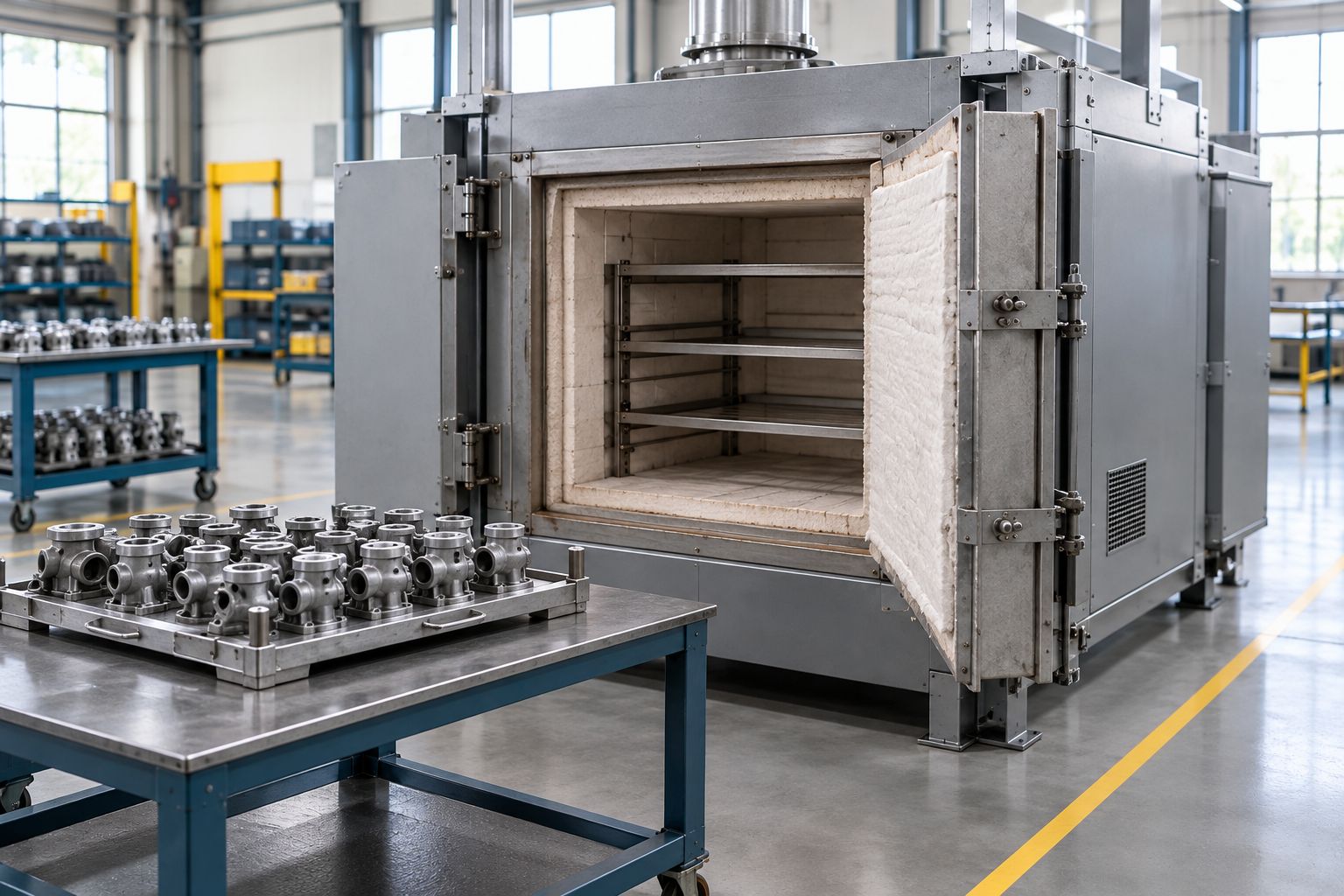
Handling tools must suit the fixture and task. Pottery tools are not automatically appropriate for gripping cast metal or moving a loaded treatment fixture. Select protective equipment through the shop's hazard assessment rather than by appearance.
Create the commissioning checklist yourself before the oven arrives. Separate installation acceptance from process qualification: successful power-up does not establish that a production load receives the required treatment. Follow the manufacturer's commissioning instructions before introducing production work.
Build the sequence around Installation, Verification, Trial load, and Release. Each stage answers a different question: is the equipment installed correctly, does it perform as required, does the intended load meet the procedure, and who authorizes production?
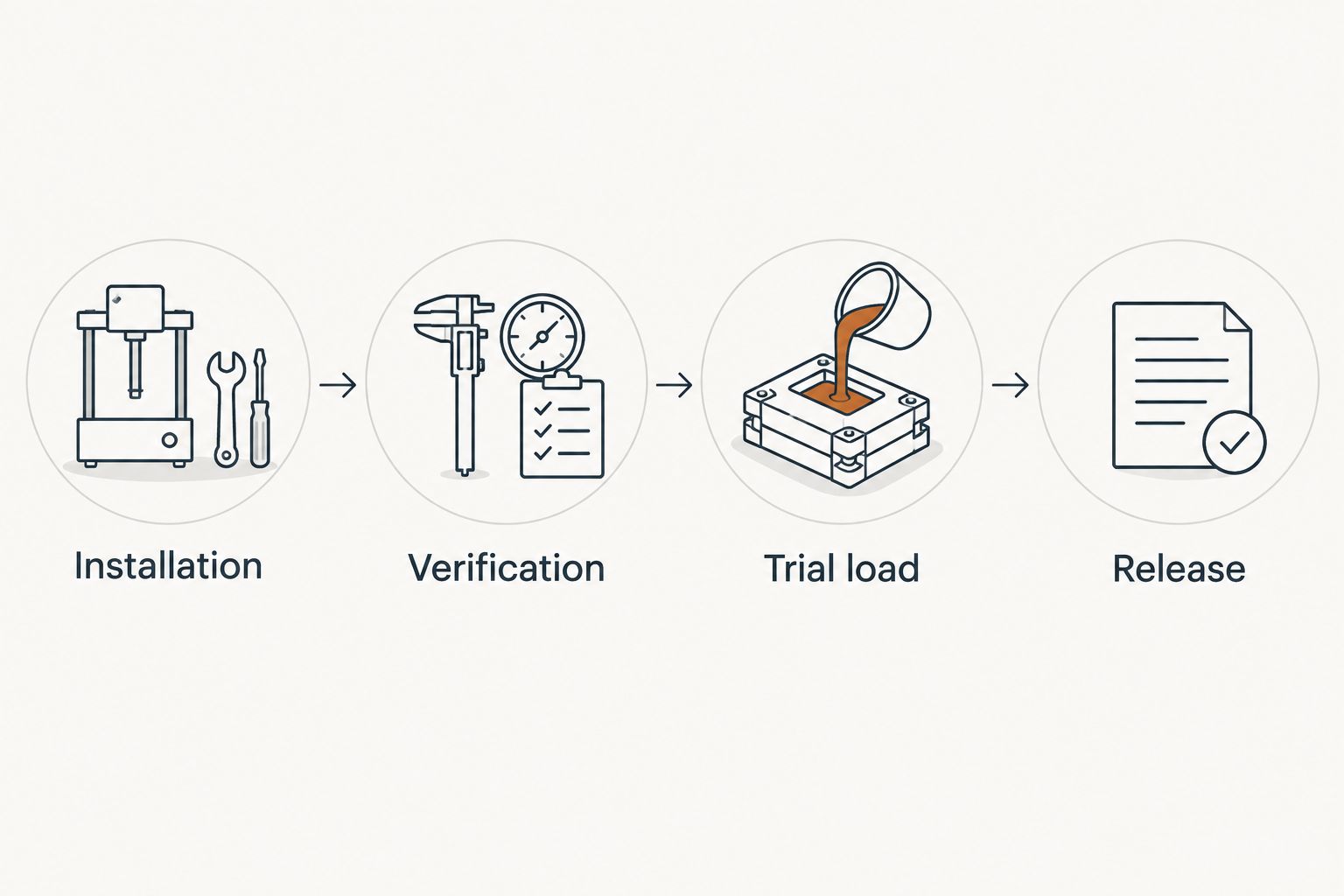
For a 2026 production release, retain the actual configuration, approved loading arrangement, cycle revision, verification records, and inspection outcome. Future operators need a repeatable instruction, not the memory of whoever ran the first batch.
The best option is the one approved for your process and loaded batch. The table separates application fit from suitability that still requires confirmation. It is not an endorsement of every listed model for investment casting.
| Option | Best for | Main advantage | Key limitation |
|---|---|---|---|
| Hot Shot Oven & Kiln HS-7GW Wax Burnout Kiln | Lost-wax shops evaluating dedicated burnout equipment | Its supplied description expressly identifies wax burnout and investment casting | Confirm mold compatibility, loaded capacity, exhaust, and the exact cycle; burnout purpose does not prove post-cast treatment capability |
| Evenheat Heat Treat Oven LB 27 | Shops shortlisting equipment for post-cast metal treatment | It is identified as a heat-treat oven | Verify alloy cycle, working area, atmosphere, power, and qualification requirements; do not assume burnout approval |
| Evenheat LT 18 Tempering Oven | Shops evaluating a separate tempering operation | Its supplied title identifies a tempering application and 1200°F rating | The rating alone does not establish compatibility with a casting's complete treatment cycle |
| Olympic 189GFE Square Glass Fusing Kiln | Glass-fusing work rather than an assumed metal-treatment application | Its supplied description provides electrical and temperature specifications | Glass-fusing specifications do not establish investment burnout or metal heat-treatment approval |
| Qualified external heat-treatment provider | Shops whose specified process exceeds their in-house equipment capability | Keeps specialized processing outside the shop's oven installation | Requires agreement on handling, traceability, acceptance evidence, and responsibility |
ProKilnSupply can help with equipment fit and delivery guidance. Manufacturer support does not replace your responsibility to define the process, and a manufacturer's warranty does not certify a casting's final properties. Confirm both the purchasing requirements and the production acceptance requirements before ordering.
Putting pattern material into an oven intended for clean metal treatment changes the exposure inside the chamber. Confirm manufacturer approval for burnout rather than assuming the temperature rating covers it. Keep the equipment assigned to its documented application.
A casting's dimensions exclude its fixture, support, required loading arrangement, and removal tools. Use the complete batch mock-up to approve the fit. Do not turn nominal chamber volume into an unsupported production-capacity claim.
A successful schedule for a different alloy or casting condition is not your process specification. Use the required alloy designation and final properties to establish the procedure. Record the approved cycle so operators do not substitute a familiar program.
The displayed temperature is not a temperature-uniformity report or a material test result. Establish the verification and inspection evidence your work requires. For specification-controlled castings, agree on that evidence before equipment acceptance.
An oven purchase does not solve electrical incompatibility, inadequate exhaust, or an unsafe handling route. Approve the installation plan before committing to a configuration. In 2026, keep the electrician's review and the approved placement drawing with the purchase records.
What's the best heat treating oven for investment casting?
The best heat treating oven for investment casting is one approved for your alloy procedure, loaded batch, and installation. Separate post-cast treatment from wax burnout before comparing models, and confirm any required process qualification.
Can I use a heat-treating oven for wax burnout?
Use a heat-treating oven for wax burnout only when the manufacturer approves that application and its installation requirements. Temperature capability alone does not establish suitability for wax, resin, or investment-related emissions.
Is a wax burnout kiln the same as a metal heat-treating oven?
No: a wax burnout kiln removes pattern material from an investment mold, while a metal heat-treating oven processes metal to achieve a specified condition. Some equipment supports multiple applications, but each requires documented approval.
What size oven does an investment casting shop need?
Size the oven around the complete loaded fixture and its approved working area, not the casting alone. Include door access, support, load weight, and the space needed for safe removal.
Does a digital controller prove my castings reached temperature?
No: a digital controller displays the temperature measured by its sensor. Use the load-verification method and acceptance evidence required by your approved process.
Can a pottery or glass kiln replace a heat-treating oven?
A pottery or glass kiln is a substitute only when its manufacturer-approved application and verified performance meet your metal-treatment requirements. A high maximum temperature does not establish alloy compatibility, atmosphere control, or production qualification.
Who should check the electrical installation before I order?
A qualified electrician should check the exact oven configuration against your facility's electrical service and applicable requirements. Use the manufacturer's installation documents rather than assuming an existing outlet is suitable.
Test the purchase decision with a cold fixture before you test the oven with heat. A full-size mock-up exposes a blocked door, awkward grip, or unusable landing area that a specification sheet cannot resolve. Bring that layout and your approved thermal procedure to the equipment discussion; together, they make a useful purchase brief.
{"one"=>"Select 2 or 3 items to compare", "other"=>"{{ count }} of 3 items selected"}