


Instead of relying on room ventilation to clear glaze overspray, connect your spray booth to a manufacturer-approved outdoor exhaust system with matched ductwork, replacement air, and verified capture at the booth opening. This 2026 guide explains the glaze spray booth exhaust connection process—and why an existing kiln vent or building exhaust duct is not automatically a suitable connection point.
Spraying glaze creates airborne droplets and particles. Depending on the formulation, those particles contain silica or other hazardous ingredients identified in the glaze safety data sheet. Capture them where you spray rather than letting them disperse through the studio.
A fan that runs is not proof of effective extraction. Filters, elbows, duct length, outdoor fittings, and insufficient replacement air all affect the airflow delivered at the booth.
Start with the booth requirements, not the nearest duct. The glaze spray booths for ceramic studios guide provides equipment-selection context; this connection guide addresses the installation decisions that follow.
ProKilnSupply is best for ceramic studio equipment buyers who want kiln-specialist fit guidance. Exhaust sizing, building penetrations, and commissioning belong with a qualified ventilation contractor or engineer.
Do not select a duct diameter or fan from a general online rule. Your booth manual and the installed system's resistance determine the requirements. For a 2026 installation, confirm the locally adopted mechanical, building, electrical, and fire requirements with the responsible authority.
A dedicated, professionally designed outdoor exhaust route is the default starting point. An existing studio exhaust system is usable only after its suitability has been established—not because its duct happens to fit the booth outlet.
| Arrangement | Best for | Advantage | Limitation or next move |
|---|---|---|---|
| Dedicated booth exhaust | New installations needing an independently assessed spray system | Separates glaze overspray from other exhaust processes | Requires its own approved route, discharge, and replacement-air assessment |
| Existing dedicated spray exhaust | Replacing a booth on a documented spray system | Can retain suitable infrastructure | Recalculate resistance and verify capture with the replacement booth |
| Engineered shared process exhaust | Facilities with a professionally designed compatible system | Can coordinate compatible extraction points | Requires documented compatibility, balancing, and operating controls |
| HVAC return or improvised kiln-vent connection | No recommended application without redesign | Physical proximity does not establish suitability | Do not connect; obtain an approved exhaust design |
Filters that capture overspray do not establish that recirculating the discharge is safe. Likewise, a kiln vent designed for firing emissions does not establish suitability for collecting glaze particles.
Ask ProKilnSupply for equipment fit guidance, then give your installer the actual booth documentation. Retailer support does not replace a site-specific ventilation assessment.
Expected result: You have a documented booth specification and material list that the installer can use to design the connection. Unresolved manufacturer requirements stop the installation—not the final inspection.
Keep respiratory protection separate from equipment selection. A booth does not eliminate the need for an exposure assessment, and a respirator does not correct inadequate ventilation. Where workplace respiratory protection is required, selection, fit testing, training, and program requirements apply.
Expected result: The approved route identifies duct construction, fan suitability, service access, and outdoor discharge. The installer can explain how the system meets the booth's requirements.
The connection is a complete air path, not just a collar between two pieces of equipment. Use this sequence to organize the installation review: Booth requirements, Duct route, Replacement air, and Capture verification.
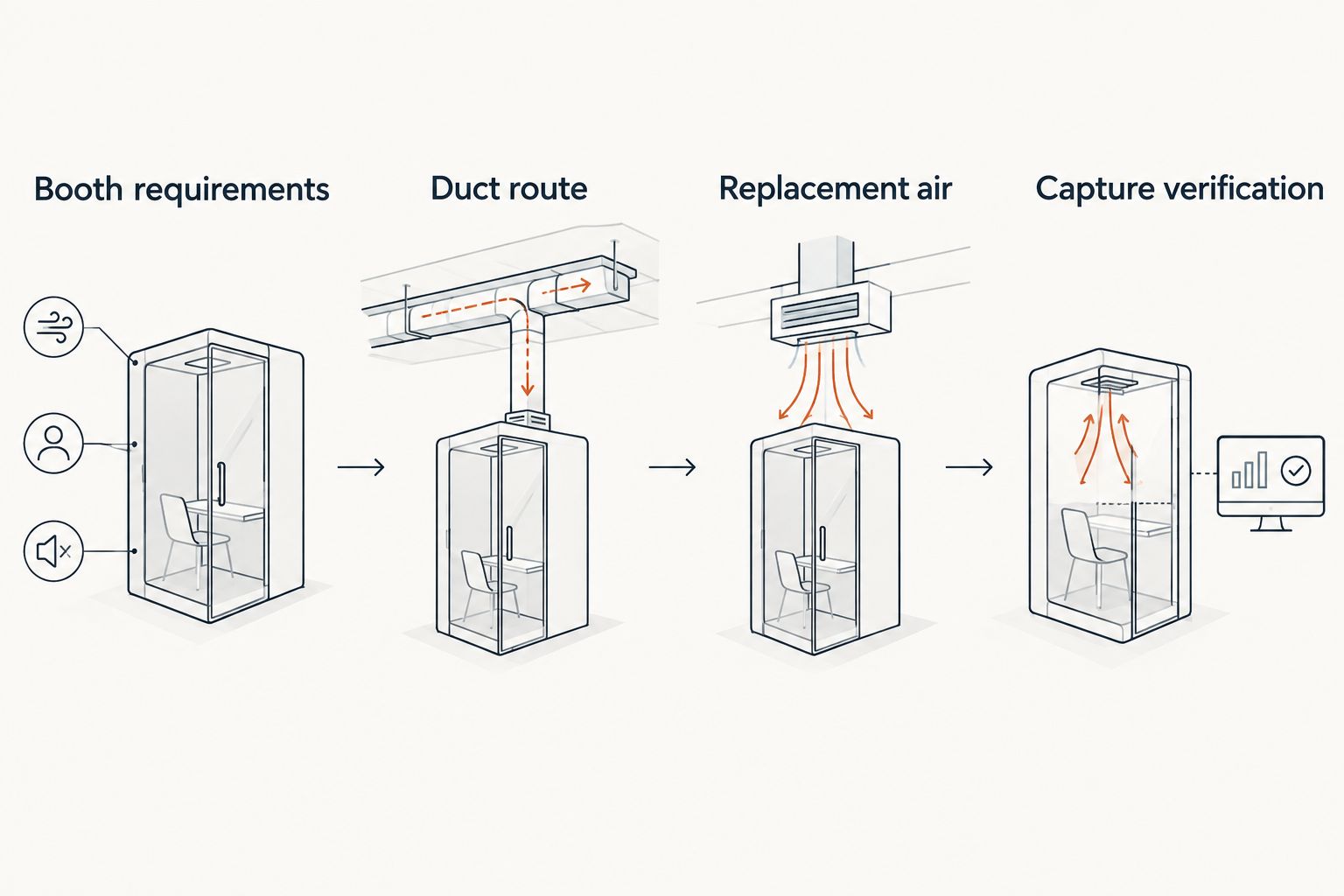
Expected result: The booth receives sufficient replacement air under its approved operating conditions, electrical work is complete, and the operating sequence is documented.
Do not invent switch names or assume every booth has an airflow alarm. Some installations use a pressure gauge, others use different monitoring arrangements. Your commissioning professional must identify what the installed indicator measures and what its acceptable range means.
Expected result: You receive a commissioning record and an operating procedure, not simply confirmation that the fan turns on.
For your 2026 handover file, organize 1 commissioning record, 1 operating procedure, and 1 maintenance log. These are document counts, not airflow specifications; the measured acceptance criteria come from the approved design.
A visual airflow check can help identify movement, but it does not quantify exposure or establish compliance. Do not use incense, flames, or improvised smoke sources around a spray process. Use only assessment methods approved by the commissioning professional.
An existing connection needs reassessment when you change the booth, filters, duct route, fan, workpiece arrangement, or replacement-air supply. A system accepted before the change does not automatically remain acceptable afterward.
Best for: Studios retaining an established spray station while replacing equipment or changing the room layout. The benefit is a repeatable recommissioning process; the limitation is that previous measurements cannot certify a changed system.
Treat a 2026 studio rearrangement as an airflow change whenever partitions, doors, supply vents, or nearby extraction move. Even an unchanged booth can lose effective capture when cross-drafts change.
Stop spraying when capture fails, overspray escapes, or the system operates outside its approved limits. Diagnose the cause before resuming work.
For dried glaze residue, use cleaning methods selected for the material and equipment, such as appropriate wet cleaning or suitable HEPA-filtered collection where permitted. Handle collected material according to its safety data sheet and local disposal requirements.
Build the spray station around the production sequence: prepare the glaze, spray inside the approved working area, move ware without disturbing deposits, and clean using the documented method. Keep unnecessary storage away from the booth and service access.
For shared studios, assign responsibility for start-up checks and maintenance. Make the stop-work rule visible: an airflow fault means no spraying until the problem is corrected.
ProKilnSupply's kiln and studio equipment fit guidance helps you plan the broader workspace. Keep that equipment planning separate from ventilation approval, especially when a kiln and spray station occupy the same room.
In your 2026 maintenance log, record filter changes, observed faults, corrective work, and subsequent verification. Trend the installed monitoring readings against the accepted baseline rather than treating fan noise as an airflow measurement.
Can I connect a glaze spray booth to my kiln vent?
Do not connect a glaze spray booth to a kiln vent unless a qualified designer and the equipment manufacturers approve the complete arrangement. Kiln emissions and glaze overspray impose different collection and maintenance requirements.
What duct size do I need for a glaze spray booth exhaust connection?
Use the duct size specified by the booth manufacturer and verified for the installed exhaust design. Outlet size alone does not establish that a long duct route, its fittings, and its fan will deliver adequate capture.
Can I use my studio HVAC return for glaze overspray?
Do not connect glaze overspray exhaust to an HVAC return. Use an approved process-exhaust arrangement that prevents contaminated air from being distributed through occupied spaces.
Does a glaze spray booth need replacement air?
A glaze spray booth exhaust system needs a suitable replacement-air path. Its design must support capture without disruptive cross-drafts or unsafe pressure effects on combustion equipment.
How do I know the booth fan is strong enough?
Have a qualified professional verify airflow and capture with the complete system installed. Fan operation or a free-air rating does not establish performance through filters, ductwork, and discharge fittings.
Can I spray any glaze if the booth has a filter?
No; spray only materials compatible with the booth's approved application. Review the glaze safety data sheet and manufacturer restrictions, and assess ventilation and respiratory-protection requirements for the actual material.
When should I recheck the exhaust connection?
Recheck the connection whenever equipment, filters, ductwork, replacement air, or room layout changes affect performance. Stop spraying immediately if capture deteriorates or monitoring falls outside the approved operating range.
The replacement-air inlet is part of the exhaust installation. A correctly connected duct still fails its purpose when the room cannot supply the air the booth removes. Before accepting the job, ask the commissioning professional to demonstrate performance with the studio operating as you intend to use it—not under an artificially favorable test arrangement.
{"one"=>"Select 2 or 3 items to compare", "other"=>"{{ count }} of 3 items selected"}