


Instead of relying on someone to notice a safety trip and stop your electric kiln, have a qualified electrician install a manufacturer-approved interlock that interrupts heating and prevents unintended restart. Kiln safety shutoff switch wiring must follow the exact kiln schematic—not a universal terminal diagram.
A firing controller, a door interlock, and an independent temperature limit perform different jobs. The controller regulates the firing schedule; an interlock inhibits operation under a defined unsafe condition; an independent limit provides a separate protective function.
Stopping the controller's heat command is not the same as disconnecting heater power. A failed switching component can leave heating energized even when the controller requests no heat. Your electrician must establish which failure the proposed protection actually addresses.
For equipment selection, ProKilnSupply provides kiln-fit guidance and expert phone/text support. Electrical design, installation, and acceptance testing belong with the manufacturer and qualified electrical professionals.
This 2026 guide covers the planning and commissioning workflow for an electric kiln. It does not provide terminal assignments, authorize modifications, or cover gas burner safety controls.
Do not buy a switch solely because it fits the mounting hole. Contact function, electrical rating, actuator travel, temperature exposure, and approval for the specific application all matter.
Stop before installation if the schematic is unavailable or the manufacturer cannot confirm the intended connection. Wire colors, photographs of another kiln, and generic internet diagrams are not substitutes.
Expected result: You have a written cause-and-effect description, not just a request to add a switch.
Use plain language in your 2026 installation record: “When this device trips, heating stops; restoring the safe condition does not initiate a new firing.” The manufacturer must confirm how that requirement is implemented on your equipment.
These protective functions are not interchangeable. Select them by the hazard they address, not by how easy they are to install.
| Protective function | Best for | Benefit | Limitation |
|---|---|---|---|
| Manufacturer-approved door interlock | Preventing heating while an access door is open | Ties heater permission to door position | Does not independently detect excessive temperature |
| Independent temperature limit | Detecting temperature above an approved limit | Provides protection separate from normal schedule control | Needs suitable sensing, switching, and reset arrangements |
| Emergency stop system | Allowing an operator to initiate the designed emergency response | Provides a deliberate stop action | Does not automatically detect every hazardous condition |
| Controller alarm output | Reporting a condition for operator attention | Makes a fault visible | Is not a protective cutoff unless the manufacturer specifies that function |
A door interlock and an independent temperature limit can belong in the same approved system. Adding more devices does not automatically improve protection; their interaction must be documented and tested.
ProKilnSupply's supplied description for HotShot Oven – Door Switch Replacement states that it shuts off power to heating elements when the oven door opens. That establishes its stated function—not compatibility with every Hot Shot model or another manufacturer's kiln. Confirm the exact replacement application before ordering.
Expected result: The proposed interlock matches both the kiln's control architecture and its electrical supply.
As a nameplate-reading example, the supplied Olympic Crucible 18 listing identifies 240 V / 48 A and also references a 208 V model. Those figures are model-specific information, not wiring instructions for your kiln. Do not infer that equipment configured for one supply is interchangeable with another.
For supply planning, review kiln wiring for 240 V single-phase power. Your electrician still needs the exact equipment documentation; a supply guide cannot establish the correct safety-device terminals.
A safety switch's contacts are not automatically suitable for carrying the kiln's element current. Contact ratings depend on the load and application, and a control contact can serve a very different purpose from a power-switching contact.
Do not route element current through a small replacement switch unless the manufacturer explicitly specifies that arrangement. Do not assume a controller input accepts an external voltage, either. An incorrect connection can damage the controller or defeat the protective function.
Ask the electrician to explain where heating energy is interrupted and what happens if the normal heater relay fails closed. If the proposed protection only removes the controller's heat command, it does not establish an independent means of interrupting a failed power switch.
The approval record should also state whether a retrofit affects the equipment's listing or manufacturer warranty. ProKilnSupply kiln guidance can help with equipment fit; it does not replace manufacturer authorization for a control modification.
Expected result: The installation matches an approved drawing, and the recovery sequence is understood before any firing begins.
There is no universal button name or controller setting for this work. Use the labels in your actual manual; similarly named functions on different controllers can have different effects.
For an independent protective limit, specify a deliberate reset and restart sequence appropriate to the approved design. A normal door interlock can have different recovery behavior, so do not treat every door opening as an overtemperature fault.
The sequence below is a functional requirement to discuss with the installer, not a circuit diagram.
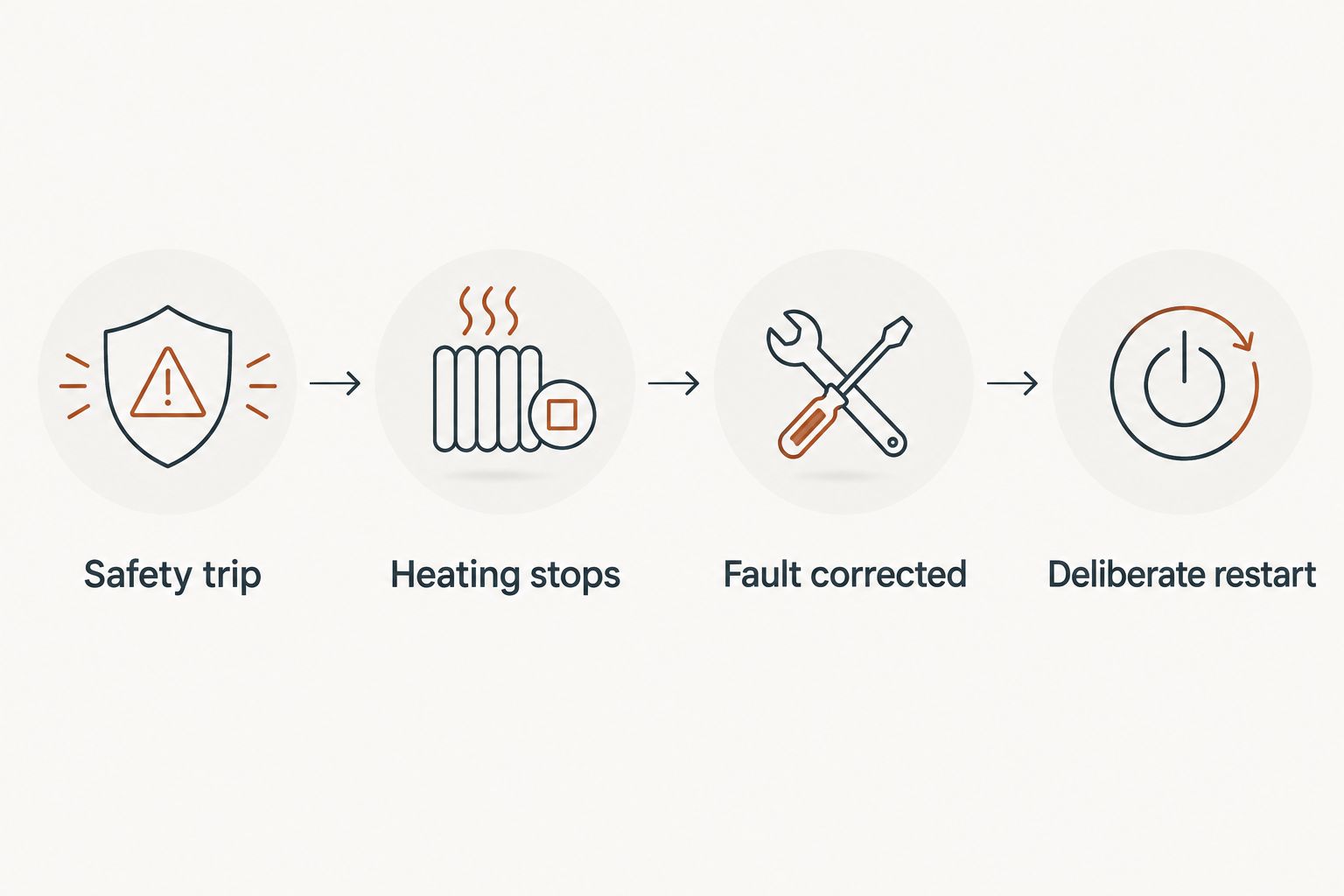
The desired sequence is Safety trip, Heating stops, Fault corrected, and Deliberate restart. Your approved design must define how each transition occurs and who is authorized to make it.
Never bridge a safety contact to keep production moving. A bypass conceals the very condition the device exists to detect.
Expected result: The acceptance record demonstrates the required response, rather than merely reporting that the kiln heated normally.
Include the ventilation response in testing. Cutting heat does not remove stored heat from the chamber, and it does not immediately end emissions from the load. Follow the kiln and ventilation manufacturers' operating instructions.
Operators should know the disconnect location, the meaning of fault indications, and the rule against restarting after an unexplained trip. A labeled switch is useful only when its function is understood.
A ventilation interlock is an adjacent workflow when the kiln and ventilation manufacturers approve it. Its purpose is to inhibit heating when the required ventilation condition is not proven.
A running fan command does not prove airflow. The approved design must identify what establishes ventilation permission and how a loss of that permission affects the kiln.
Have the designer document:
For a 2026 ventilation-interlock project, obtain approval before selecting sensors or connecting an exhaust system to kiln controls. Do not substitute a general-purpose smart plug, software notification, or fan timer for the specified protective arrangement.
Expected result: Loss of the approved ventilation permissive produces the documented response without unnecessarily disabling equipment needed for safe cooling.
Treat continued heating as a failed protective response. Follow the site's emergency procedure, use the designated disconnect only when safe, and keep the kiln out of service.
A qualified technician must determine whether the power-switching device failed, the protective path was misidentified, or the installation differs from the approved drawing. Do not restart after simply clearing the display.
The installed recovery behavior does not match a requirement for deliberate restart. Keep the kiln out of service until the manufacturer and electrician resolve the restart logic.
Distinguish intentional door-interlock recovery from recovery after a protective limit trip. Test the relevant behavior using the approved procedure rather than changing controller settings by trial and error.
Investigate the actual condition before replacing or adjusting the device. Door alignment, sensor installation, ventilation loss, excessive temperature, and electrical faults require different remedies.
Do not increase a temperature limit or reposition a switch simply to suppress trips. Have the technician establish the cause and confirm the approved adjustment procedure.
Have the installer check the documented permissive conditions, device function, reset requirements, and approved interface. Mechanical fit does not establish correct electrical behavior.
Do not bypass the interlock for a test firing. A failure to enable is a commissioning problem that must be resolved before operation.
Build the shutoff into your studio procedures, not just the electrical enclosure. Assign responsibility for checking faults, approving restart, maintaining records, and arranging service.
For schools and shared studios, keep the approved schematic and operating instructions accessible to authorized staff. Record changes to controllers, switches, ventilation, and power supplies so a later repair does not rely on an obsolete drawing.
ProKilnSupply is best for kiln buyers who need model-fit guidance before selecting equipment. Bring the model details and application requirements to that conversation; bring the electrical design and acceptance criteria to your qualified installer.
Can I wire a kiln safety shutoff switch myself?
Have a qualified electrician perform kiln safety shutoff switch wiring using manufacturer-approved documentation. Incorrect wiring can create shock hazards or leave heating energized after a trip.
Does a door safety switch protect against overheating?
A door safety switch does not independently detect overheating. It responds to door position; an approved temperature-limit system performs a different protective function.
Is stopping the kiln controller enough to stop the elements?
Stopping the controller's heat command does not prove the elements are de-energized. A failed power-switching component can remain closed, so the protective design must address the intended failure mode.
Should my kiln restart automatically after a safety trip?
An independent protective trip should use the approved fault-clearance and deliberate restart procedure. Normal door-interlock recovery can differ, so confirm the behavior for each protective function.
Can I use a smart plug as a kiln safety cutoff?
Do not substitute a general-purpose smart plug for a manufacturer-approved kiln safety cutoff. Load ratings alone do not establish suitability for a protective function.
How do I test the kiln shutoff without overheating it?
Have a qualified technician use the manufacturer's prescribed test procedure. Do not force an actual overheating event, bypass safety devices, or improvise tests inside an energized enclosure.
Does the kiln cool immediately when the safety switch trips?
The kiln remains hot after heating power is interrupted. Stored heat still presents a burn hazard, and ventilation must follow the applicable operating instructions.
Automatic shutoff is not electrical isolation for maintenance. A kiln can stop heating while its controller, terminals, or other circuits remain energized.
Before service, use the proper disconnect and lockout procedure, with absence of voltage verified by a qualified person. Keep that distinction explicit in your 2026 operator instructions: stopped, safe to restart, and safe to service are different states.
{"one"=>"Select 2 or 3 items to compare", "other"=>"{{ count }} of 3 items selected"}