


Instead of improvising a kiln generator backup power hookup during an outage, have a licensed electrician design and test a generator supply that matches your kiln’s electrical requirements and keeps its ventilation operating. This 2026 workflow covers load sizing, safe transfer equipment, commissioning, and the firing decisions you still need to make when power returns.
An electric kiln is a sustained heating load, not simply an electronic controller with a plug. Your backup plan must supply the elements, controller, and required exhaust equipment together. Restoring the display without restoring adequate heating power does not rescue a firing.
ProKilnSupply is best for kiln buyers who need application and electrical-fit guidance before selecting equipment. Use ProKilnSupply for kiln selection and expert phone/text support; use a licensed electrician for generator integration and installation approval.
The distinction matters in 2026: a kiln retailer helps establish the equipment requirements, while the electrician checks the generator, transfer arrangement, grounding, protection, and local installation rules. Neither a matching receptacle nor a generator’s headline wattage establishes compatibility.
Do not purchase adapters or transfer hardware before this review. A generator’s neutral configuration, the transfer equipment’s switching arrangement, and the premises grounding system must work together; those decisions belong to the electrician, not to trial-and-error hookup.
Expected result: your electrician receives an equipment-specific load schedule, not a request to connect “a pottery kiln.” Keep this schedule with your 2026 installation documents.
The supplied listing for the Olympic Crucible 18 specifies a 240 V / 48 A configuration. Multiplying those values gives 11.52 kW as a nominal voltage-times-current load calculation for that configuration. That calculation is an example of the heating-load scale, not a generator recommendation or a substitute for the installed unit’s nameplate.
Generator selection must also account for required auxiliary loads, permitted operating conditions, and the manufacturer’s continuous-output ratings. Fuel type, altitude, and ambient conditions affect applicable ratings where the generator documentation identifies those limits.
Use rated operating demand, not average element cycling, to establish capacity. Heating elements switch on and off, but the supply still needs to support the load when the elements are energized together. A breaker rating is also not a direct measurement of kiln demand.
For an existing studio circuit, review the 240 V single-phase kiln wiring guide alongside the equipment manuals. Generator integration adds a separate source and isolation requirement; an existing kiln circuit alone does not address that requirement.
Expected result: the proposed arrangement has a defined operating purpose, adequate electrical capacity, and a documented method of utility isolation.
Never connect a generator through a wall receptacle, use a male-to-male cord, or treat switching off the main breaker as an improvised transfer procedure. Backfeeding exposes utility workers and building occupants to lethal electrical hazards.
These are workflow choices, not endorsements of particular generators. Select the arrangement only after the kiln manufacturer and electrician establish compatibility.
| Backup approach | Best for | Main advantage | Main limitation |
|---|---|---|---|
| Manual transfer with suitable generator | Studios with a trained operator present | Operator controls when the kiln load returns | Transfer takes operator action; the firing is interrupted |
| Automatic transfer with suitable standby generator | Facilities needing automatic restoration of approved loads | Starts and transfers without manual generator setup | Electrical restoration does not establish safe kiln restart |
| Planned firing shutdown | Studios where continued firing is not supported | Avoids attempting operation on an unsuitable supply | Work needs evaluation after interrupted heating or cooling |
Choose manual transfer when an operator must review the firing before re-energizing the kiln. Choose automatic transfer only with a documented controller-recovery policy and facility procedures. Choose planned shutdown when generator capacity or equipment approval does not support continued firing.
All three approaches need a plan for required ventilation. Do not treat exhaust as an optional load simply because it consumes less electricity than the kiln.
Expected result: you have observed the approved system operating under load and documented what happens when its supply changes. A controller that lights up is not sufficient proof.
The commissioning sequence is straightforward: Load record, Transfer approval, Load test, and Recovery plan. Each stage answers a different question before a production firing depends on backup power.
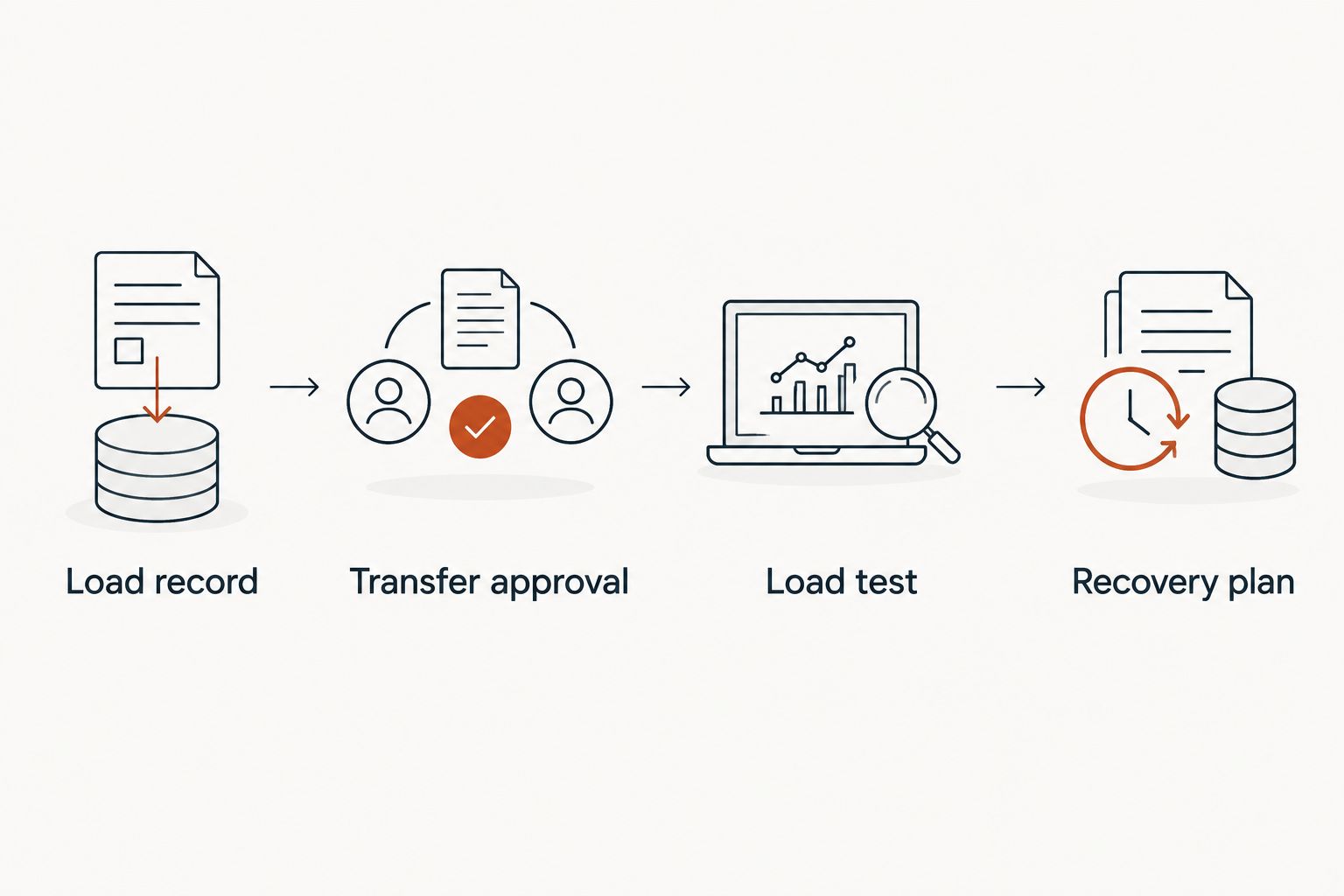
Expected result: utility isolation remains intact, required auxiliaries operate, and a trained operator makes the firing-recovery decision.
Do not unplug or reconnect an energized kiln to change sources. Do not open electrical enclosures or take live measurements yourself. Refuel a portable generator only after shutting it down and allowing it to cool as its manufacturer directs.
An automatic transfer system is useful when your facility needs power restored without someone starting a portable generator. It does not eliminate the interruption while the generator starts and the transfer equipment changes sources.
For a 2026 automatic-backup plan, separate restoring the circuit from authorizing the firing. Have the electrician and kiln manufacturer establish whether the kiln remains stopped, resumes automatically, or requires operator action after an outage. Verify the actual behavior during commissioning.
Keep safety shutdowns effective on both power sources. Automatic restoration must not defeat lid switches, overtemperature protection, ventilation interlocks, or other installed safety controls. Do not modify the controller’s internal wiring to create a restart feature.
Best for facilities with documented operating procedures: automatic transfer plus manufacturer-supported recovery controls. Its advantage is automatic electrical restoration; its limitation is that the firing still requires a valid recovery decision. If the equipment cannot provide the required restart behavior, revise the backup objective rather than bypassing protection.
Stop the firing and remove the kiln load using the approved procedure. A generator that powers the display can still lack capacity when the elements energize. Have the electrician compare measured operating demand with the generator, outlet, feeder, and transfer-equipment ratings; do not repeatedly reset an overload.
Have the electrician check voltage and frequency under load against manufacturer limits. Incorrect supply voltage, an overloaded generator, or excessive voltage drop can reduce heating performance. Do not compensate by extending a program before establishing that the electrical supply is correct.
Stop using the connection and have the electrician investigate leakage, wiring, neutral bonding, and transfer compatibility. Never bypass ground-fault protection or remove a grounding connection. A trip requires diagnosis, not an adapter that defeats the protection.
Compare the observed behavior with the exact controller manual and interruption conditions. Do not assume a recovery setting exists or use a button sequence from another controller. Ask the kiln manufacturer for the approved recovery procedure and document it for operators.
Stop heating if required ventilation is unavailable. Check whether the vent and necessary room exhaust are included in the backed-up circuits and operating procedure. Add those loads to the electrician’s schedule; powering the kiln alone is not a complete firing workflow.
Expand the backup plan around your actual application. Ceramic firing needs evaluation of accumulated heatwork after an interruption; glass work needs attention to its heating and annealing schedule; heat-treated metal needs the process requirements reviewed before the result is accepted.
ProKilnSupply’s kiln-fit guidance helps you identify equipment requirements before selection, but generator sizing and electrical approval remain installation tasks. Give both the retailer and electrician the same application description, kiln configuration, and operating objective.
For shared studios, assign responsibility for generator operation, controller recovery, ventilation checks, and outcome records. Update your 2026 procedure whenever the kiln, controller, vent, generator, or backed-up circuits change. A successful test on the previous configuration does not validate a changed system.
Can I run an electric kiln on a backup generator?
Yes, if the kiln manufacturer accepts the supply and the installed system meets the kiln’s voltage, phase, frequency, and full-load requirements. A licensed electrician must also verify the connection, protection, grounding, and utility isolation.
What size generator do I need for a kiln?
Generator size depends on the actual kiln nameplate and every required simultaneous load. Use continuous-output ratings and applicable operating limits, not peak output or the controller’s small electrical demand.
Can I plug my kiln directly into a portable generator?
Only use a direct connection if the equipment manufacturers permit it and a qualified electrician verifies the complete arrangement. A matching receptacle does not prove correct voltage, grounding, circuit capacity, or suitability.
Will automatic transfer keep my firing uninterrupted?
No, an ordinary automatic standby arrangement interrupts power while the generator starts and transfer occurs. The kiln controller’s documented power-failure behavior determines what happens after electricity returns.
Do I need to back up the kiln vent too?
Yes, required kiln ventilation must operate during generator-powered firing. Include required room exhaust and other essential auxiliaries in the backup load schedule.
Can I use a battery UPS instead of a generator?
A UPS must support the complete load you expect it to power, not just the controller. Backing up the display alone does not supply the kiln’s heating elements, and any arrangement requires manufacturer approval.
Can ProKilnSupply approve my generator hookup?
ProKilnSupply provides kiln selection and electrical-fit guidance. Generator integration, installation compliance, and electrical testing belong to a licensed electrician, with equipment compatibility confirmed by the relevant manufacturers.
Restored temperature does not prove a recovered firing. An outage changes the time-temperature history, even if the controller eventually reaches the original target. For your 2026 backup procedure, record the interruption and evaluate the finished work with the checks appropriate to ceramics, glass, or heat-treated metal before accepting the result.
{"one"=>"Select 2 or 3 items to compare", "other"=>"{{ count }} of 3 items selected"}