


Technical ceramics manufacturing kilns are thermal-processing systems selected to remove binders and fire engineered ceramic parts to defined material properties. This 2026 guide explains how to match your material, atmosphere, loaded chamber and electrical supply before asking ProKilnSupply for kiln-fit guidance.
Technical ceramics manufacturers buy a process capability, not simply a hot chamber. Your finished parts must meet dimensional, mechanical or electrical requirements, so the firing cycle belongs in the product specification—not just the operator's notebook.
A kiln that reaches its advertised maximum temperature has not automatically demonstrated temperature uniformity, acceptable contamination or repeatable results under your production load. Qualify the material, firing recipe and loading arrangement together. Changing any of them requires a documented review.
For a 2026 equipment purchase, distinguish development work from production work. A small batch kiln can support trials when its documented operating envelope matches the recipe; a specialized process needs equipment designed for its atmosphere, exhaust and control requirements.
The practical consequence is straightforward: define the required process before comparing catalog models. Otherwise, you risk evaluating equipment that cannot complete the firing cycle your parts need.
Start with the ceramic powder or body supplier's processing guidance and your existing test results. Record the material composition, binder system, green-part geometry and finished-part requirements in a shared specification. This manual worksheet is more useful than an early shortlist of kiln models.
Technical ceramics include materially different systems. Alumina, zirconia, silicon carbide and silicon nitride are not interchangeable firing applications; composition, additives and processing route determine the required thermal treatment. Do not transfer a pottery schedule to an engineered ceramic because both materials are called ceramics.
Your 2026 purchase specification should distinguish a development target from a validated manufacturing recipe. If the recipe is still under development, define what the equipment must let you investigate rather than presenting an unproven schedule as a production requirement.
Use measurable acceptance criteria tied to the part's function. Appearance alone does not establish whether a structural component or electrical insulator meets its requirements.
Map the entire thermal cycle on paper before selecting equipment. Binder removal, sintering and cooling serve different purposes, and their requirements do not necessarily fit the same chamber or exhaust arrangement.
Binder decomposition produces gases that require suitable handling. Heating too aggressively can damage bound parts; the correct schedule depends on the binder, geometry and material supplier's instructions. A general kiln vent is not evidence that an installation can safely handle a particular binder's emissions.
An integrated cycle reduces transfers between machines, but it also asks one system to manage every process stage. Separate burnout and sintering equipment adds handling while allowing each stage to use its own operating conditions. Choose between them from the process specification, not convenience alone.
At this stage, ProKilnSupply kiln guidance can help you check whether a retail model's documented capabilities match your application. Provide the complete recipe and request manufacturer confirmation for any uncertain requirement. A suitability question needs a written technical answer, not an assumption based on the product category.
Compare your process worksheet with manufacturer documentation, line by line. Check the permitted operating temperature, atmosphere restrictions, heating-element compatibility and continuous-duty conditions. A maximum-temperature label does not answer all of those questions.
The supplied listing for the Olympic 1414HE test kiln states a maximum of 2350°F/1260°C. That establishes a screening boundary, not a production recommendation. Reject it for a recipe above that stated limit; below the limit, investigate the remaining requirements before deciding.
Temperature sensing needs the same discipline. The Olympic Type S Thermocouple listing gives a sensor range of 538–1481°C. A sensor's range does not increase a kiln's temperature rating. Confirm the controller input, installation requirements and suitability for the intended environment separately.
For programmable recipes, distinguish the ability to enter a schedule from the ability to document actual performance. The guide to digital kiln controllers for programmable firing provides related selection context; manufacturing acceptance still requires evidence from your specific equipment and load.
Draw the loading arrangement at full scale before choosing chamber capacity. Include setters, shelves, supports and the access needed to place fragile green parts without damage. Empty chamber dimensions are not the same as usable production space.
The Olympic 1414HE listing gives an interior width of 14.5 inches and depth of 13.5 inches. Those dimensions help screen a proposed load, but you still need the complete chamber geometry, furniture arrangement and manufacturer-required spacing. Do not infer usable capacity from the width alone.
Technical ceramic fixtures are part of the process. Their composition, surface condition and thermal behavior must suit the ceramic and firing environment. Furniture intended for glazed pottery or glass is not automatically appropriate for contamination-sensitive engineered parts.
Loading access also matters. A top-loading arrangement requires reaching down into the chamber; front loading provides different access to shelves and fixtures. Evaluate both with the actual part shape, operator task and handling aids in mind.
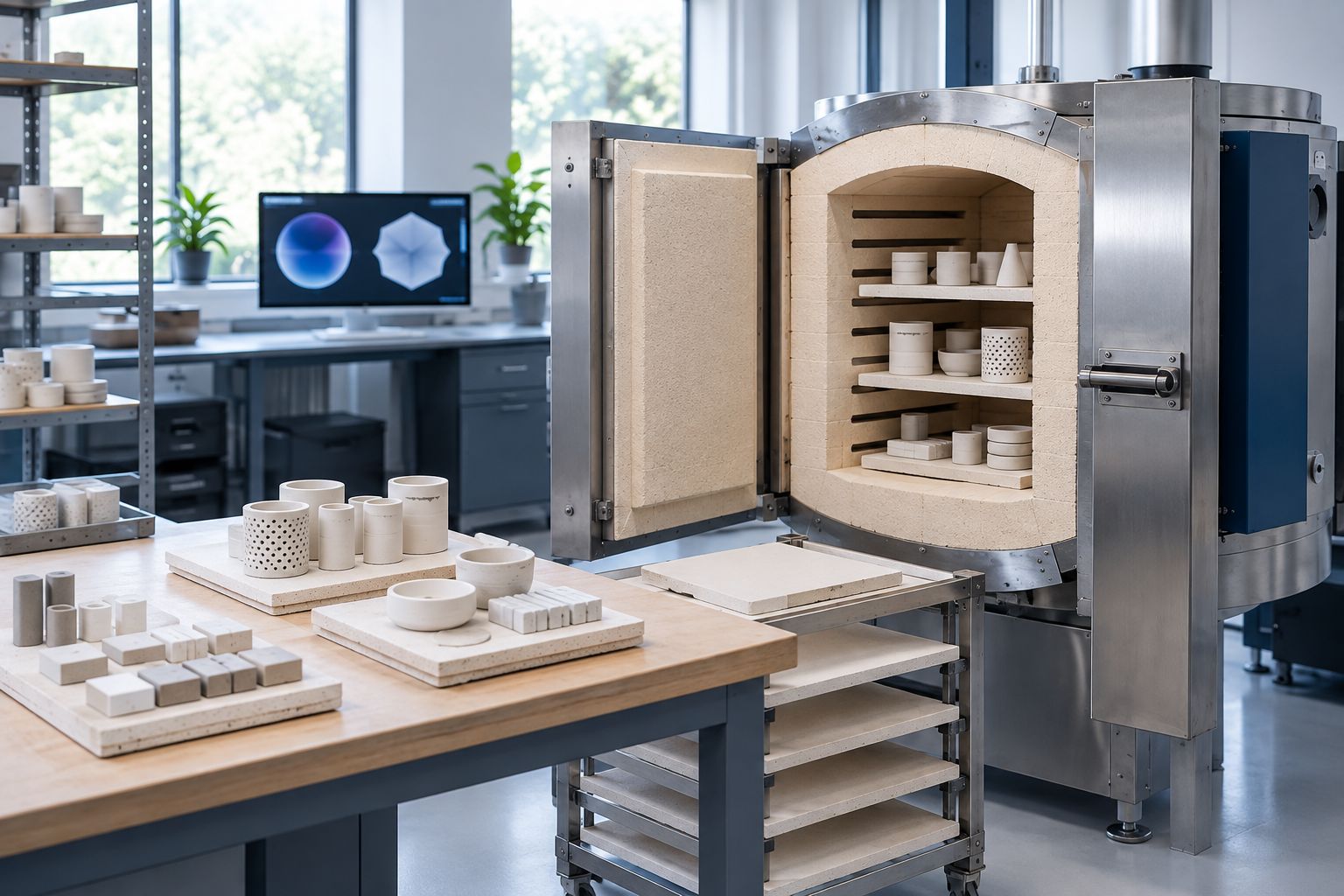
Use a site worksheet and the proposed kiln's installation manual before arranging an order. Have a qualified electrician verify the supply, circuit requirements, connection method and protective devices. A matching plug shape is not proof of a suitable installation.
Voltage variants require attention. The Olympic 1414HE description identifies 240-volt or 208-volt versions; your selected configuration must match the verified supply. Do not treat those versions as interchangeable without manufacturer approval.
Evaluate exhaust against the actual process emissions. Room heat removal, kiln ventilation and binder-emission treatment address different problems. Your facility's environmental, health and safety review should establish what the proposed process requires.
Delivery access is another purchase gate. Confirm the route from unloading point to installation position, including doors, turns, floor suitability and equipment handling. Ask ProKilnSupply for delivery guidance and clarify the applicable manufacturer warranty before ordering; purchase support does not replace electrical or process approval.
Create a qualification plan before the kiln arrives. Define the intended load, measurement locations, inspection methods and acceptance criteria so the first trials answer specific questions. An empty commissioning firing checks different things from a representative production run.
Evaluate parts from different load positions using the tests required by your specification. Record the recipe, actual temperature data, material lot, fixture arrangement and inspection results together. A controller completing its program does not prove that every part meets acceptance criteria.
For your 2026 qualification record, identify exactly which equipment configuration and loading pattern earned approval. Keep later changes visible: replacement sensors, different setters, revised binders or altered load density can affect the process.
Maintenance planning belongs here too. Establish inspections and replacement decisions from manufacturer instructions and observed equipment condition. Keep electrical troubleshooting with qualified personnel, and distinguish routine operator checks from service work.
Choose the option that meets the recipe, not the option with the broadest category label. The table identifies useful application boundaries; it does not certify any equipment for your material.
| Option | Best for | Main advantage | Key limitation |
|---|---|---|---|
| Programmable electric batch kiln | Air-fired development or batches within documented limits | Supports staged firing without combustion burners | Atmosphere, uniformity and emissions suitability still need verification |
| Olympic 1414HE test kiln | Small-scale evaluation when the recipe fits its stated limits | Supplied listing identifies chamber dimensions and maximum temperature | No supplied evidence establishes technical-ceramics process qualification |
| Separate burnout and sintering systems | Processes with different removal and densification requirements | Lets each stage use equipment matched to its task | Adds handling and requires coordination between stages |
| Controlled-atmosphere or vacuum furnace | Recipes explicitly requiring controlled gas conditions or vacuum | Addresses atmosphere requirements by design | Requires specialized process and installation evaluation |
| Gas kiln | Processes explicitly compatible with combustion firing | Provides a combustion-based heating option | Reduction firing is not equivalent to a specified inert atmosphere |
An electric batch kiln is not a universal substitute for a specialized furnace. Conversely, a specialized atmosphere system adds unnecessary complexity when an approved air-fired process does not require it. Let the recipe settle that distinction.
The Olympic 1414HE test kiln is a documented candidate for dimensional and temperature screening. The Olympic Type S Thermocouple is a temperature-sensing candidate, not a confirmed accessory for that kiln. Verify compatibility separately before combining them.
These products support different decisions: the kiln establishes an equipment boundary, while the sensor requires a controls and installation check. Neither supplies evidence of loaded uniformity or finished-part acceptance.


What's the best kiln for technical ceramics manufacturing?
The best kiln is the system that meets your material recipe, atmosphere, loaded performance and documentation requirements. Maximum temperature alone is insufficient; qualify the equipment with representative parts and fixtures.
Can I use a pottery kiln for technical ceramics?
A pottery kiln is a candidate only when its documented capabilities meet the technical ceramic's process requirements. Verify temperature, atmosphere, contamination, exhaust and loaded performance before using it for accepted production.
Is an electric kiln better than a gas kiln for technical ceramics?
Neither heating method is universally better for technical ceramics. Choose from the required atmosphere, thermal cycle, installation conditions and evidence of acceptable loaded performance.
Do binder burnout and sintering need separate kilns?
They need separate equipment when one system cannot safely and adequately meet both stages' requirements. Compare emissions, residue, atmosphere and handling requirements before deciding whether an integrated cycle is suitable.
Is the Olympic 1414HE suitable for my technical ceramic parts?
The Olympic 1414HE cannot be approved from its temperature rating alone. Its supplied listing states 2350°F/1260°C and an interior width of 14.5 inches by 13.5 inches deep; verify the remaining process and installation requirements with the manufacturer.
Will a Type S thermocouple let my kiln fire hotter?
A Type S thermocouple does not increase the kiln's operating temperature rating. The sensor, controller, heating elements and insulation each have separate limits and compatibility requirements.
What should I send a kiln retailer before requesting guidance?
Send the material and binder details, full firing recipe, required atmosphere, part-and-fixture layout and verified electrical supply. ProKilnSupply can use that information for kiln-fit guidance, while manufacturing release still requires your process qualification.
The fixture is part of the firing process. Keep an approved loading drawing beside the approved recipe; it prevents a different setter layout from quietly becoming the new standard.
Before your 2026 purchase, send the same process worksheet to the retailer, equipment manufacturer and facility team. Resolve conflicting requirements before ordering—not during the first production firing.
{"one"=>"Select 2 or 3 items to compare", "other"=>"{{ count }} of 3 items selected"}