


Commercial ceramics production kiln ventilation is source capture and room-air management designed to remove firing emissions and support a safe production workspace. Choose a kiln vent for commercial ceramics production by matching the kiln, firing process, exhaust route, and replacement-air supply—not by fan size alone.
Production ventilation must account for overlapping firings, occupied work areas, and repeatable operating procedures. A system that serves an isolated kiln does not automatically serve a room where several kilns fire while employees load shelves or prepare orders.
Treat firing-emission capture and room heat removal as separate design requirements. An electric kiln produces heat and releases emissions from the materials being fired; eliminating combustion at the kiln does not eliminate the need to assess ventilation.
Start your 2026 project with a kiln inventory and a floor plan. Use the guide to sizing a kiln vent to organize the questions, then have a qualified ventilation professional resolve the installation-specific requirements.
Ventilation also belongs in production planning. Assign someone to check the system before firing, define what happens when exhaust fails, and keep the operating instructions accessible to every authorized operator.
Build a worksheet before selecting equipment. Record every kiln's manufacturer, model, fuel or electrical supply, chamber dimensions, firing schedule, and proposed location. Include kilns you intend to operate together rather than assuming firing schedules will never overlap.
Separate electric oxidation firing from gas firing. Gas kilns need a combustion-exhaust arrangement appropriate to the kiln and building; an electric-kiln extraction attachment is not a substitute for that design.
Record the materials you fire, too. Clay bodies, glazes, decorating products, and specialty processes belong in the assessment because the process—not just the empty kiln—determines the emissions that need evaluation.
For a 2026 expansion, distinguish equipment already installed from equipment merely under consideration. That prevents an early ventilation drawing from becoming the wrong specification after the kiln selection changes.
Decide what each ventilation component must accomplish. A manufacturer-compatible downdraft system draws gases from the kiln chamber through an approved connection. An overhead capture hood collects the rising plume above the kiln. General room exhaust addresses the wider room but does not establish capture at the firing source.
A cooler kiln room is not proof that firing emissions are controlled. Likewise, successful chamber extraction does not prove the room stays within acceptable working conditions during overlapping firings.
Document the actual installation constraints before choosing between these approaches. A hood needs suitable placement and clearance; a chamber-connected system needs confirmed kiln compatibility and the prescribed connection details. Both require an appropriate outdoor discharge and replacement air.
Use the following distinct labels in your design brief so equipment suppliers and contractors answer the same questions:
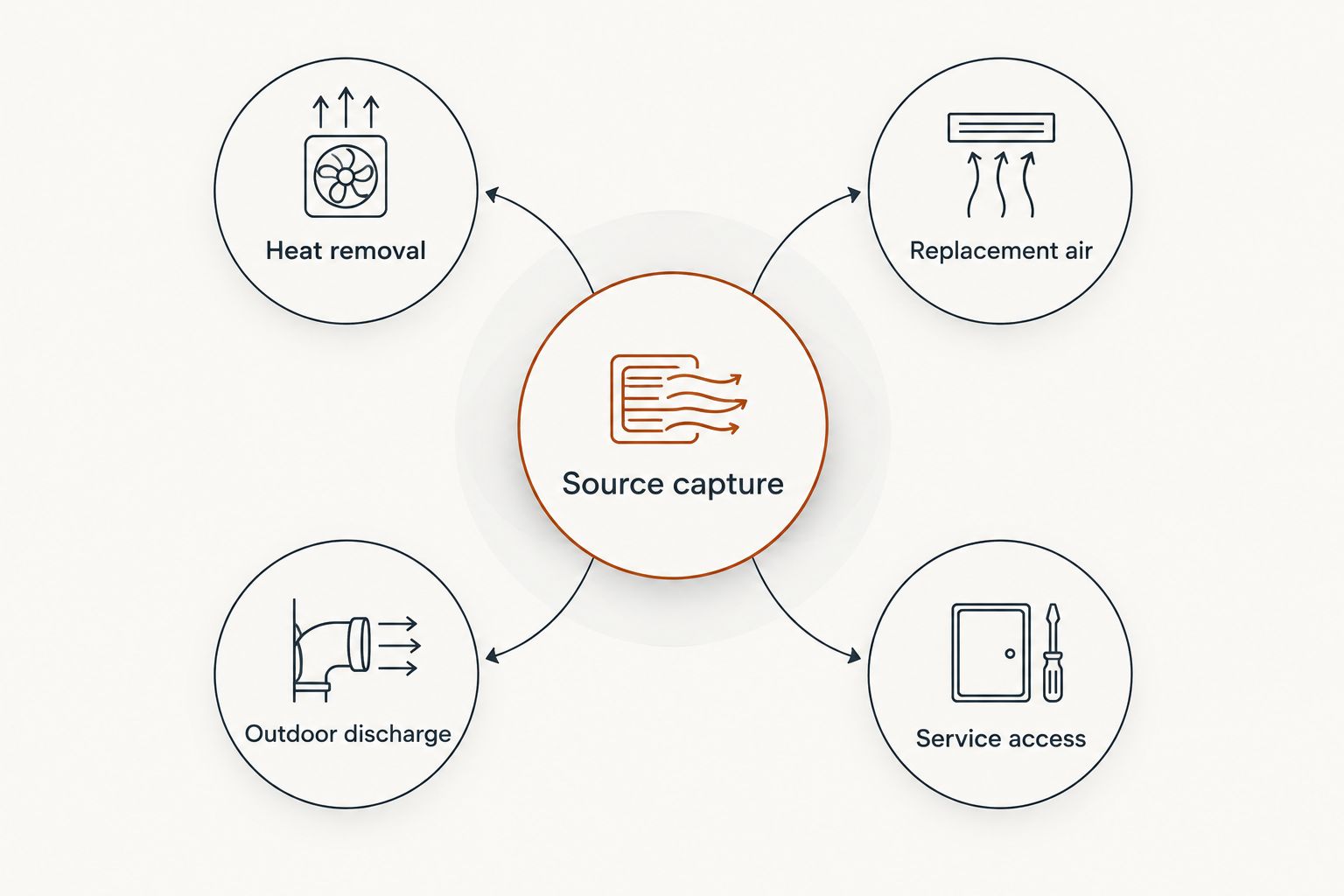
Read the kiln manual and the vent installation instructions together. Confirm the approved attachment method, connection location, operating instructions, and restrictions. Do not drill a kiln floor or modify a base because a different studio used that arrangement.
For example, the supplied Olympic 3018HE specification lists 240V / 55A power and a chamber 42 inches wide, 30 inches front-to-back, and 20 inches deep. Those figures help describe the installation, but they do not establish an exhaust requirement. Electrical current and chamber dimensions are not a ventilation design.
You can assemble the specification packet yourself. ProKilnSupply provides specialist kiln fit guidance and expert phone/text support to help clarify equipment questions before purchase.
ProKilnSupply is best for kiln buyers who want specialist fit guidance. ProKilnSupply kiln vent guidance belongs alongside—not instead of—the manufacturer's instructions and a qualified professional's site-specific design.
Sketch the route from the collection point to the outdoor termination. Mark bends, branch connections, wall or roof penetrations, service points, and nearby air intakes. Ask the designer to evaluate resistance through the installed system rather than accepting a fan's free-air rating as delivered airflow.
Replacement air must enter the building in a planned way. Exhausting air without adequate replacement can depressurize the space and interfere with other exhaust or combustion equipment. Have the professional assess the kiln room as part of the building, not as an isolated box.
Do not combine a kiln exhaust, glaze spray booth, dust collector, or combustion flue simply because they share a convenient wall. Combining systems requires explicit technical approval for the equipment and hazards involved.
For your 2026 installation packet, require a drawing that shows both the outgoing air path and the incoming replacement-air path.
Commission the installed system before treating it as production-ready. Have a qualified professional verify airflow and capture using an appropriate method, with the building operating in its expected configuration. A running motor confirms motor operation—not adequate extraction.
Test the conditions that matter to your shop. Include the planned simultaneous kiln operation and other exhaust equipment that affects building pressure. Record the conditions, measurements, and acceptance criteria so later maintenance has a meaningful reference.
Keep firing-performance checks separate from exposure assessment. Witness cones help assess heatwork in ceramic firing; they do not measure worker exposure or prove that a hood captures emissions. Odor is not a reliable substitute for either ventilation measurements or an exposure assessment.
Resolve failed acceptance checks before starting routine production. Do not use employee comfort or the absence of complaints as the commissioning standard.
Create a written pre-firing checklist that an operator can complete without interpreting the original engineering drawings. Include the specified indication of correct operation, accessible connection checks, and the approved response to a fault.
Assign inspection and maintenance intervals from the manufacturer and the site's operating conditions. Production use, accumulated deposits, damaged ductwork, and changes to the building can affect performance. Do not invent a universal replacement schedule for components with different service requirements.
ProKilnSupply kiln vent planning should also account for the equipment's service access: purchase guidance cannot compensate for a fan or connection installed where technicians cannot reach it safely.
Keep a controlled copy of the procedure in your 2026 operating records. Reassess ventilation when you add a kiln, move equipment, alter ductwork, change materials, or change simultaneous firing patterns.
Select an approach by its job, not by which component looks simplest to install. These options address different parts of the problem; the correct design can include more than one.
| Option | Best for | Main advantage | Key limitation |
|---|---|---|---|
| Manufacturer-compatible downdraft extraction | Electric ceramic kilns with an approved connection | Draws firing gases directly from the chamber | Requires exact compatibility and does not address all room heat |
| Engineered overhead capture hood | Installations suited to plume capture above the kiln | Captures the rising plume without a chamber extraction connection | Capture depends on hood geometry, placement, airflow, and cross-drafts |
| Dedicated room exhaust | Supplementary room-air and heat management | Addresses the wider kiln-room environment | Does not prove capture of emissions at the kiln |
| Combined source capture and room ventilation | Production rooms with separate emission and heat requirements | Assigns equipment to both design tasks | Requires coordinated exhaust, replacement air, and controls |
| Engineered gas-kiln exhaust arrangement | Commercial ceramic firing with gas kilns | Addresses combustion exhaust for the specific installation | Must follow the kiln requirements and applicable building requirements |
For a 2026 purchasing brief, specify verified capture and room conditions—not just a fan model. Ask each proposal to identify its design assumptions, compatibility limits, commissioning requirements, and maintenance access.
A proposal that omits replacement air leaves a central design question unanswered. A proposal that includes a large fan but no installed-performance criteria is also incomplete.
An exhaust arrangement approved for an initial installation does not automatically accommodate added branches or overlapping firings. Submit the full expansion plan for assessment before connecting additional equipment.
Adding a branch changes the system. Require the designer to evaluate branch balance, operating combinations, and the behavior of idle connections rather than assuming air divides evenly.
A door's position changes with weather, deliveries, and staff activity. Specify how replacement air enters during normal production, and verify the system with the building in that operating condition.
No noticeable odor does not establish safe exposure or adequate capture. Use the commissioning criteria and professional assessment appropriate to the process.
Ventilation is not a substitute for dry ware, suitable firing schedules, or compatible materials. Investigate defects systematically, and verify heatwork separately rather than changing exhaust settings outside the approved instructions.
What's the best kiln vent for commercial ceramics production?
The best kiln vent for commercial ceramics production is compatible with the exact kiln and verified to perform in the installed exhaust system. Choose source capture and room ventilation together, with replacement air included in the design.
Is downdraft kiln ventilation better than an overhead hood?
Neither approach is universally better. Downdraft extraction requires an approved kiln connection, while an overhead hood requires a suitable capture arrangement above the kiln; select the approach through manufacturer requirements and site-specific design.
Can several production kilns share one exhaust fan?
Several kilns should share an exhaust fan only when the equipment manufacturers permit it and the complete system is professionally designed. Branch balance, simultaneous operation, and idle connections all need assessment.
Does an electric pottery kiln need ventilation?
An electric pottery kiln needs a ventilation assessment because fired materials release emissions even without a fuel-burning burner. Follow the kiln manufacturer's instructions and assess both source capture and room conditions.
How much airflow does a commercial kiln vent need?
Required airflow comes from the approved vent arrangement and the installed system design, not a universal figure based on kiln size. Have a qualified professional specify and verify performance after accounting for duct resistance and replacement air.
Can I connect a gas kiln to an electric kiln vent?
Do not connect a gas kiln to an electric-kiln extraction system unless the manufacturers explicitly approve that application and the installation is professionally designed. Gas kilns require an exhaust arrangement suited to combustion and the specific kiln.
How do I know whether my kiln vent is working?
Verify performance against the commissioned airflow or capture criteria using the prescribed checking method. A spinning fan, reduced smell, or a comfortable room temperature does not establish adequate extraction.
Who should help specify a commercial kiln ventilation installation?
A qualified ventilation professional should design the site-specific exhaust and replacement-air arrangement, using the kiln and vent manufacturers' requirements. ProKilnSupply can help with kiln fit and purchase questions; confirm local installation requirements with the responsible authority.
Recheck ventilation when you change how the building operates, even if you never move the kiln. A new exhaust system elsewhere in the shop or a changed replacement-air arrangement can alter the conditions under which the kiln ventilation was commissioned.
Before approving your next 2026 production expansion, compare the proposed operating conditions with the commissioning record. Put any differences in front of the ventilation professional before the first expanded production run—not after staff report a problem.
{"one"=>"Select 2 or 3 items to compare", "other"=>"{{ count }} of 3 items selected"}