


Tile and mosaic studio slab rolling is the process of flattening clay to a controlled thickness so you can cut repeatable ceramic tiles and tesserae. Choose a slab roller for tile production around your largest wet-clay layout, working space, and drying capacity—not the machine’s footprint alone.
A slab roller controls forming; it does not guarantee flat fired tiles. Tile production also depends on consistent clay preparation, supported handling, even drying, and a tested firing process. Improving the rolling station without checking those stages leaves the same defects downstream.
Architectural tiles need repeatable dimensions and edges that work together across a layout. Handmade ceramic mosaic pieces need manageable thickness differences so assembly does not become a sorting exercise. Studios assembling purchased glass or stone tesserae do not need a clay slab roller for that work.
For your 2026 equipment plan, compare slab rollers by roller width, then measure the entire material path. The useful question is not just whether the roller fits: can you move the slab from rolling to cutting to drying without stretching it?
Start manually with your existing rolling pin, thickness guides, and a reusable cutting template. Make a representative sample of the tile or mosaic shape you intend to repeat, including any texture, relief, or glaze. Carry that sample through your actual drying and firing process.
Measure the wet piece and the fired result rather than assuming the cutter size equals the finished size. Clay shrinks during drying and firing; the amount depends on the body and process. A change in clay body requires another dimensional check.
Keep a physical master sample beside the written record. A dimension alone will not show whether a textured edge, recessed back, or glaze application changes how neighboring tiles sit together.
Mark the proposed roller position on the floor before ordering. Include the operating handle’s travel, your standing position, slab support, and access for cleaning or maintenance. Use the manufacturer’s installation instructions for actual equipment requirements.
A compact storage arrangement does not remove the need for working space while rolling. Likewise, a permanent table is useful only when the surrounding area lets you handle the clay safely. Plan the 2026 studio layout around the machine in operation, not folded away.
Place cutting and drying surfaces within a practical transfer route. If you must repeatedly carry an unsupported slab across the room, revise the layout before buying a larger machine.
Use your manual trial to identify the actual problem: repeated thickness adjustments, limited slab area, or handling interruptions. A machine is the next step when repeat slab preparation is the constraint. It will not fix a shortage of drying boards or kiln shelf space.
The Durston Fixed Slab Roller F750 is described for permanent studio, workshop, and classroom environments. The Durston Compact Slab Roller C750 uses a space-saving, drop-leaf design. Those are different layout choices, not evidence that either machine produces better tiles.
ProKilnSupply offers slab roller selection guidance alongside kiln and studio-equipment support. Ask for the current usable rolling dimensions, adjustment method, and operating instructions; do not infer dimensions from a model name.
Write down the hand-rolling method that produces your approved sample, then adapt it to the slab roller’s instructions. Keep clay condition consistent and avoid asking the machine to flatten an unsuitable lump in an aggressive pass. Follow the manufacturer’s limits and keep hands clear of pinch points.
Check the slab itself rather than relying only on the adjustment setting. As a practical inspection routine, measure at 3 locations: near the entry end, the center, and the exit end. Compare the readings against the tolerance you established during testing.
For your 2026 batch sheet, separate the machine setting from the measured clay thickness. That distinction helps you investigate changes in clay condition, working surfaces, or operator technique without treating the dial as proof.
Support the slab while moving it to the cutting surface. Avoid lifting a broad, soft sheet by its edges; stretching at this stage changes the geometry you just established. Let the clay reach a suitable cutting firmness for your body and design, confirmed through testing.
Choose cutters around the tested wet dimensions, not the desired fired dimensions. Scott Creek Pottery’s 4-inch and 6-inch square aluminum tile cutters provide named size options, but neither size establishes your finished fired measurement. A reusable template remains useful for custom shapes and mosaic layouts.
Keep cutting, edge finishing, and transfer methods consistent. If the piece sticks, correct the release method rather than pulling it free and accepting distortion as part of production.
Run a complete pilot batch before increasing rolling volume. Track where pieces wait: cutting, drying, bisque firing, glazing, or final firing. Increasing slab output is useful only when those stages can accept the work.
Dry tiles with attention to both surfaces and edges, using a method tested for the clay and tile geometry. Do not impose a universal drying deadline. Thickness, relief, moisture, airflow, and the studio environment affect readiness for firing.
Treat the 2026 production schedule as a connected process. A faster forming station that fills every drying rack creates work in progress, not finished saleable tiles. Keep kiln installation and firing decisions separate from slab roller setup, and follow the applicable equipment manuals.
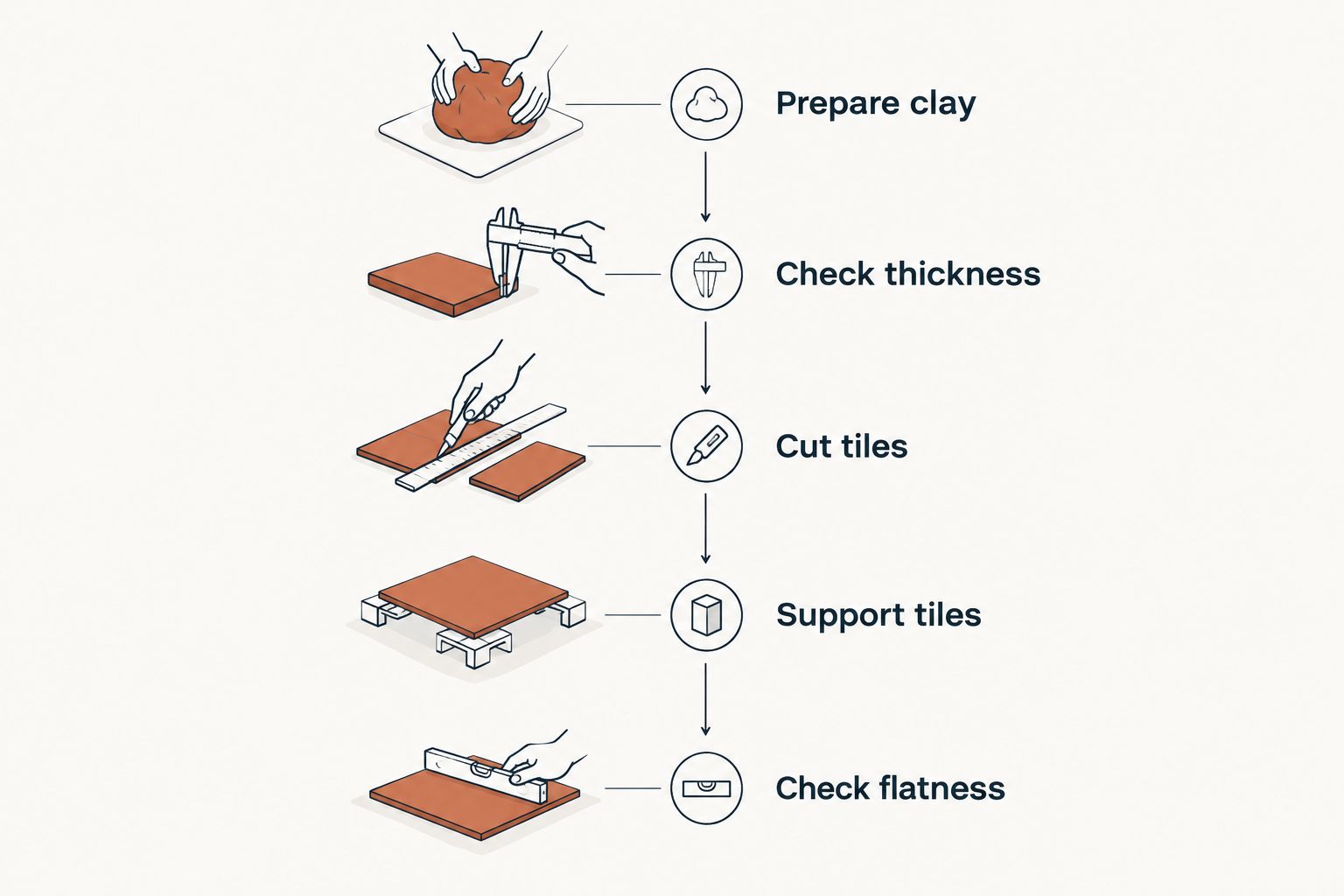
Choose the workstation format first, then verify the machine specifications. This 2026 comparison separates the supported layout differences from details you still need to confirm before ordering. No model name substitutes for a usable-width measurement or an operating manual.
| Option | Best for | Practical advantage | Key limitation |
|---|---|---|---|
| Rolling pin with thickness guides | Prototype tiles and occasional small batches | Lets you establish a process with existing hand tools | Requires repeated manual rolling and checking |
| Durston Compact Slab Roller C750 | Shared studios needing a drop-leaf arrangement | Space-saving design supports a room with changing uses | Folded space does not represent the working footprint |
| Durston Fixed Slab Roller F750 | Dedicated studio, workshop, or classroom stations | Designed for a permanent working environment | Requires a dedicated location; verify operating clearances |
The Durston Compact Slab Roller C750 is the appropriate layout choice when its drop-leaf design solves a real space problem. The Durston Fixed Slab Roller F750 is the appropriate layout choice when you can keep the station permanently assigned. Neither recommendation establishes a throughput advantage or a finished-tile tolerance.
Ask ProKilnSupply to confirm the chosen slab roller’s working dimensions and delivery requirements before ordering. Check manufacturer warranty terms, qualifying freight conditions, and any installation responsibilities for the specific order rather than assuming every studio-equipment purchase follows the same terms.

A roller that accommodates your layout still needs a supported exit and transfer route. Arrange the boards and cutting surface before committing to the machine. Otherwise, handling the larger slab becomes the difficult part of the process.
A nominal cutter dimension describes the tool, not your finished ceramic. Test the chosen clay, thickness, surface treatment, and firing process together. Keep the approved template tied to that tested process.
A clay slab roller forms ceramic components; it does not prepare sheet-glass tesserae. If your mosaics combine ceramic and fused-glass accents, maintain separate material and firing procedures. Do not assume a pottery workflow answers glass-processing questions.
Count acceptable fired tiles, not only freshly cut pieces. Record warped, cracked, or dimensionally unsuitable work by stage so you can identify the constraint. More green tiles do not establish better production performance.
Leave room to clean beneath and around the station. Use wet-cleaning methods appropriate to ceramic dust control, and avoid dry sweeping clay dust. Follow the machine’s maintenance instructions rather than applying water or cleaners indiscriminately.
What is the best slab roller for tile production?
The best slab roller for tile production fits your tested wet-clay layout and complete working area. Compare usable width, thickness adjustment, slab support, and permanent versus shared-space setup before choosing a model.
Is the Durston Compact Slab Roller C750 better than the Fixed Slab Roller F750?
The Durston Compact Slab Roller C750 is better suited to a layout that benefits from its drop-leaf design. The Durston Fixed Slab Roller F750 suits a permanent studio, workshop, or classroom station; confirm working dimensions for either choice.
Can I make mosaic tiles without a slab roller?
You can make ceramic mosaic tiles with a rolling pin, thickness guides, and cutting templates. Establish the clay preparation, thickness, drying, and firing process manually before deciding whether repeat rolling justifies a machine.
How thick should I roll clay for ceramic tiles?
Set tile thickness through testing with your clay body, tile size, relief, and intended use. There is no single thickness that guarantees flatness or suitability for every ceramic tile application.
Will a slab roller stop my tiles from warping?
A slab roller does not guarantee warp-free tiles. Consistent thickness helps control forming, but clay preparation, handling, drying, and firing also affect the final shape.
Do I need a slab roller for glass mosaics?
You do not need a clay slab roller to assemble mosaics from glass tesserae. A slab roller becomes relevant when you make ceramic components for the mosaic.
What should I ask before ordering a slab roller?
Ask for usable rolling dimensions, the operating footprint, thickness-adjustment instructions, and delivery requirements. ProKilnSupply can provide selection guidance; confirm the specific equipment and order terms before purchase.
Approve a fired tile, not just a rolled slab. For your final 2026 buying decision, carry a representative batch through cutting, drying, glazing, and firing using your current tools. If the process produces acceptable tiles but repeated rolling interrupts production, you have a clear reason to add a slab roller.
If the batch fails after drying or firing, fix that stage first. A larger rolling station only moves more clay into the same unresolved problem.
{"one"=>"Select 2 or 3 items to compare", "other"=>"{{ count }} of 3 items selected"}
