


Ceramic sculpture artists’ clay extrusion is the process of pressing clay through a shaped die to build repeatable components; choose a clay extruder for sculpture by profile, clay capacity, and mounting requirements. Your sculpture’s joints, unsupported spans, and kiln fit matter more than the size of the extruder alone.
An extruder produces a consistent cross-section. That makes it useful for repeated branches, architectural ribs, tubular bodies, and coils that you reshape after extrusion. It does not design the sculpture, strengthen every joint, or remove drying constraints.
Sculpture differs from handle production because the extruded component often becomes part of a load-bearing assembly. A long tube needs support while you move it; an attached branch needs a sound joint; a hollow body needs a drying and firing plan.
For your 2026 equipment shortlist, separate those construction problems from machine capacity. Buy an extruder to repeat a useful profile, not to compensate for an unresolved building method.
Start with a handbuilt sample before adding equipment. ProKilnSupply offers studio equipment and kiln-fit guidance, but your sample establishes the shape the equipment must produce.
Roll a coil or build a short hollow section by hand first. Cut, bend, texture, and attach it as you intend to use the extruded version. This establishes whether a uniform section helps your sculpture or simply adds another preparation step.
Distinguish the finished sculpture from its components. A tall assembled piece does not automatically require a large extruder; small repeated sections can become a larger structure. Conversely, a small sculpture with a wide hollow body requires an appropriate die arrangement.
Write a component specification for your 2026 purchase. Include the profile, intended length, joining method, and how you will support the wet clay. Use the same specification when comparing machines.
Use your existing wedging surface to prepare a small batch with consistent moisture. Remove hard fragments and follow your clay supplier’s handling guidance. An extruder shapes clay; it is not a substitute for preparing an uneven batch.
Stiff clay increases resistance. Very soft clay loses its profile after leaving the die. Find a workable consistency with a short test rather than forcing the handle or changing the entire batch at once.
For sculpture, judge the result after handling, not just at the die opening. A clean-looking tube that collapses during transfer is not ready for your assembly method. Record what worked so later components behave similarly.
Try your component workflow manually before choosing the faster equipment route. A handheld extruder fits short runs without a permanent wall installation. A wall-mounted machine serves repeated extrusion, but its mounting and receiving area become part of the purchase decision.
The Scott Creek Pottery XL Clay Gun Extruder has a 14-inch barrel and accommodates up to 5 pounds of clay. The Scott Creek Pottery 4″ Wall Mount Clay Extruder lists an 8–9-pound clay capacity; the Scott Creek Pottery 5″ Wall Mount Clay Extruder lists 12 pounds. These are barrel capacities, not promises about sculpture size or output speed.
ProKilnSupply is best for sculpture buyers who want clay extruder selection alongside kiln-fit guidance. The retailer’s phone/text support gives you a place to resolve equipment-fit questions; you still need to verify your mounting structure and working clearances.
Shape a sample by hand, then decide which features the die must reproduce. A solid coil die serves a different construction method from a hollow die. A decorative trim profile is not automatically useful for a sculptural tube or branching framework.
Treat the barrel, die, holder, and expansion accessories as a matched system. Scott Creek Pottery lists separate accessories for its 4-inch and 5-inch extruders. Confirm the exact product and required holder rather than assuming similarly named accessories interchange.
For your 2026 accessory list, begin with the profile you will use immediately. A broader die collection adds choices, but it also adds parts to identify, clean, and store. Custom dies belong after you understand how a basic profile behaves.
Practice the assembly with hand-rolled coils or handbuilt tubes first. Once the joint works, use extrusion to repeat the component. This separates a construction problem from a machine-setting problem.
Support the clay as it leaves the die rather than letting its weight stretch the profile. Transfer it onto a suitable work surface and allow it to firm enough for the intended manipulation. The right handling point depends on the clay body, section, and studio conditions—not a universal waiting time.
Extrusion does not require a mechanically uniform final appearance. Bend, carve, compress, or texture the section while preserving the structure you need. Avoid adding heavy branches to a body that cannot yet support them.
Check your sample through drying and firing before scaling the sculpture. Thick junctions and thin extruded walls dry differently, so a successful wet assembly is not enough. Avoid sealed cavities and follow your clay supplier’s drying and firing guidance.
Measure the sculpture in its loading orientation. Include the shelf, supports, opening, and the space needed to move the piece safely. A sculpture that fits the chamber on paper still needs a practical loading route.
For a 2026 studio setup, treat cleanup access as part of machine placement. Clay left in a barrel or die can dry into hard obstructions. Follow the equipment instructions, wet-clean clay residue, and avoid creating airborne dust.
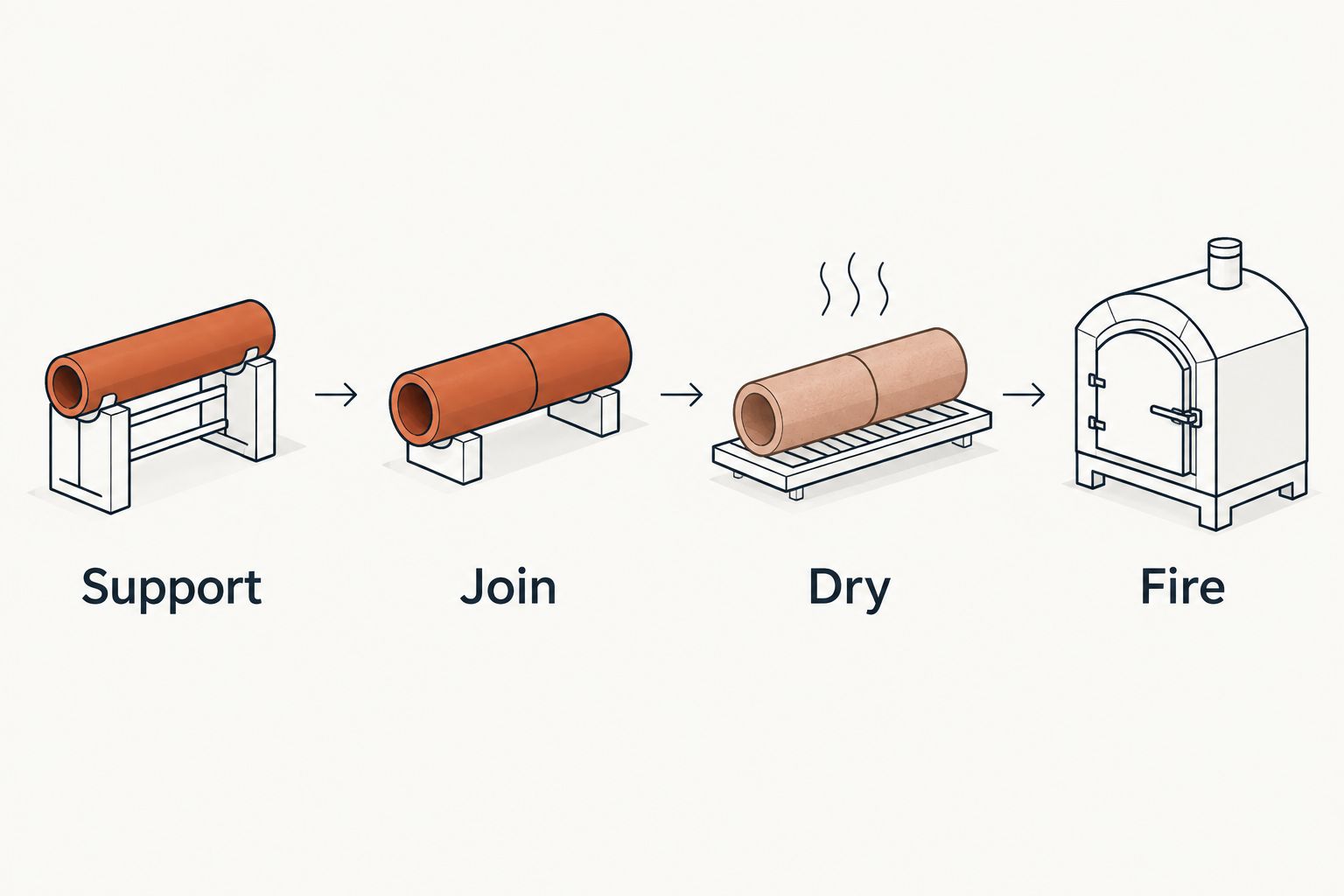
Hand rolling wins for testing a form; extrusion wins when you need to repeat the section. Choose the smallest setup that handles your actual components without making loading and cleanup unnecessarily cumbersome.
The comparison below uses the supplied product descriptions, not timed production testing. The limitations describe the working trade-offs rather than measured performance differences.
| Option | Best for | Main advantage | Key limitation |
|---|---|---|---|
| Hand-rolled coils and handbuilt tubes | One-off studies and irregular sections | Direct control without an extruder installation | Repeating the same section requires continued hand shaping |
| Scott Creek Pottery Super Duper Clay Gun Extruder | Small runs of a particular form | Handheld operation for limited batches | Not the first choice for repeated large-batch loading |
| Scott Creek Pottery XL Clay Gun Extruder | Artists wanting a larger handheld barrel | Holds up to 5 pounds in a 14-inch barrel | Handheld operation still requires a practical receiving setup |
| Scott Creek Pottery 4″ Wall Mount Clay Extruder | Repeated sculptural coils and sections | Listed clay capacity of 8–9 pounds | Requires appropriate mounting and compatible dies |
| Scott Creek Pottery 5″ Wall Mount Clay Extruder | Repeated work needing a larger clay charge | Listed clay capacity of 12 pounds | Larger capacity does not establish die suitability or finished-form strength |
For a 2026 shortlist, compare handheld and wall-mounted operation before comparing barrel sizes. If your work changes shape constantly, keep handbuilding central and use extrusion selectively. If the same tube or coil appears throughout a series, a fixed extrusion station deserves closer consideration.
ProKilnSupply carries the following handheld and wall-mounted options. Review exact die requirements before ordering: barrel capacity alone does not confirm that a machine will produce your intended hollow profile.


A larger clay charge reduces how often you reload; it does not automatically create a wider tube. Confirm the die opening, hollow-die arrangement, and compatible accessories first. Choose the profile system before upgrading capacity.
A hollow section still bends, stretches, and deforms while wet. Unsupported spans and heavy attachments require construction planning. Test the assembled joint, not just a straight sample from the die.
A secure machine is only part of a usable station. You also need room for handle travel, loading, die changes, and receiving the extrusion. Keep the emerging section within comfortable reach without placing hands near moving mechanisms.
Tall projections and wide branches complicate loading even when the main body fits. Plan sections and joins around the actual kiln opening and usable chamber. Decide whether to fire components separately before committing to the full assembly.
Uniform sections are a starting material, not a required visual style. Alter the profile where the design calls for variation. Keep the repeatability that helps construction without forcing every component into the same finished shape.
What’s the best clay extruder for sculpture?
The best clay extruder for sculpture matches your required profile, batch size, and mounting space. A handheld machine suits small runs; a wall-mounted machine suits repeated components at a fixed workstation.
Should a ceramic sculptor choose a handheld or wall-mounted extruder?
Choose handheld operation for small batches and wall-mounted operation for repeated work at a dedicated station. Confirm the receiving area, handle clearance, and mounting requirements before selecting a machine.
Can I make hollow sculpture forms with a clay extruder?
Yes, a compatible hollow-die system produces hollow sections for sculptural construction. Confirm the exact die, holder, and extruder compatibility, then test how the section handles joining and drying.
Does a bigger extruder make stronger ceramic sculpture?
No, a bigger barrel does not establish sculpture strength. Clay body, section geometry, joint construction, drying, and firing all matter beyond the machine’s clay capacity.
Can I put very stiff clay through an extruder?
Use clay at the consistency specified for the equipment rather than forcing very stiff material through it. Stop when resistance is abnormal and check the clay, loading, and die arrangement.
Can an extruder replace handbuilding for sculpture?
An extruder repeats components; it does not replace sculptural assembly and surface work. Keep handbuilding for testing, joining, reshaping, and forms that need changing cross-sections.
What should I check before ordering an extruder in 2026?
Check the required profile, exact die compatibility, mounting method, receiving space, and kiln-loading plan. Send ProKilnSupply your component sketch and equipment questions before choosing the machine and accessories.
The most useful test is a joint, not a long extrusion. Build a short section with the thick junction, bend, or attachment your sculpture actually needs, then take that sample through drying and firing. A successful straight tube proves the die works; a successful assembly tells you the method suits your sculpture.
{"one"=>"Select 2 or 3 items to compare", "other"=>"{{ count }} of 3 items selected"}