


Olympic builds cone 10 electric kilns, glass fusing kilns, and gas kilns in chamber sizes that run from an 8-inch tabletop unit to a 42-inch-wide production oval. Ranking Olympic kilns by size means matching interior width, depth, and amp draw to what you actually fire in 2026 — not grabbing the biggest box that fits the corner of the garage.
A kiln that's too small forces multiple firings for one batch, which burns elements and electricity. A kiln that's too large sits half-empty and still draws full power every cycle. Both mistakes cost money over a 2026 firing season, not just at checkout.
Olympic's own spec sheets, browsable across the full Olympic kiln lineup, show the tradeoff clearly: every step up in chamber width or depth comes with a jump in amp draw and, for the ceramic line, brick thickness. Size the kiln to your actual work first, then check whether your electrical panel can support it.
| Model | Best for | Chamber size | Power | Key limitation |
|---|---|---|---|---|
| Olympic HB84E | Small studios, first kilns | 8 in. wide | 120V / 15A | Cone 10 max, but very little shelf space |
| Olympic Quatro 16 TLC | Compact glass fusing | 16.5 x 16.5 in. | 120V / 16A | Caps at 1700°F, no stoneware |
| Olympic 1823 Raku E | Raku firing | 17.5 x 22.5 in. | 240V | Built for raku, not general bisque work |
| Olympic Square 1814GFETLC | Production glass fusing | 18 x 18 x 13.5 in. deep | 240V / 25A | Glass only, 1700°F ceiling |
| Olympic 2527HE | Growing home or small studio | 37 x 25 x 29 in. deep | 240V / 56A | Needs a dedicated 240V circuit |
| Olympic 3018HE | Wide, shallow batch loads | 42 x 30 x 20 in. deep | 240V / 55A | Less depth than the 3031HE |
| Olympic 3031HE | Maximum chamber depth | 42 x 30 x 33.5 in. deep | 240V / 85A | 85A draw needs heavy electrical service |
The HB84E is Olympic's HotBox line, an 8-inch-wide electric kiln that runs on a standard 120V/15A outlet and still fires to full cone 10 (2350°F). It ships with an electronic controller, so you get programmable firing without upgrading household wiring.
Olympic HB84E pros:
Olympic HB84E cons:
Best for: apartment studios, dorm rooms, and buyers testing clay bodies before scaling up. Guidance on right-sizing a first kiln is covered in ProKilnSupply's guide to choosing a small electric kiln.
Verdict: Buy if your studio space and firing volume are both small in 2026.
This model gives you a 16.5 x 16.5 inch chamber with both top and clamshell loading, running on a 120V/16A circuit to a 1700°F ceiling. It's built specifically for glass, not ceramics.
Olympic Quatro 16 TLC pros:
Olympic Quatro 16 TLC cons:
Best for: home glass artists without access to a 240V circuit.
Verdict: Buy for glass-only shops; Skip if you also fire ceramics.
The 1823 Raku E uses a 17.5 x 22.5 inch chamber on a 240V circuit with a lid-lift design and a pilot light, firing to cone 8 (2300°F) — the range raku glazes need.
Olympic 1823 Raku E pros:
Olympic 1823 Raku E cons:
Best for: studios and workshops running dedicated raku programs.
Verdict: Buy for regular raku programs; Hold if raku is only an occasional project.
A square 18 x 18 x 13.5 inch deep chamber on a 240V/25A circuit, with top-and-clamshell loading and a 2-year warranty. The square design uses more of the interior than a round kiln at the same diameter, which matters once you're loading full sheets and multiple molds per firing.
Olympic Square 1814GFETLC pros:
Olympic Square 1814GFETLC cons:
For a similar chamber tier with a lower amp draw, the Olympic GF214ETLC glass fusing kiln runs on 13.5A at 240/208V and fires to the same 1700°F ceiling.
Best for: glass studios scaling past hobby-level volume.
Verdict: Buy.
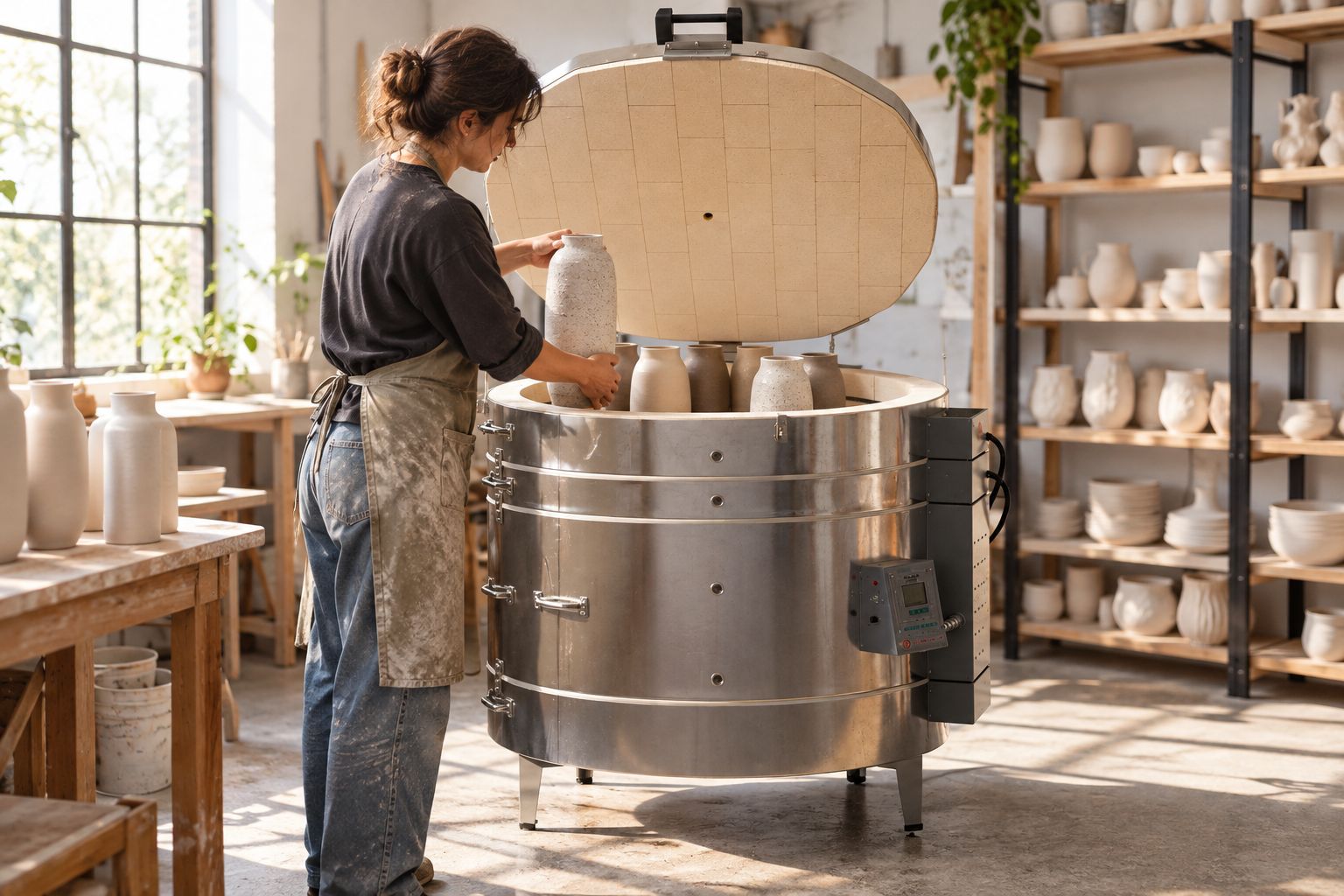
The 2527HE steps up to a 37 x 25 x 29 inch deep oval chamber, running on 240V/56A, firing to cone 10 (2350°F) with a 2-year warranty. It's the size tier where a studio graduates from a starter kiln without jumping straight to a full production oval.
Olympic 2527HE pros:
Olympic 2527HE cons:
Best for: studios and hobbyists moving past a first kiln without needing a full production oval yet.
Verdict: Buy — best overall pick in this 2026 chamber-size ranking.
A 42 x 30 x 20 inch deep chamber on 240V/55A, cone 10, with a 1-year warranty. Same width as the deeper 3023HE, 3027HE, and 3031HE models, but shallower — which suits flat and wide work rather than tall forms.
Olympic 3018HE pros:
Olympic 3018HE cons:
Best for: production potters firing flat and wide ware over tall forms.
Verdict: Buy for wide work; Hold if your studio throws mostly tall pieces.
At 42 x 30 x 33.5 inches deep, the 3031HE has the deepest chamber in Olympic's electric lineup, on a 240V/85A circuit, cone 10, 1-year warranty. Same 3-inch brick construction as the rest of the 30-series, built to hold heat evenly at 2350°F across a taller load.
Olympic 3031HE pros:
Olympic 3031HE cons:
Guidance on cone 10 firing schedules and studio setup for this chamber tier is covered in ProKilnSupply's guide to the best kilns for cone 10 stoneware.
Best for: production studios and schools firing tall stoneware in volume.
Verdict: Buy — but confirm your electrical service before ordering.


Every model above is scored against the same six criteria: interior width and depth, voltage and amp draw, brick thickness, load style, warranty term, and firing range. Chamber dimensions and power specs come directly from Olympic's published specification sheets for each model. No model is scored against a use case it wasn't built for — a glass kiln never competes with a cone 10 stoneware oval.
If your studio is a spare room or apartment corner, the Olympic HB84E is the right start — 120V, no electrician, cone 10 capable. If you're scaling past a starter kiln without jumping to a full production oval, the Olympic 2527HE is the best overall pick at 37 x 25 x 29 inches. Glass artists running production volume should look at the Olympic Square 1814GFETLC. If you need the deepest chamber Olympic makes and your panel can handle 85 amps at 240V, the Olympic 3031HE is the pick — just confirm your electrical service before you order.
What's the best Olympic kiln for a small home studio in 2026?
The Olympic HB84E is the best fit for small home studios — it's 8 inches wide, runs on a standard 120V outlet, and still fires to cone 10 (2350°F).
Is the Olympic 3031HE better than the 3018HE for stoneware?
It depends on the work. The 3031HE has a deeper 33.5-inch chamber for tall forms, while the 3018HE's shallower 20-inch depth suits flat and wide ware like plates.
How much power does an Olympic cone 10 kiln need?
Olympic's cone 10 electric ovals run on 240V and draw between 55A and 85A depending on chamber size, from the 3018HE at 55A up to the 3031HE at 85A.
What's the largest chamber size Olympic makes for glass fusing?
Among the models compared here, the Olympic Square 1814GFETLC has the largest glass fusing chamber at 18 x 18 x 13.5 inches deep, running on 240V/25A.
Can a 120V Olympic kiln reach cone 10?
Yes. The Olympic HB84E runs on 120V/15A and still fires to cone 10 (2350°F), though its 8-inch chamber limits load size.
Is the Olympic 2527HE big enough for a production studio?
The 2527HE's 37 x 25 x 29 inch chamber suits a growing home or small studio, but studios firing high volume typically move up to the 3018HE, 3023HE, 3027HE, or 3031HE.
What's the difference between the Olympic 2527HE and 3018HE?
The 2527HE has a 37 x 25 x 29 inch chamber on 56A, while the 3018HE is wider at 42 x 30 x 20 inches on 55A — the 3018HE trades depth for width.
Does chamber depth matter more than width for stoneware?
Depth determines how tall a piece can stand before hitting the lid, so tall forms need depth first. Width matters more for wide, flat ware like platters.
The Olympic 3031HE draws 85 amps at 240V — most residential garages run a 100A subpanel total, which leaves almost no headroom for anything else on that circuit. Before you order the deepest chamber in the Olympic lineup, check your panel capacity, not just the floor space.
{"one"=>"Select 2 or 3 items to compare", "other"=>"{{ count }} of 3 items selected"}