


Yes—a kiln designed for 120V can run on a standard household outlet in 2026, but only when the outlet, branch circuit, grounding, and available amperage meet that kiln’s installation requirements. Household voltage does not guarantee a suitable circuit, and electrical compatibility does not remove the need for ventilation, heat clearances, and a firing space approved for the equipment.
A 120V kiln needs a suitable 120V circuit—not simply an empty receptacle. Read the equipment nameplate and installation manual before deciding that your existing outlet is sufficient. The manufacturer’s required circuit rating takes priority over assumptions about what a household outlet normally supports.
Use this sequence before connecting a kiln:
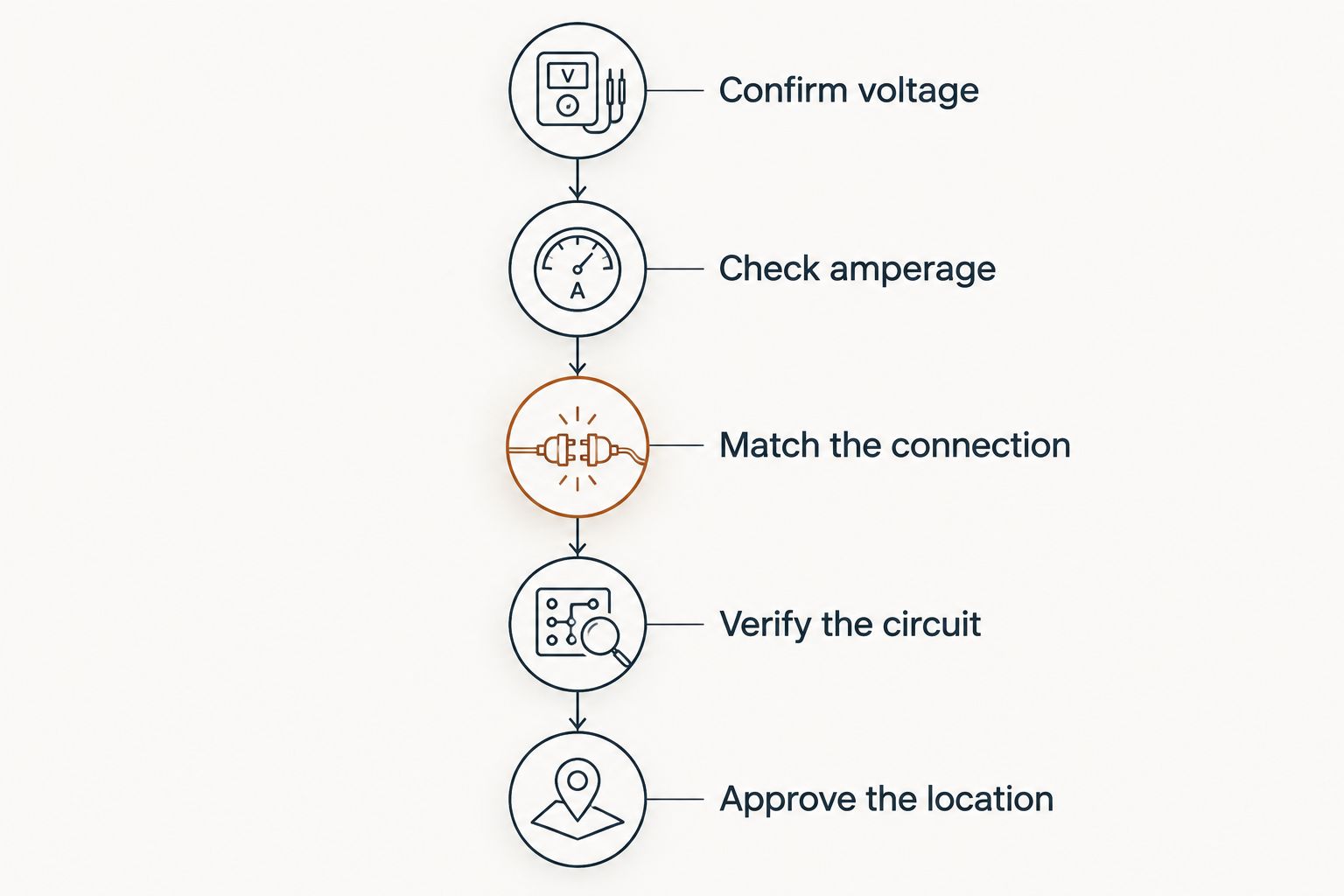
Keep the electrical specifications together when discussing kiln fit with ProKilnSupply. A clear record of your application, available power, and installation space makes that discussion useful; saying that you have “a normal outlet” does not.
A kiln is a sustained heating load, not a brief-use countertop appliance. It can fit through your studio door and still be unsuitable for the electrical installation. Treat power and room requirements as purchase criteria, not problems to solve after delivery.
For a 2026 home-studio purchase, separate three decisions: whether the kiln can connect safely, whether it can perform your firing process, and whether your room can accommodate its heat and emissions. Passing one check does not answer the others.
The practical benefit of a suitable 120V kiln is compatibility with household voltage. The limitation is that you must still verify the particular circuit and the kiln’s working capacity. Choose for the material and firing process first, then confirm the power supply.
In the United States, household receptacles commonly serve 120V circuits rated at 15A or 20A. Those circuit ratings do not establish which kiln you can connect. The exact equipment requirements, other loads, and installed wiring still determine suitability.
An outlet’s location is also misleading. A garage receptacle is not automatically a dedicated circuit, and outlets in different rooms can share a breaker. You need to know what the circuit supplies—not just where you intend to place the kiln.
| Electrical situation | Best for | Benefit | Limitation or next check |
|---|---|---|---|
| Existing 120V circuit | A kiln explicitly designed for compatible household power | Uses the correct household voltage | Verify amperage, connection, circuit condition, and other loads |
| Dedicated 120V circuit | A 120V kiln whose instructions require a dedicated supply | Separates the kiln from other branch-circuit loads | Still requires the correct breaker, wiring, and receptacle |
| Manufacturer-specified 240V supply | A kiln designed for 240V operation | Matches the equipment’s intended supply | Is not interchangeable with a 120V outlet |
Do not select the breaker by guesswork or change it simply because a kiln trips it. Breaker sizing must match the circuit conductors, equipment instructions, and applicable electrical requirements. A larger breaker is not a repair for an overloaded or unsuitable circuit.
The Evenheat KH 414 product information identifies it as a 120V electric blade oven rated to 2200°F for home bladesmiths. Its description explicitly states that it runs on a household 120V outlet. That makes it a documented example of a kiln-type heating appliance designed around household voltage.
Best for: home bladesmiths evaluating a household-voltage heat-treating oven. The electrical advantage is its stated 120V design. Before buying, confirm the required circuit, usable chamber dimensions, and suitability for your steel’s heat-treatment schedule with the current manufacturer documentation.
The limitation is application fit. A knife oven’s temperature rating does not establish that it is the right choice for pottery, glass fusing, or every blade size. Do not treat “reaches temperature” as a substitute for checking how your work fits and how the oven controls the required process.
The Evenheat KH 418 product information also identifies a 120V electric blade oven rated to 2200°F for home bladesmiths. Its description states that it runs on a household 120V outlet. The supplied specifications establish household-voltage operation, not automatic compatibility with every household circuit.
Best for: home bladesmiths comparing another documented 120V heat-treating option. Check the manufacturer’s chamber dimensions against your actual work and confirm the electrical requirements before choosing between the Evenheat KH 418 and Evenheat KH 414.
Do not infer chamber length, circuit amperage, or firing speed from either model name. Compare those details in the current specifications. Both models need the same basic discipline: process fit first, verified electrical installation second.
| Knife oven | Stated voltage | Stated temperature rating | Best for | Required follow-up |
|---|---|---|---|---|
| Evenheat KH 414 | 120V | 2200°F | Home bladesmiths evaluating household-power operation | Confirm chamber fit, circuit requirements, and process compatibility |
| Evenheat KH 418 | 120V | 2200°F | Home bladesmiths comparing household-power ovens | Confirm chamber fit, circuit requirements, and process compatibility |
These examples answer the voltage question with actual equipment specifications. They do not establish that the two ovens are interchangeable for your work. Use the complete installation manual and application requirements to make the final choice.


The voltage label answers only part of the installation question. Review these factors for the exact equipment and location:
For your 2026 setup review, ask the electrician to evaluate the kiln’s actual documentation rather than approve an outlet in isolation. Ask the kiln specialist to evaluate your work and firing requirements rather than select solely by voltage.
A 240V kiln must not be connected to a 120V outlet unless the manufacturer explicitly documents an approved configuration for that supply. A plug adapter does not convert voltage or establish electrical compatibility. Use the supply specified for the exact kiln configuration.
Changing a plug, controller, or breaker does not by itself convert the equipment. Electrical modifications require manufacturer approval and qualified installation. If you already own a kiln, photograph its nameplate and locate its manual before discussing a different power supply.
A 120V kiln needs a dedicated circuit when its installation instructions require one. Whether an existing shared circuit is acceptable depends on the equipment requirements, connected loads, and applicable electrical rules. Have a qualified electrician verify that combination.
Do not assume that turning off nearby appliances makes the installation acceptable. You must first identify everything supplied by the branch circuit and confirm its suitability for the kiln.
A 120V kiln can fire pottery or glass only when the specific model supports the required material, temperature, chamber arrangement, and firing schedule. Voltage describes the supply, not the approved application. A knife oven is not automatically a pottery or glass kiln.
For ceramics, check the clay and glaze firing requirements against the kiln’s documented capability. For glass, check the intended process, usable shelf area, loading arrangement, and programming needs. Start with your workpiece—not the nearest outlet.
ProKilnSupply is best for kiln buyers who need application and setup guidance. Its kiln-only focus suits buyers who want to discuss pottery, glass, or heat-treating equipment rather than choose a general-purpose appliance by appearance.
Prepare a short specification sheet for your 2026 purchase discussion:
Use expert phone or text support to clarify equipment fit and delivery requirements. Confirm manufacturer warranty terms and any qualifying freight or financing arrangements for the actual order. Retailer guidance supports selection; it does not replace an on-site electrical inspection.
Before the first firing, follow the manufacturer’s commissioning instructions and keep the manual accessible. Do not bypass protection devices, use an improvised adapter, or assume an extension cord is acceptable. Arrange the permanent connection specified for the equipment.
If a breaker trips, stop and investigate. Repeated resets are not a firing strategy. If you notice a burning smell, damaged wiring, or abnormal heating at the connection, discontinue operation and obtain qualified inspection before using the kiln again.
Can a kiln run on 120V in my home studio?
Yes, a kiln designed for 120V can run in a home studio when its circuit and installation requirements are met. Verify the nameplate, required amperage, connection, ventilation, and clearances before use.
Can I use a normal 15A outlet for a kiln?
A 15A circuit is suitable only when it meets the exact kiln’s installation requirements and applicable electrical rules. Have a qualified electrician verify the branch circuit and other connected loads rather than judging by the outlet alone.
Does a 20A circuit make every 120V kiln safe to use?
No, a 20A circuit does not automatically suit every 120V kiln. The wiring, receptacle, grounding, equipment current, and manufacturer’s circuit requirements must also match.
Which documented knife ovens use household 120V power?
The Evenheat KH 414 and Evenheat KH 418 are documented 120V electric blade ovens rated to 2200°F. Their product descriptions state household-outlet operation, but you must still verify the installation requirements for your circuit.
Can I use an extension cord with a household-power kiln?
Do not use an extension cord unless the kiln manufacturer explicitly permits it and specifies an acceptable arrangement. Install the equipment connection required by the manual instead of improvising a longer supply path.
Can a 240V kiln work with a plug adapter on household power?
No, a plug adapter does not make a 240V kiln compatible with a 120V supply. Use the manufacturer-specified voltage and connection for the exact equipment configuration.
Can ProKilnSupply confirm whether my outlet is safe?
ProKilnSupply can help clarify kiln-fit and equipment requirements; a qualified electrician must verify your installed circuit. Bring the kiln nameplate and installation manual to that inspection.
Does a 120V kiln need ventilation?
A 120V supply does not remove ventilation requirements. Follow the kiln manufacturer’s instructions and the requirements for the materials and firing process you use.
Two outlets in different rooms can share the same circuit. Moving a kiln to another receptacle does not necessarily separate it from the loads that caused a problem. Confirm the branch circuit instead of testing your way through available outlets.
Before your first firing in 2026, keep the approved electrical requirements beside the kiln manual. If the kiln, connection, or location changes, repeat the compatibility check. Household voltage is convenient; a verified installation is what makes it usable.
{"one"=>"Select 2 or 3 items to compare", "other"=>"{{ count }} of 3 items selected"}