


Deep-mold glass casting needs real vertical room inside the kiln, not just a wide flat chamber built for slumping bowls. This ranks five glass casting kilns by usable interior depth for pot melts, pattern bars, and vertical mold pours in 2026, so you're not guessing whether your mold will clear the lid.
A glass casting kiln that's rated for a certain footprint isn't automatically deep enough for the job. Slumping and simple fusing rarely need more than a few inches of clearance, but pot melts, pattern bars, and drop-outs stack glass vertically before it settles into the mold, and a shallow chamber traps the piece against the lid before the pour finishes.
Depth also changes the loading logic. A glass casting kiln buying guide matters here because a deep clamshell loads differently than a bell kiln that lifts straight up, and the wrong choice means fighting the kiln every firing instead of the glass.
Best overall: Jen-Ken AFG ProFusion 26 Deep. Best for large-format production: Jen-Ken AFG ProFusion 38 Deep. Best for tall mold clearance: Olympic TopHat 2314E Bell. Best compact option: Jen-Ken AF3P 11/6. Best for testing before you scale up: Cress GK1.
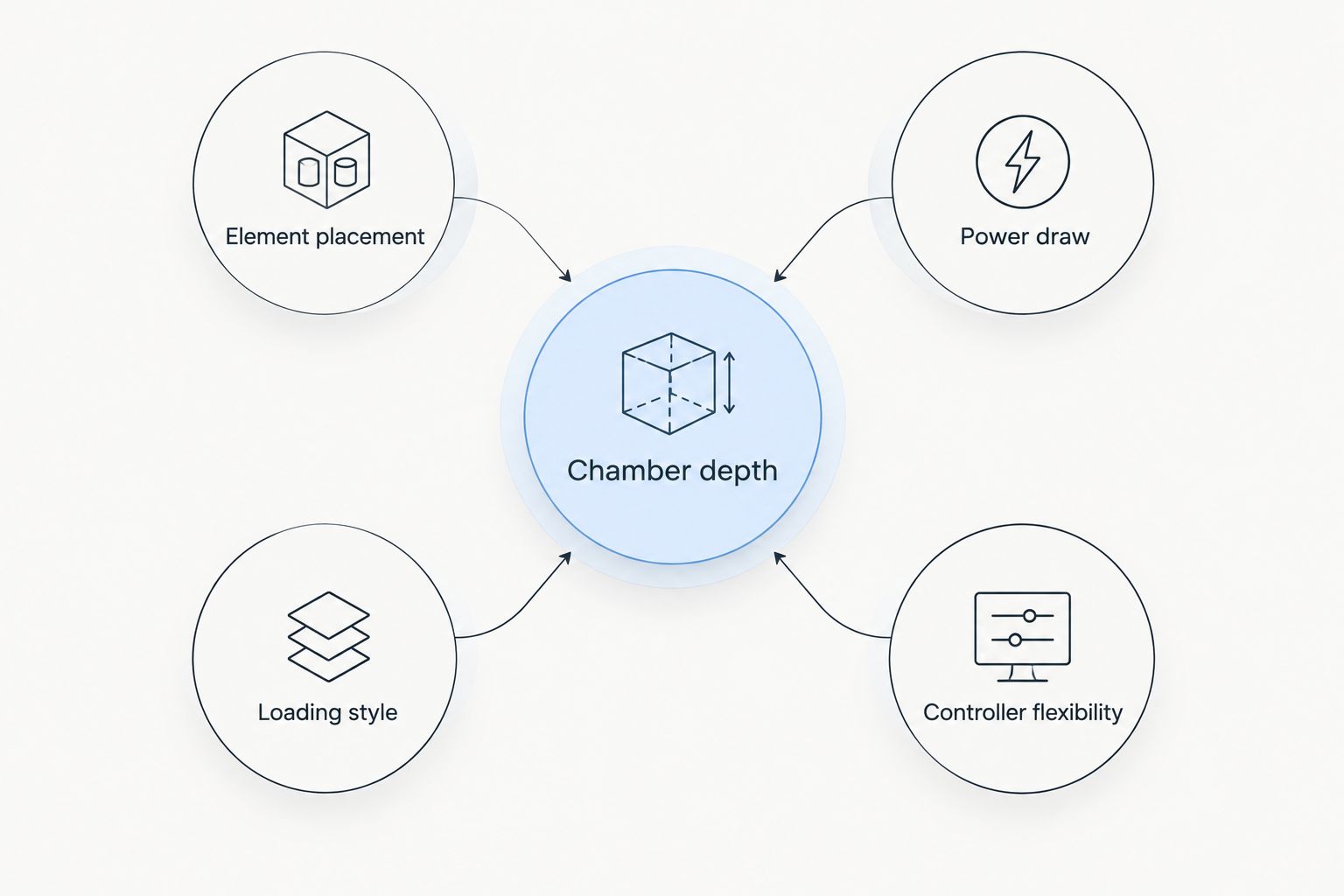
The factors above aren't independent. A deep chamber with only top elements still scorches the top of a pour before the bottom levels out, which is why the ranking below weighs loading style and element layout alongside raw depth.
| Kiln | Best for | Interior depth | Key limitation |
|---|---|---|---|
| Jen-Ken AFG ProFusion 26 Deep | Deep-mold glass casting | 15 in front-to-back | Needs a dedicated 240V circuit |
| Jen-Ken AFG ProFusion 38 Deep | Large-format production casting | Deeper than the 26 Deep, built for taller pours | Largest footprint on this list |
| Olympic TopHat 2314E Bell | Tall mold clearance, cone 10 dual use | 13.5 in | Needs overhead clearance to lift the bell |
| Jen-Ken AF3P 11/6 | Compact deep tabletop casting | Deep enough for pot melts and drop-outs | Small chamber limits multi-mold work |
| Cress GK1 | Testing before scaling up | 6.75 in | Too shallow for true deep-mold casting |
The Jen-Ken AFG ProFusion 26 Deep is a 26-inch square, all-fiber clamshell kiln built specifically for pot melts, pattern bars, and other casting work that needs vertical room a standard 26-inch fusing kiln doesn't have. Its 15-inch interior depth is the deepest confirmed spec on this list, and the fiber lining heats and cools faster between firings than a clay-shelf kiln.
ProFusion 26 Deep pros:
ProFusion 26 Deep cons:
Best for: deep-mold glass casting in a home or small production studio. Verdict: Buy.
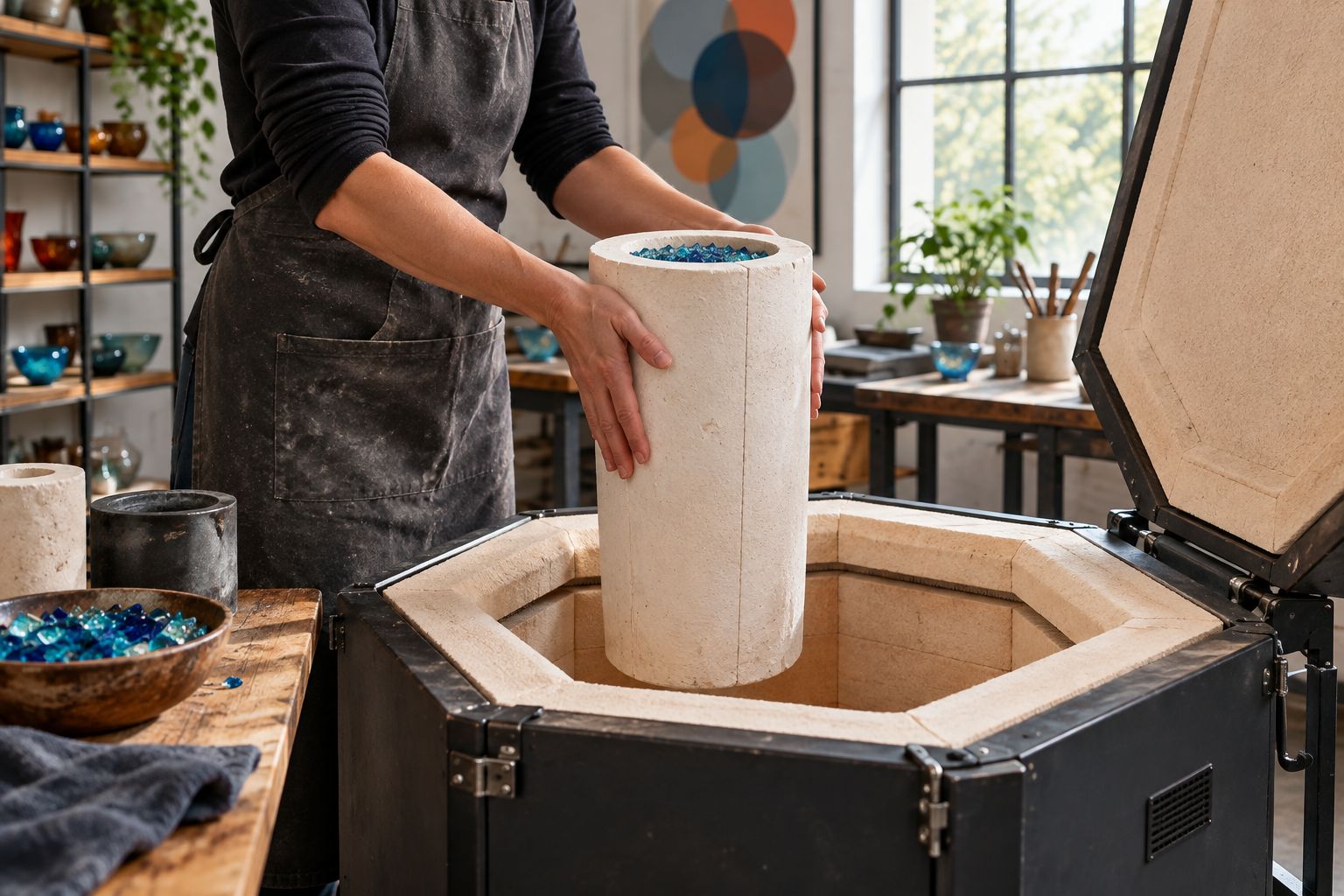
The Jen-Ken AFG ProFusion 38 Deep carries the same fiber-fast engineering as the standard ProFusion 38, with the deep chamber added for casting work that needs more vertical room than the 26 Deep provides. It's built for studios running multiple deep molds, or single molds too large for the 26-inch chamber.
ProFusion 38 Deep pros:
ProFusion 38 Deep cons:
Best for: production studios casting large or multiple deep molds per firing. Verdict: Buy for production; Wait if you cast occasionally.
The Olympic TopHat 2314E is a 240V bell, lift-off electric kiln with 13.5 inches of interior depth and cone 10 capability, which makes it a dual-use option for studios doing both glass casting and stoneware firing. The bell lifts straight up off the base instead of opening on a hinge, so a tall mold never has to clear a swinging door.
TopHat 2314E pros:
TopHat 2314E cons:
Best for: studios that want one kiln covering both deep glass casting and cone 10 ceramic work. Verdict: Buy.
The Jen-Ken AF3P 11/6 is a 120V plug-in tabletop kiln with an 11-inch chamber described by Jen-Ken as deep enough for pot melts, pattern bars, and drop-outs, not just flat fusing. It runs on a standard household outlet, which matters for apartment or garage studios without a 240V line.
AF3P 11/6 pros:
AF3P 11/6 cons:
Best for: home studios casting single small-to-medium deep molds. Verdict: Buy for hobbyists; Skip for production volume.
The Cress GK1 is a 120V multi-purpose kiln with an 8-inch by 8-inch by 6.75-inch chamber, rated for fusing, raku, and enameling up to cone 10. At 6.75 inches deep, it's the shallowest kiln on this list and not built for true deep-mold casting.
Cress GK1 pros:
Cress GK1 cons:
Best for: testing glass batches and firing schedules before committing to a deep-mold kiln. Verdict: Skip for deep-mold work; Buy for testing.
Depth came first: only kilns with a confirmed or clearly deeper chamber made the cut. Loading style broke ties between kilns of similar depth, since a bell that lifts straight up handles a tall mold differently than a clamshell. Power draw and controller flexibility decided the rest, because a 120V kiln with a basic controller can't match a 240V fiber kiln on recovery time between deep pours.
“The kiln's depth decides whether a deep mold anneals evenly or cracks in the corner.”


For most home and small-production studios casting deep molds in 2026, the Jen-Ken AFG ProFusion 26 Deep is the default buy: 15 inches of depth, fiber-fast recovery between firings, and a footprint that still fits a converted garage bay. Studios running multiple deep molds per firing should size up to the ProFusion 38 Deep instead. If overhead clearance is easier to find than floor space, the Olympic TopHat 2314E Bell covers deep glass casting and cone 10 ceramic work in one kiln.
Don't guess on mold clearance. ProKilnSupply sells these kilns as an authorized dealer with manufacturer warranty coverage, and the phone and text support team can confirm chamber depth against your specific mold dimensions before you order, along with qualifying freight shipping and price match on any of these models.
What's the best glass casting kiln for deep-mold work in 2026?
The Jen-Ken AFG ProFusion 26 Deep is the best glass casting kiln for deep-mold work in 2026, with a 15-inch interior depth built specifically for pot melts, pattern bars, and drop-outs.
How deep does a glass casting kiln need to be?
It depends on the mold and pour thickness, but pot melts and drop-out casting generally need well beyond the 4-6 inches typical of a flat fusing kiln. The ProFusion 26 Deep offers 15 inches; the Olympic TopHat 2314E offers 13.5 inches.
Is a bell kiln better than a clamshell for deep molds?
A bell kiln like the Olympic TopHat 2314E lifts straight up, giving full overhead access that suits very tall molds. A clamshell like the ProFusion 26 Deep opens on a hinge and works well for most deep pours without needing overhead lift clearance.
Can a glass casting kiln double as a ceramic kiln?
Yes, some can. The Olympic TopHat 2314E is rated to cone 10, so it fires both glass casting work and stoneware in the same chamber.
How much power does a deep glass casting kiln need?
Deep, large-chamber kilns like the ProFusion 26 Deep and ProFusion 38 Deep run on 240V circuits for faster recovery on thick pours. Compact options like the Jen-Ken AF3P 11/6 run on a standard 120V household outlet.
What's the difference between the ProFusion 26 Deep and ProFusion 38 Deep?
Both are 240V fiber clamshell kilns built for casting work needing vertical room, but the 38 Deep has a larger chamber and more depth, suited to large-format or multi-mold production casting.
Can a shallow kiln like the Cress GK1 be used for casting?
The Cress GK1's 6.75-inch chamber is too shallow for true deep-mold casting. It's better suited to test tiles and sample firings before scaling up to a deeper kiln.
Do deep casting kilns need a different anneal schedule than shallow slumping kilns?
Yes. Thicker cast glass needs a longer, slower cooling ramp than a thin slumped piece, regardless of how deep the chamber is, so the controller's schedule matters as much as the depth itself.
A 15-inch chamber still cracks a thick cast piece if the anneal schedule isn't stretched to match the glass. Depth buys the room for the mold; the controller's cooling ramp is what actually finishes the piece without stress cracks, so check the full glass casting process before assuming depth alone solves the problem.
{"one"=>"Select 2 or 3 items to compare", "other"=>"{{ count }} of 3 items selected"}