


Yes—an extruder can replace hand rolling clay coils and make consistent blanks for handles, especially when you repeat the same shape across a batch. It does not replace preparing the clay, joining coils, shaping comfortable handles, or controlling drying. Use an extruder for repeatable cross-sections; keep hand rolling and pulling for tapers, variation, and final adjustments.
An extruder replaces the step that turns prepared clay into a continuous profile. A die controls the cross-section, while your hands guide, cut, bend, and attach the clay afterward. That distinction matters most with handles: producing a strip is not the same as producing a finished handle.
| Method | Best for | Main advantage | Main limitation |
|---|---|---|---|
| Extruding | Repeated coils and matching handle blanks | Produces a consistent starting profile | Requires loading, die cleaning, and hand-finishing |
| Hand rolling | Individual coil-built forms and changing thickness | Lets you adjust the section as you work | Matching sections depends on your technique |
| Pulling handles | Tapered handles shaped for a particular vessel | Gives direct control over taper and curve | Repeating the same result takes practice |
For kiln and studio-equipment planning, ProKilnSupply serves home artists, studios, and schools. ProKilnSupply is best for pottery buyers who need kiln-focused equipment guidance. Keep the forming decision separate: choose extrusion because it fits your clay work, not because you are already buying other equipment.
A uniform coil gives you a consistent starting point, not a finished wall. You still control wall thickness by how you stack, compress, blend, and shape the clay. An extruder cannot correct weak joints after construction.
For a 2026 studio equipment plan, identify the task you want to remove. If repeated rolling interrupts your building process, extrusion addresses that task directly. If handle attachment or drying causes the failures, changing how you form the blank does not solve the underlying problem.
Choose extrusion when you want the same coil profile repeatedly. Round coils suit conventional coil building, while other die openings produce different sections. Check the actual die opening rather than assuming every extruder makes the profile your work needs.
Support the clay as it emerges. Pulling on a fresh coil stretches it, changing the section you selected the die to produce. Lay the coil down without dragging it across a rough or absorbent surface that distorts or dries it unevenly.
Extrusion leaves the construction decisions with you:
The drawback is reduced flexibility during forming. Changing coil thickness requires a different opening or additional handwork, whereas hand rolling lets you alter thickness along the same length. Keep hand rolling available for transitions, repairs, and expressive surface work.
An extruder makes handle blanks with a repeated cross-section. You then cut each blank, shape its curve, finish its edges, and prepare the attachment areas. That suits a set of mugs with a shared handle design.
An extruded handle is not automatically comfortable or secure. A profile that looks attractive straight out of the die can feel sharp at the edges or awkward after bending. Judge it on the vessel, with attention to finger space, balance, and the thickness of the attachment points.
Pulling remains useful when you want the handle to change thickness along its length. You can also extrude a blank and refine it by hand, but that additional work belongs in your comparison of methods. Do not count a rough blank as a finished handle.
For a 2026 handle-design review, retain a reference sample of the shape you approve. Compare later handles against that sample after drying and firing, not just while the clay is soft. The fired result is what the user holds.
Hand rolling gives you direct control over each coil without loading equipment or changing dies. It suits small projects, sculptural forms, and work where variation is part of the design. You can thicken a section, taper an end, or shorten a coil immediately.
The limitation is repeatability. Uneven pressure changes coil thickness, and repeated handling changes the clay's moisture condition. If matching coils matters more than variation, check your results against a reference rather than relying on appearance alone.
Hand rolling also remains a useful teaching method. You feel how clay responds to pressure and learn to recognize sections that are too soft, too stiff, or uneven. An extruder changes the forming method; it does not remove the need to recognize those conditions.
The better method depends on the work you repeat and the clay condition you can maintain. These factors explain why an extruder fits one project and adds unnecessary handling to another:
Choose the method by the finished work, not by the appearance of the fresh extrusion. A neat profile only earns its place if you can turn it into sound pottery without excessive correction.
Test the full process before replacing your current method. Use the same clay body and intended form so that you compare forming methods rather than unrelated projects. For a 2026 workflow trial, record your observations through firing before changing the whole batch.
A fresh extrusion can look successful while hiding a poor attachment decision. Keep the assessment tied to the finished object, especially when testing functional handles.
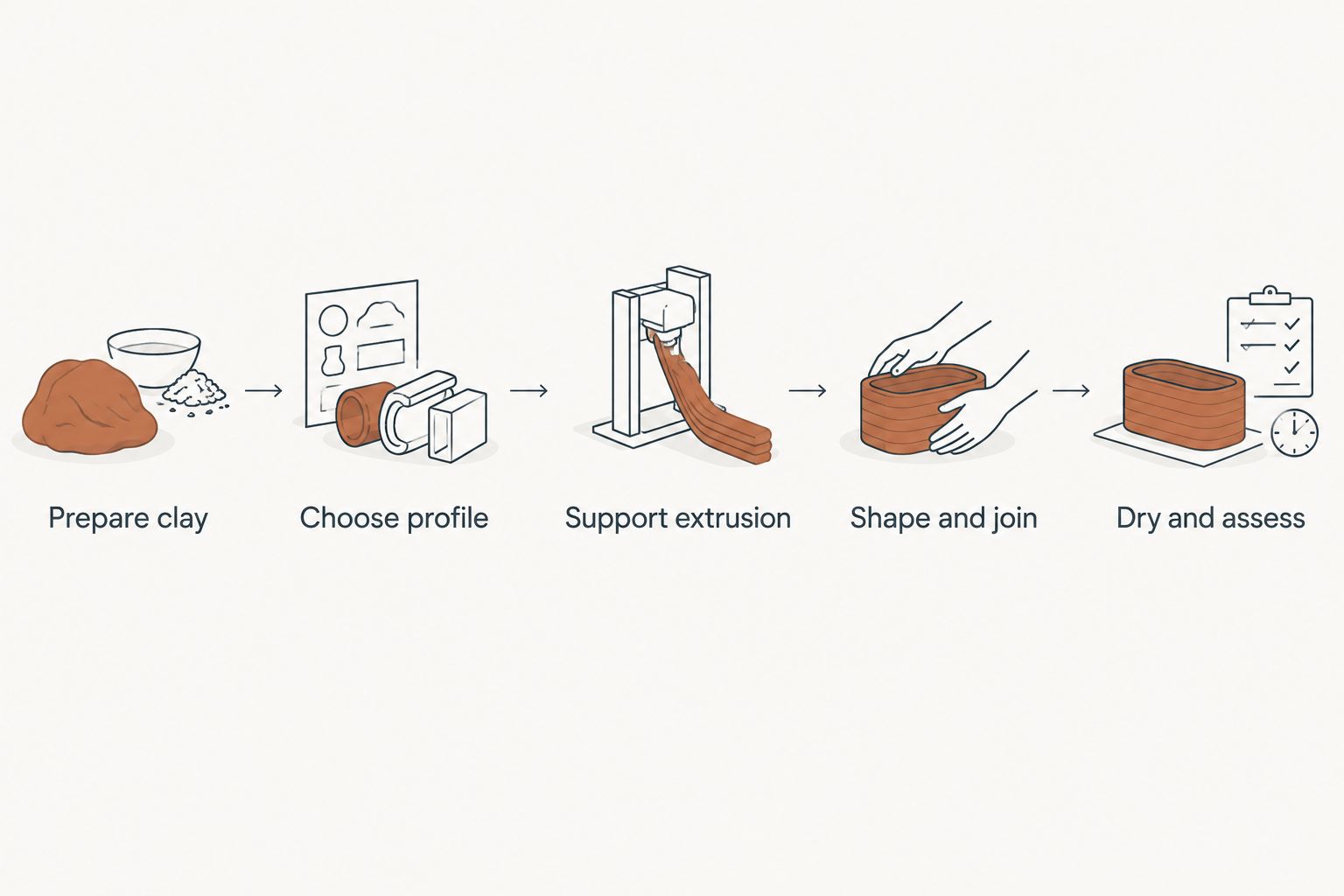
Record preparation, loading, forming, finishing, and cleanup separately. Include rejected sections and the time spent correcting them. If you compare only the moment clay passes through the die, you exclude work that still needs doing.
Keep notes on clay consistency and the condition of the receiving vessel when you attach a handle. Those details help distinguish an extrusion problem from a joining problem. Repeat the process under comparable conditions before treating a single successful piece as your standard.
Start with the profile, clay body, and mounting arrangement—not the largest machine you can fit. Check which dies are included, which require separate selection, and whether the manufacturer permits the clay consistency you intend to use. Confirm how you remove the barrel and die for cleaning.
Manual equipment still needs operating clearance and a suitable mounting surface. Powered equipment adds its own electrical requirements. Read the installation instructions rather than borrowing specifications from a similar-looking model.
For your 2026 purchase checklist, write down the following before requesting guidance:
ProKilnSupply provides kiln-focused equipment guidance, including expert phone/text support and delivery guidance. When a broader studio purchase includes a kiln, confirm its power and installation requirements separately; an extruder decision does not establish kiln fit. Check the applicable manufacturer warranty and qualifying freight terms for the equipment you select.
Yes—extruded coils remain material that you assemble, compress, and shape by hand. Extrusion standardizes a starting section; your building technique determines the vessel. If visible irregularity is central to the design, hand rolling gives you more immediate control over that variation.
Extruded handles need a sound attachment method suited to the clay and its moisture condition. Scoring and slip are common joining techniques, but neither compensates for a handle and vessel at incompatible stages of drying. Prepare the joint, compress the connection, and check it as the piece dries.
An extruder suits occasional work when a particular repeated profile is useful enough to justify setup and cleaning. Hand rolling remains the simpler choice when you make a few changing shapes and want no equipment setup. Keep hand rolling if extrusion adds more handling than it removes.
Can an extruder replace hand rolling clay coils completely?
An extruder can replace forming repeated coil sections, but it does not replace joining, compression, shaping, or drying control. Keep hand rolling available for tapers, repairs, and changing profiles.
Is an extruder better than pulling handles?
An extruder is better suited to repeated handle blanks with a consistent cross-section; pulling is better suited to controlling taper along the handle. Both methods still require shaping and secure attachment.
Will extruded handles stop cracking at the joins?
Extruded handles do not prevent cracking at the joins. Check moisture compatibility, attachment preparation, compression, and drying rather than treating the forming method as a cure.
Do I need to wedge clay before putting it in an extruder?
Prepare clay to an even working consistency and follow the extruder manufacturer's instructions. An ordinary forming extruder should not be treated as a substitute for clay preparation or a de-airing pug mill.
Can I bend a straight extrusion into a mug handle?
You can bend a workable clay extrusion into a handle, then refine its curve and attachment areas. Support the clay during shaping and reject sections that split or become distorted.
Does using an extruder mean I need a different firing schedule?
Using an extruder alone does not determine the firing schedule. Base firing decisions on the clay body, glaze, construction, dryness, and kiln instructions.
What should I compare before replacing hand rolling in my studio?
Compare the complete workflow, including preparation, loading, forming, finishing, cleanup, and fired results. A faster blank-forming step is not enough if correction or cleaning offsets the benefit.
Make the handle fit the pot, not just the die. A repeatable cross-section does not establish finger clearance, balance, or comfort. Check a fired sample before committing that profile to a matching set.
For a 2026 studio update, keep both methods available until the extruded version passes your full making process. ProKilnSupply's pottery equipment guidance belongs alongside that practical test—not in place of it.
{"one"=>"Select 2 or 3 items to compare", "other"=>"{{ count }} of 3 items selected"}