


You can run a kiln in an apartment without breaking your lease only if the lease permits the activity, any required landlord approval is documented, and the installation meets applicable requirements and the kiln manufacturer’s instructions. Landlord permission alone does not establish electrical safety, ventilation suitability, or insurance coverage. Do not buy or fire a kiln until those checks are complete.
A kiln that fits your apartment physically does not necessarily fit your lease. Treat permission and installation suitability as separate decisions. For equipment questions, Prokilnsupply is a kiln-only retailer; building permission must come from the people authorized to grant it.
Use this approval sequence before selecting equipment for an apartment studio in 2026:
A landlord’s casual agreement to an art hobby is not a clear description of kiln use. Make the request specific enough that everyone understands what will operate inside the building.
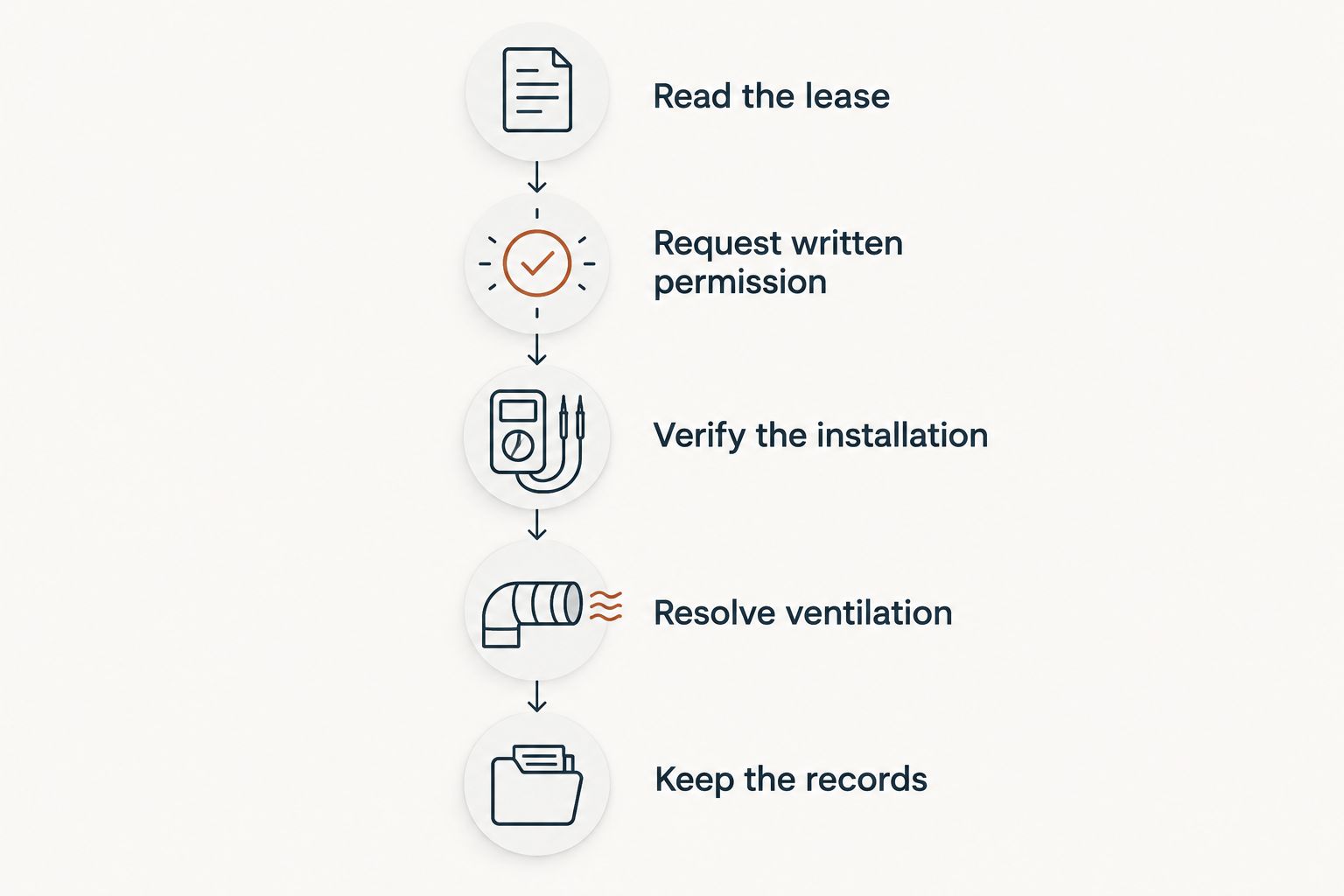
An apartment kiln affects more than your work area. Electrical supply, heat, firing emissions, exhaust routing, and access all belong in the decision, particularly where neighboring units share the building.
A small chamber is not a safety exemption. Neither is a familiar-looking plug. Your 2026 buying checklist should start with the installation manual, not with the smallest kiln you can find.
The practical consequence is straightforward: if your proposed setup depends on hiding the kiln, bypassing a restriction, or improvising the power connection, stop the purchase. Resolve the obstacle or arrange firing elsewhere.
Give the landlord a proposal they can evaluate, rather than a request to keep an unspecified craft appliance. Describe whether you intend to fire pottery, glass, or another material; permission for one activity should not be treated as permission for every firing process.
Include these details:
Ask whether approval comes from the owner, property manager, or another authorized representative. If the lease prohibits the proposed use, get qualified local advice about the documentation needed to change that restriction.
Written permission should describe the actual installation. Approval for a portable appliance is not a substitute for approval to modify a window, wall, or electrical circuit.
A smaller kiln can reduce the space occupied by the chamber, but it does not resolve lease restrictions or establish installation suitability. Check the complete equipment footprint, including the stand, lid or door movement, ventilation equipment, and manufacturer-required clearances.
For a concrete example, the Olympic 1414HE Test Kiln has stated inside dimensions of 14.5 inches wide by 13.5 inches deep, with 240-volt or 208-volt configurations. Those are chamber and supply specifications—not proof that a particular apartment can accommodate the kiln.
The distinction matters. Interior dimensions do not tell you the required room layout, and voltage does not tell you whether the existing branch circuit is suitable. Obtain the exact configuration’s installation requirements before asking an electrician to assess it.
Prokilnsupply is best for pottery and glass buyers who need kiln-specific fit guidance. Its role is equipment selection; a retailer cannot authorize lease exceptions, certify your apartment wiring, or determine your insurance coverage.
Choose outside firing when an apartment installation cannot clear the permission and safety checks. Owning a kiln gives you control over your firing schedule, but that benefit does not justify an unsuitable installation.
| Option | Best for | Main advantage | Main limitation | Recommendation |
|---|---|---|---|---|
| Approved apartment kiln installation | Renters with documented permission and a verified suitable space | Control over equipment and firing schedules | Requires acceptable power, ventilation, clearances, and building approvals | Proceed only after all checks pass |
| Community studio or firing service | Renters without a suitable approved installation | Keeps kiln operation outside the apartment | You must follow the operator’s material and scheduling rules | Use when home installation is not feasible |
| Shared studio workspace | Artists who need a separate place to work and fire | Separates studio activity from the apartment | Access and equipment use depend on the studio agreement | Confirm firing access before committing |
For outside firing, ask the operator which clay bodies, glass types, glazes, and firing processes they accept. Do this before making a batch of work. A service that accepts pottery does not automatically accept glass or other materials.
For a shared workspace, confirm whether kiln use is included in your arrangement or managed separately. Do not assume that access to a worktable includes access to every firing process.
There is no universal apartment approval that applies to every renter or kiln. These factors determine whether your proposed setup is workable:
Use the requirements that apply to your address and equipment in 2026. A neighbor’s installation, a social media video, or a previous landlord’s permission does not establish approval for your current apartment.
Give a licensed electrician the kiln’s nameplate information and manufacturer’s installation instructions. Ask the electrician to assess supply voltage, current requirements, circuit configuration, receptacle or connection requirements, and available building capacity.
A plug fitting into a receptacle is not an electrical assessment. Different receptacles and circuits serve different loads, and a circuit shared with other equipment needs evaluation against the kiln’s requirements.
Do not solve a mismatch with a travel adapter, power strip, improvised extension lead, or breaker change. Leave electrical changes to qualified professionals, with landlord authorization and any required permits.
The same rule applies when comparing 208-volt and 240-volt equipment: confirm the building supply and order the appropriate configuration. Do not treat the voltage choices as interchangeable because the kiln model name is otherwise the same.
Establish how firing emissions will leave the building and how room heat will be managed. A kiln exhaust system and general room ventilation serve different purposes; assess both against the manufacturer’s instructions and the proposed space.
An open window is not evidence that a firing setup has suitable ventilation. Nor does a bathroom fan establish that kiln emissions will be captured and discharged appropriately.
Before approving the location, check:
Do not use a closet or enclosed cabinet as an improvised kiln room. If the apartment cannot provide the required installation conditions, changing the furniture arrangement is not enough.
Landlord approval does not establish insurance coverage. Ask your insurer about the exact kiln, location, materials, and intended use, including whether you will sell work or conduct classes.
Request a clear response about relevant policy terms, exclusions, and any required changes. Keep that response with your installation records. Permission to use the apartment and coverage for a particular loss are different questions.
Review these details again if your activity changes during 2026. A personal pottery hobby and a home-based production operation should not be presented as the same use when seeking permission or coverage guidance.
A balcony is not an automatic alternative to an unsuitable indoor installation. You still need lease permission, manufacturer acceptance of the environment, suitable electrical supply, required clearances, and an acceptable location relative to neighbors and exits.
Weather exposure and building restrictions also require review. Do not move an indoor kiln outside simply to avoid addressing exhaust or room heat.
If a balcony is the only proposed location, describe that location explicitly in every approval request. Permission for equipment inside the apartment does not necessarily cover an exterior installation.
Can you run a kiln in an apartment if the lease does not mention kilns?
Lease silence is not enough to establish permission for a kiln. Check broader equipment, alteration, nuisance, and use restrictions, then request written clarification for the exact installation.
Do I need my landlord’s permission for a small pottery kiln?
Get written confirmation before installing a small pottery kiln in a rental apartment. Small chamber size does not remove lease restrictions or the need to verify power, ventilation, and clearances.
Can I use an apartment outlet if the kiln plug fits?
A matching plug does not prove the apartment circuit is suitable for the kiln. Have a licensed electrician compare the exact equipment requirements with the existing supply and circuit.
Is opening a window enough ventilation for an apartment kiln?
Opening a window does not establish suitable kiln ventilation. Follow the equipment manufacturer’s instructions and confirm an acceptable exhaust route and room ventilation plan.
Can I leave an apartment kiln firing while I am away?
Do not plan an apartment installation around firing while you are away. Follow the manufacturer’s supervision instructions and any building, insurer, or approval conditions; a programmable controller does not replace those requirements.
Will renters insurance cover a kiln in my apartment?
Coverage depends on your policy and the proposed use. Ask your insurer about the exact equipment and activity, including any business use, rather than assuming landlord permission establishes coverage.
What should I do if my landlord refuses kiln permission?
Use a community studio, firing service, or separately approved workspace instead of operating a kiln against the restriction. Confirm that the operator accepts your materials and intended firing process before making work.
Choose the approved space before choosing the kiln. That reverses a common buying mistake: finding equipment you like, then trying to make the apartment accommodate it.
For your 2026 shortlist, send Prokilnsupply the application, verified supply details, proposed location, and installation constraints. Keep the landlord’s written permission separate from equipment advice. A suitable kiln cannot fix an unsuitable tenancy or installation.
{"one"=>"Select 2 or 3 items to compare", "other"=>"{{ count }} of 3 items selected"}