


Instead of rearranging studio loads before every firing, plan your kiln dedicated subpanel installation around the kiln’s nameplate, a licensed electrician’s load calculation, and local inspection requirements. This 2026 workflow takes you from model selection to an approved installation and first firing—without treating panel work as a do-it-yourself task.
A dedicated kiln circuit and a dedicated subpanel are different things. The circuit serves the kiln; the subpanel distributes power to branch circuits. Installing a subpanel does not automatically make an undersized service adequate.
Start with the firing application and exact kiln configuration. ProKilnSupply sells pottery, glass, and heat-treating kilns, with fit guidance for home artists, studios, schools, and commercial shops. That guidance supports equipment selection; your electrician determines the building’s electrical requirements.
For a 2026 installation, ask the local permitting authority which electrical code edition and amendments apply. The calendar year alone does not establish the rules for your address.
Use this guide to coordinate the project, not to terminate conductors, open energized equipment, or select breaker and wire sizes yourself. Those decisions require the equipment instructions, site conditions, and applicable code.
Expected result: you have an equipment-specific project brief, not a request for a generic kiln outlet.
The supplied Olympic listings illustrate why model-specific documents matter. The Olympic Square 146GFETLC is listed at 120V / 16A, the Olympic Square 1814GFETLC at 240V / 25A, and the Olympic 3018HE at 240V / 55A. These are equipment ratings—not instructions for selecting their branch breakers, feeders, or conductors.
Ask ProKilnSupply to confirm the proposed kiln’s electrical configuration before finalizing the order. Have the electrician match that documentation to the site, rather than designing around a product-family name.
Expected result: the electrician provides a documented design with a capacity assessment and a defined approval path.
| Layout | Best for | Advantage | Limitation |
|---|---|---|---|
| Dedicated branch circuit from the existing panel | One kiln where the existing system passes evaluation | Avoids adding a separate distribution panel | Routing and available capacity still need verification |
| Studio subpanel with a dedicated kiln branch circuit | A studio needing several local branch circuits | Groups circuit distribution near the work area | Adds equipment and requires a properly designed feeder |
| Service upgrade with studio distribution | A project whose existing service fails the load evaluation | Addresses the upstream capacity constraint | Expands project scope and requires utility coordination where applicable |
Choose the layout after the load calculation. A subpanel is a distribution decision, not proof that the building can support the kiln.
The project sequence stays the same regardless of layout: establish the kiln specification, assess capacity, obtain approvals, install, and commission. Do not skip the upstream assessment because a contractor can physically fit another panel on the wall.
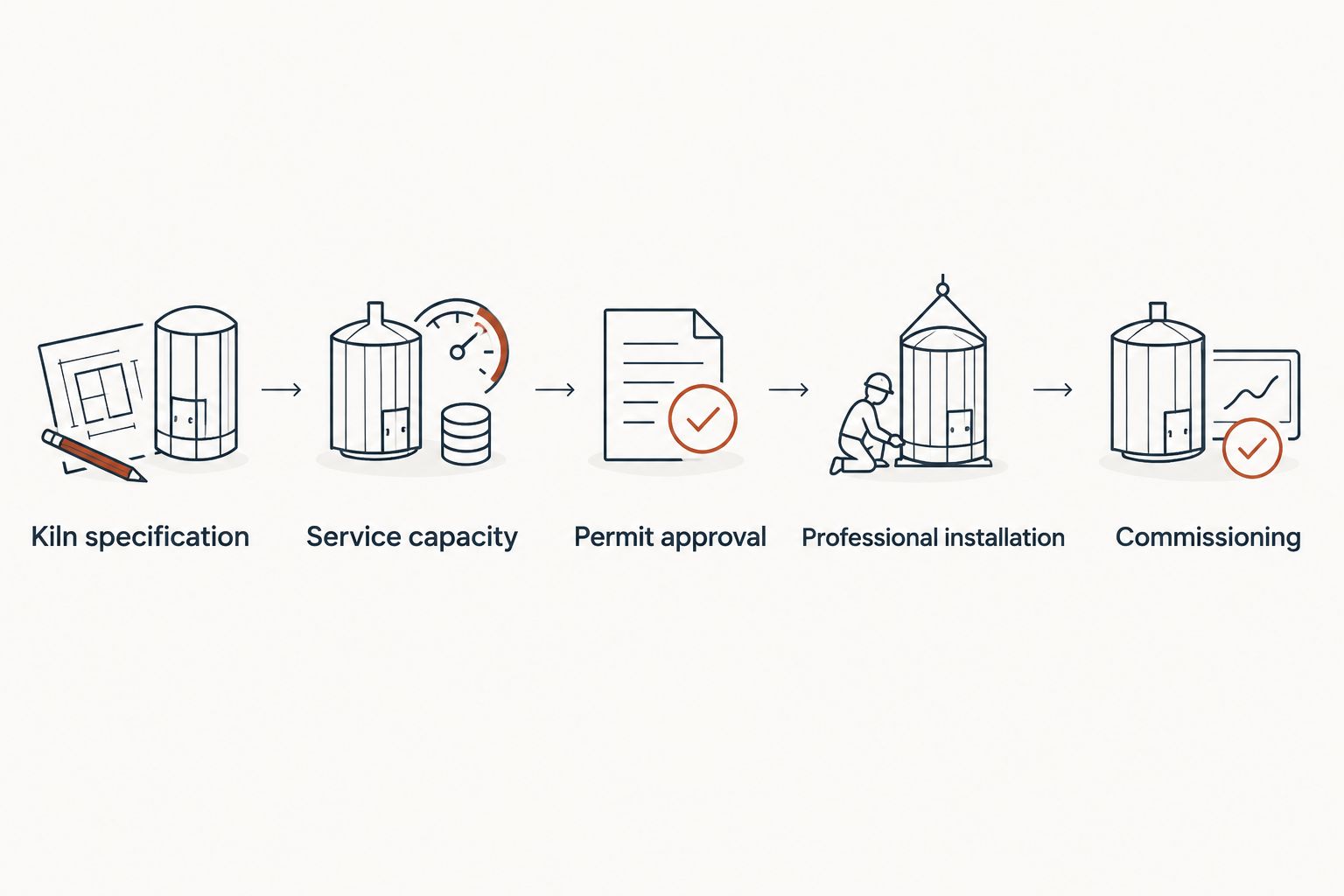
Expected result: an approved electrical installation with identifiable circuits and documented equipment connections.
A subpanel downstream of service equipment generally requires neutral isolation from the enclosure and equipment-grounding system. This is an electrician’s verification item, not an invitation to move bonding hardware yourself. Detached-building requirements also need their own assessment; grounding electrodes do not replace an equipment-grounding conductor.
Do not assume every kiln needs the same conductors or protective devices. Some equipment requires a neutral and some does not. Location, connection method, equipment listing, and the locally adopted code determine requirements such as GFCI protection.
Expected result: you have a documented startup under the manufacturer’s procedure, with unresolved electrical problems addressed before production firing.
For your 2026 commissioning record, separate electrical acceptance from firing performance. An approved circuit does not establish that a clay body, glass schedule, or heat-treatment recipe is correct. Likewise, a controller powering on does not prove that the entire electrical installation is suitable under heating load.
A second kiln changes the load assessment even when the subpanel has unused spaces. Repeat the capacity review before connecting additional equipment. Do not assume a larger panel label means the feeder can supply its full rating.
Expected result: the expanded studio has a verified electrical plan rather than an informal agreement to avoid simultaneous firing.
If the design depends on preventing concurrent operation, ask the electrician and permitting authority what approved control or load-management arrangement is required. A handwritten reminder is not an electrical interlock.
Keep ventilation in that discussion. Turning off exhaust equipment to reduce electrical demand does not create an acceptable firing arrangement. Equipment selection, electrical capacity, and ventilation must work together.
Stop the firing and have a licensed electrician investigate the circuit and equipment load. Possible causes include a circuit fault, unsuitable protection, connection problems, or an equipment defect; the trip alone does not identify the cause. Never replace the breaker with a larger one to silence the symptom.
Have the electrician verify supply voltage under load against the kiln’s required configuration. Then have a qualified kiln technician investigate heating components and controls if the supply is correct. A lit controller display does not establish correct heater power.
Stop using the kiln and keep people away from damaged equipment. Have the electrician inspect the connection and determine the cause before operation resumes. Do not use an adapter or extension cord as a workaround.
Obtain the written correction notice and have the electrician resolve each item. Reinspection belongs in the project schedule. Do not treat a functioning kiln as a substitute for approval.
Ask for an assessment of a suitable lower-demand kiln, an approved load-management design, or a service upgrade. Compare those paths against your firing requirements. Installing another subpanel does not remove the upstream constraint.
Build a single handoff folder containing the kiln manual, nameplate information, approved electrical scope, permits, inspection record, and first-firing observations. Add a simple room layout showing the kiln, disconnect, ventilation, and access routes.
For a 2026 studio expansion, update that folder whenever equipment or electrical requirements change. A replacement kiln with a similar chamber size still needs its own electrical review.
Use the 240V single-phase kiln wiring guide to prepare questions for your electrician. Keep equipment-selection advice and electrical approval separate: ProKilnSupply helps with kiln fit, while your electrician and local authority establish installation requirements.
Does every electric kiln need a dedicated subpanel?
No. A dedicated branch circuit from an existing panel can serve a kiln when the electrical assessment and manufacturer’s requirements support that layout. A subpanel provides local circuit distribution; it is not automatically required.
Does installing a subpanel give my studio more power?
No. A subpanel does not increase electrical service capacity. Your electrician must evaluate the service and feeder against the proposed loads.
Can I install a kiln subpanel myself?
Use a licensed electrician for kiln subpanel design, installation, and testing. Panel work presents shock and arc hazards, and the project must satisfy local permit and inspection requirements.
What size breaker and wire does my kiln need?
The exact kiln specifications, manufacturer’s instructions, installation conditions, and applicable code determine breaker and conductor sizing. Do not select either from a generic kiln chart or another model’s installation.
Can a 240V kiln run on a 208V supply?
Use a 240V kiln on a 208V supply only when the manufacturer explicitly approves that exact configuration. Verify the building supply before ordering and obtain the correct kiln configuration.
Can two kilns share one subpanel?
Yes, when the service, feeder, panel, and branch-circuit design support the intended loads. Have the electrician evaluate simultaneous operation rather than relying on unused breaker positions.
Does a kiln circuit need GFCI protection?
GFCI requirements depend on the locally adopted code, installation location, connection arrangement, and equipment requirements. Have the electrician resolve the requirement with the permitting authority before installation.
The largest number on the subpanel label is not your studio’s usable kiln capacity. The service, feeder, calculated loads, and equipment requirements govern what the installation can support. Get that assessment before choosing a larger kiln—not after delivery.
{"one"=>"Select 2 or 3 items to compare", "other"=>"{{ count }} of 3 items selected"}